




- The FTSE 250 continues to be stuck in between support of 22,167 and resistance of 23,234, indicating indecisive market sentiment.
- Price has slipped below key moving averages, and short-term momentum has weakened. RSI eased towards neutral territory.
- A breakout above 23,234 could rekindle bullish momentum, while a retreat below 22,167 could open the door for deeper losses towards 20,809.
The FTSE 250 provides a far more accurate picture of the actual state of the British economy than the blue-chip FTSE 100, which frequently makes headlines by riding the wave of global commodity spikes. As we move through mid-May 2026, this index is navigating a particularly turbulent “perfect storm.”
UK mid-cap stocks are trading in a cautious environment as investors assess political uncertainty and the outlook for UK interest rates. Expectations that borrowing costs could remain elevated for longer continue to pressure consumer sentiment and business activity across several sectors.
At the same time, some companies are outperforming the broader market thanks to strong earnings, resilient demand, and company-specific growth drivers. The following updates break down the core drivers, ranging from political instability to record-breaking individual stock rallies that are currently defining the technical outlook and market sentiment for the FTSE 250.
FTSE 250 Domestic and Geopolitical Headwinds:
- The GBP remains pressured by monitoring political tensions surrounding UK Prime Minister Keir Starmer following the Labour Party’s heavy losses in local elections. According to many reports, around 78 Labour members of Parliament have called for Starmer to step down. This number is too close to the threshold required to trigger a formal leadership challenge.
- Market participants fear that the potential successor could adopt a more expansionary fiscal policy stance. This could put further pressure on the United Kingdom’s public finances.
- Investors are closely watching the preliminary UK Gross Domestic Product (GDP) figures for the first quarter, as well as industrial and manufacturing production data due on Thursday.
- The “Iran War” and the Middle East conflict have hit energy supplies doubly hard, with UK households set to take a £11bn hit to their finances this year. This is particularly negative for the mid-cap index (FTSE 250) as it suppresses domestic discretionary spending.
Top FTSE 250 Performers and Resilient Sectors:
Despite the broader pressure, Raspberry Pi Holdings is the best-performing FTSE 250 stock so far in 2026, up 71.6% year-to-date. Adding to this, Hunting (HTG) in the oil sector and Ceres Power (CWR) in renewable energy have notable performance.
| Travel and Leisure | SSP Group has risen in excess of 25% recently on the back of normalization in air and rail passenger traffic. |
| Precious Metals | Shares of Hochschild Mining (HOC) have jumped more than 20% as gold and silver prices remain supported by safe-haven demand. |
| Retail | Greggs recently saw a 4.3% increase in its share price thanks to strong operational cost controls in the face of a “challenging market”. |
FTSE 250 Technical Outlook:
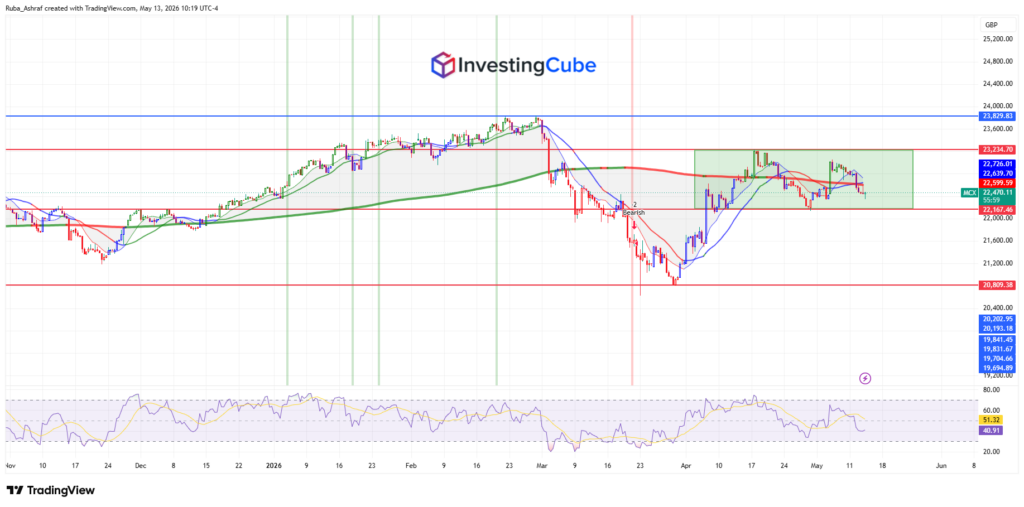
The market is consolidating in a broad sideways range on the 4-hour FTSE 250 chart after a sharp recovery from the March selloff. Price action has been contained within the green zone highlighted, with buyers defending the 22,167 support zone and sellers capping upside momentum near the 23,234 resistance zone. The range-bound structure indicates a wait-and-see mode for the market with no clear catalyst for a sustained directional move.

Technically, the short-term momentum has lost some shine over the last couple of sessions. Price has dipped below the faster-moving averages, the blue short-term average starting to turn lower and crossing below the red medium-term average, suggesting diminishing bullish momentum. Meanwhile, the price is hovering around the longer-term green moving average, which is acting as a dynamic support zone. The larger recovery structure remains intact as long as the market stays above this broader trend indicator despite the near-term softness.
The RSI is indicating momentum slowing. RSI was overbought in the April rebound but has since fallen back into the mid-40s, showing that bullish strength is waning and sellers are slowly taking back control.
From a price-structure viewpoint, the repeated rejection near the resistance level of 23,234 indicates strong supply pressure in that area. A confirmed breakout above this ceiling could open the door to the next resistance around 23,829 and possibly the 24,000 psychological region. If 22,167 is not defended, the downside risk is a further wave of selling pressure towards 20,809. This is the major swing low in the previous bearish phase.
The overall picture on the chart is of a neutral to slightly bearish short-term view in a larger stabilization process. Traders are expected to watch the breakout from the current consolidation range to pick the next sustained move in MCX prices.
The immediate resistance is located near 23,234, where sellers have repeatedly capped upside attempts.
The RSI has moved lower toward neutral levels, indicating weakening bullish momentum and a possible continuation of consolidation.