




- The FTSE 250 continues to face headwinds from persistent inflation, elevated UK interest rates, and geopolitical tensions. However, strength in the mining and energy sectors is providing partial support to the index.
The FTSE 250 is heavily exposed to the domestic UK economy. It’s apart from the more globally diverse FTSE 100. That’s why the FTSE 250 is highly sensitive to local macroeconomic factors and specific domestic sector shifts.
The UK stock market is high today, with the FTSE 100 hitting its all-time high and broader London advances after the UK GDP data. Moreover, easing tensions between the US and Iran and lower oil prices boosted investor sentiment.
The benchmark FTSE 100 is trading 0.5% higher, with its mining and financial stocks having an improving performance. The mid-cap FTSE 250 is also modestly edging higher by +0.61%, or 138.09 points, at the time of writing.
The primary catalysts for such an upside move include:
- UK GDP data beat expectations, boosting investors’ confidence in the economy.
- Geopolitical risks easing, boosting investors’ risk appetite.
- Stubborn inflation and moving far away from interest rate cuts from the BOE.
- Mining and energy stocks that benefit from the cooling crude oil prices.
Before delving into more detail about these drivers, let’s take a technical look at the FTSE 250 chart:

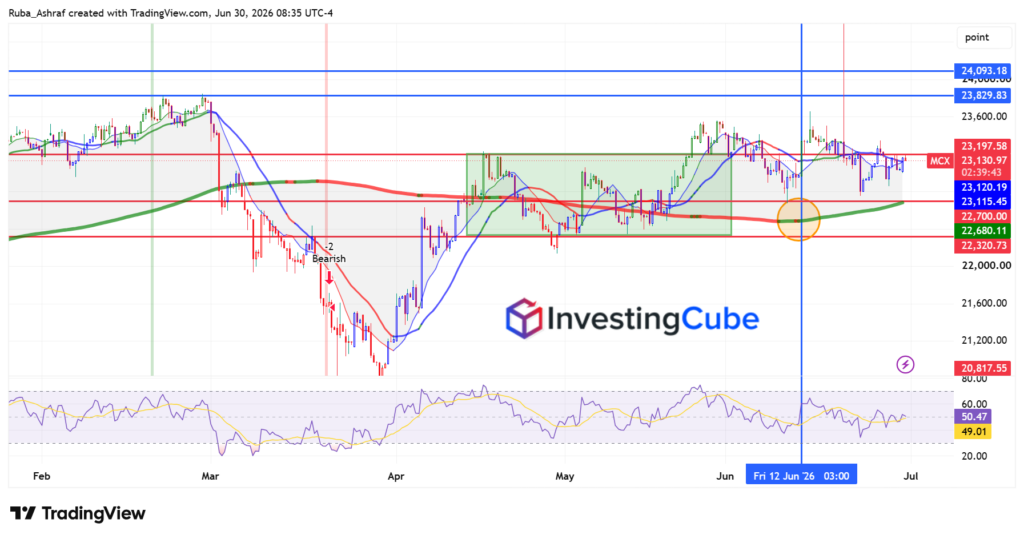
The 4-hour MCX chart shows that the market remains in a consolidation phase after recovering from the sharp decline seen in March. Since April, buyers have repeatedly defended the 22,680-22,700 support area. While sellers have capped advances at around 23,180-23,200. This range-bound structure suggests that neither bulls nor bears currently have enough momentum to establish a sustained trend. A decisive breakout from this range is crucial for determining the market’s next directional move.
The price is trading above the 200-period moving average, indicating that the broader bullish structure is still intact. The recent pullback found support near this long-term moving average, highlighted by the orange circle. At this circle, buyers stepped back into the market, reinforcing the significance of the 200-period moving average as a key dynamic support level.
On the upside, 23,180–23,200 remains the first major resistance level. A sustained move above this area could expose the next resistance around 23,830, while a stronger bullish extension may target 24,090. Conversely, a break below 23,115 would increase the probability of a retest of 22,680, where buyers have previously entered the market.
Current FTSE 250 Market Catalysts:
- Inflation has remained consistently above the Bank of England’s 2% target. This prompted policymakers to maintain interest rates at elevated levels throughout the first half of 2026 rather than deliver the previously expected rate cuts. This higher-for-longer environment continues to support the profitability of major FTSE 100 banks through stronger net interest margins. It also sustains tighter financial conditions that weigh on borrowing, investment, and earnings growth across the more domestically focused mid- and small-cap companies within the FTSE 250.
- Ongoing tensions in the Middle East continue to drive volatility in energy and commodity prices. Higher commodity prices support earnings for mining and energy companies, including Hochschild Mining.
- However, they also increase inflationary pressures. Rising costs reduce consumer purchasing power and weigh on consumer discretionary spending. This limits the broader upside potential for the FTSE 250.