


- The Titan Company share price continues to maintain the upward trajectory after a strong Q1 FY2027 earnings update.
Current Setup and Live Chart
The Titan Company share price is trading amid robust demand for premium jewelry among Indian consumers. Investor sentiment toward the stock remains constructive. The rise in disposable incomes among India’s consumers, along with increased discretionary consumer spending, remains critical to Titan’s long-term growth narrative. The company is riding on the back of a strong Q1 FY2027 earnings update, as it grew its consumer business by 41% YoY. Several consensus targets have an upside price mark of INR 5,000-INR 5,500.
The Titan share price has been a major beneficiary of the rise in gold prices, which stood at $1650 per ounce in 2023 and briefly traded above $5200 before retreating to current levels. On the consumer front, this translated to a tripling of retail prices.
Titan’s strong branding and expanding footprint in India’s retail jewelry-purchasing segment, along with its leadership in the organized jewelry market, are seen as key drivers of earnings expectations. This puts Titan at the top echelon of consumer discretionary stocks in the Indian stock exchange, as purchasing habits shift towards branded jewelry and premium lifestyle products such as premium eyewear and watches. The upcoming festive season will also shape demand dynamics, with wedding-related purchases and same-store sales emerging as potential determinants of the company’s earnings potential for the current fiscal year.
Macro Drivers for the Titan Company Share Price
1) Jewelry Demand
Surging jewelry demand in the retail segment remains the company’s primary growth engine and the major driver of the Titan share price. The demand surge comes as a result of the expansion of India’s middle class, and an increase in wedding-related purchases as a generation with more disposable cash hits marriageable age. Furthermore, clients of the company are no longer just seeking generic jewelry but are beginning to delve into premiumization and branding of jewelry products to make style statements. Furthermore, the company’s expansion into smaller inner cities is expanding its market and positioning it for market leadership, allowing it to control pricing and explore long-term growth opportunities.
2) Strong Consumer Spending supports
India’s economic resilience has led to the expansion of its middle class and provided this class with additional spending power. The rise in disposable incomes and consumer spending continues to underpin consumer confidence, which is also boosting demand for discretionary products. Personal styling items such as watches, eyewear, jewelry, and luxury accessories are among the products in demand from the new, wealthier middle class. These products represent new income streams for Titan beyond its traditional jewelry business, driving bullish earnings expectations for the company.
3) Store Expansion
Store expansion is part of the company’s strategy to achieve long-term earnings visibility. The expansion of Titan’s retail network across India’s towns, including smaller inner locations, is boosting market penetration and brand visibility, and enhancing customer acquisition. The deployment of an omnichannel strategy to boost customer engagement is also part of its customer loyalty drive, ensuring that the company acquires long-term loyal customers and that these customers have ready access to its product lines.
Near-Term Titan Share Price Catalysts
1) Gold prices

Gold prices ultimately determine the pricing variables for the company’s products. Gold has experienced severe price volatility in 2026 as the metal came under the influence of the oil-shock risk premium. The end of the recently signed US-Iran truce threatens the 3-week stability in gold prices, and could reintroduce the era of high two-way volatility. Higher gold prices increase the value of the company’s jewelry sales. Still, they could also stifle consumer demand, as inflationary pressures tend to prompt consumers to reprioritize spending away from discretionary products.
2) Consumer Spending Indicators
Common indicators used to measure discretionary spending trends include inflation, consumer confidence, and retail sales data. Lower inflation, better-than-expected retail sales, and upbeat consumer confidence generally favor an uptick in discretionary spending.
3) Global/Local Market Sentiment
An important price catalyst comes from market sentiment. A risk-on market scenario will see an influx of institutional flows into India’s consumer discretionary sector. Conversely, conditions that lead to risk aversion tend to see an outflow of institutional funds from discretionary stocks to defensive stocks.
Titan Share Price: Forecast Scenarios
Base case: bullish bias prevails amid resilient consumer spending, strong demand for jewelry products, and expansion in the retail segment.
Bull case: the triggers for the bull case scenario will have to focus on macroeconomic fundamentals, such as retail sales (up), consumer spending/consumer confidence (up), and inflation (down). Furthermore, gold prices and institutional inflows into gold and jewelry stocks will also drive this scenario if revenue expectations improve, margin forecasts remain stable or are upgraded, and earnings are upgraded.
Bear Case: A sharp increase in gold prices (leading to lower discretionary spending), softer consumer confidence, rising inflation, and earnings/margins downgrades are all triggers of the bear case scenario.
Titan Company Share Price: Technical Outlook
Having breached the 27% Fibonacci extension level, the price is aiming to reclaim the 4773.50 level, formed by the 61.8% Fibonacci extension of the 23 January 2023 – 11 March 2024 upswing. If this barrier is uncapped, the uptrend extends to the 5295 resistance formed by the 100% Fibonacci extension level.
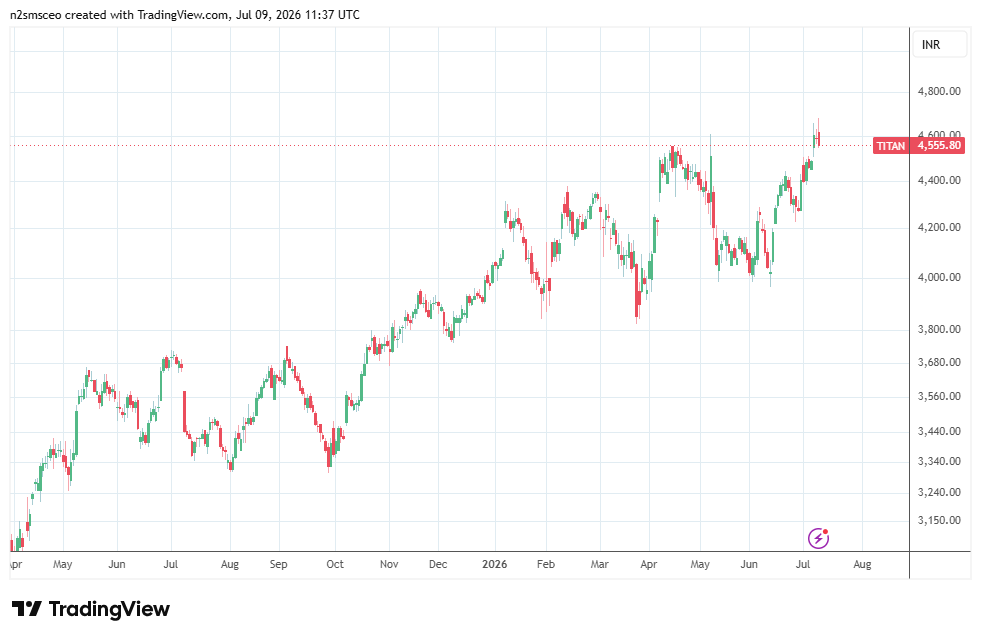
On the flip side, a retrace from current levels must degrade the 4221.50 price support to aim for the 3862.95 support formed by the prior lows of 27 January and 23 March 2026. This is also the site of the former highs of 23 January and 30 September 2024. Below this support, an additional target to the south comes in at 3310.95, where the 4 August and 22 September lows are found.