
- Rising geopolitical tensions in the Middle East lead to a selloff on US indices, including the risk-sensitive Nasdaq 100 index.
The risk-sensitive Nasdaq 100 came under severe selling pressure today amid investor reaction to renewed Middle East geopolitical tensions, rising US Treasury yields, and higher oil prices. These events followed the bombing of three cargo ships in the Strait of Hormuz, followed by retaliatory strikes by US forces, with US President Trump declaring that the ceasefire was effectively over. Oil prices gained more than 8%, and the Nasdaq plunged nearly 500 points as profit-taking hit the index after a stellar bull run. The complex of factors shifted market sentiment toward risk aversion, leading to a sell-off in US indices, including the Nasdaq.
Macro Drivers/Price Catalysts
1. Escalation in Geopolitical Tensions
The biggest price catalyst on the day is the renewal of geopolitical uncertainty after US President Donald Trump indicated that the US-Iran truce had effectively ended following the clashes at the critical shipping conduit. There had always been a cloud over the truce and ensuing peace talks, which had not gone as smoothly as projected. The upcoming burial of late Iranian Supreme Leader Ali Khamenei triggered a new wave of national anger, with calls for retribution against the US from various local quarters.
With these developments, the markets have effectively priced in the geopolitical risk premium, leading to risk aversion and a sell-off as US bond yields rose. In periods of risk aversion, investors typically rotate into defensive stocks at the expense of riskier tech stocks.
2. Oil Prices Spiked >5%
Not surprisingly, Brent oil spiked sharply and now trades above $79 per barrel. The situation has led to new fears that oil shipping across the Strait of Hormuz may be disrupted, leading to supply constraints and a return of the oil risk premium. Higher oil prices raise the cost of energy derivatives, leading to inflationary concerns and higher business operational costs. Furthermore, periods of inflation reduce disposable income and raise the risk of margin compression and corporate earnings uncertainty. The Nasdaq 100 is populated mostly by growth stocks, which are usually the first to be sold off when inflationary pressures arise.
3. Higher Treasury Yields
Long-term US Treasury yields also inched higher as inflationary pressures raise the possibility that the Fed will maintain a restrictive monetary policy for longer than expected. The hawkish tilt and higher bond yields drive capital away from stock markets and into US Dollar-denominated fixed-income markets with higher yields. Higher bond yields also lead to a discount of future earnings, which is typically the source of valuation for Nasdaq-listed tech companies. Typically, the Nasdaq is more sensitive to rate repricing than the Dow.
4. Investors Dumping Growth Stocks
Geopolitical risks in the Middle East have driven higher energy prices, benefiting oil producers at the expense of tech stocks and other high-growth names. Therefore, it is not unusual to see investors rotating out of the growth stocks towards sectors that stand to benefit from higher energy prices. This is similar to the situation seen in March 2026 when the oil-shock risk premium first played out.
5. Profit-Taking After Extended Rally

The Nasdaq 100 has had a hefty bull run, solidified by the demand for AI stocks amid strong corporate earnings and elevated valuations. Following such a trend move, it is not unusual to see some profit-taking as investors bank profits. Stretched valuations, with market prices at near-record levels, are among the reasons driving profit-taking.
Nasdaq 100: What Traders Should Watch Next
The change in the macroeconomic dynamics and risk event profile of the Nasdaq 100 should lead traders to pay attention to the following events:
1) US-Iran Developments
We could see a quick market recovery if the renewed tensions ease and there is de-escalation, with the continuation of diplomatic efforts. However, if there is a deterioration and escalation into a full-blown, renewed conflict, it could trigger a further sell-off in the Nasdaq 100, especially as many market watchers feel that the index is now overextended.
2) Oil Prices
Oil prices remain a key price catalyst due to their impact on business costs and inflationary expectations. If prices rise further above $80 per barrel, this will reinforce concerns about a return of inflationary pressures. If oil prices retreat into the early $70s, these concerns will dissipate, and we will see a rebound in the Nasdaq 100.
3) Treasury Yields
The 10-year Treasury note yield is also a key driver of the Nasdaq 100 index, given its impact on capital flows. Rising bond yields will lead to a net outflow of capital from the Nasdaq 100 and into the bond market, while falling bond yields will encourage net inflow of capital into the growth stocks that populate the Nasdaq 100.
4) Fed Rate Expectations
A resumption of hostilities will drive inflationary expectations, which in turn could force the Fed back into a hawkish tilt. Fedspeak and inflation data are likely to become more important, even as the Fed pivots towards a data-dependent process for the monetary policy outlook.
Nasdaq 100 Technical Outlook
The price action is hovering around the 29433 resistance formed by the 61.8% Fibonacci extension of the 17 October 2025 – 24 February 2026 upswing. A further retreat will target the 25400 support formed by the 27% Fibonacci extension, leaving the 30 March low at 22856 as the next support mark.
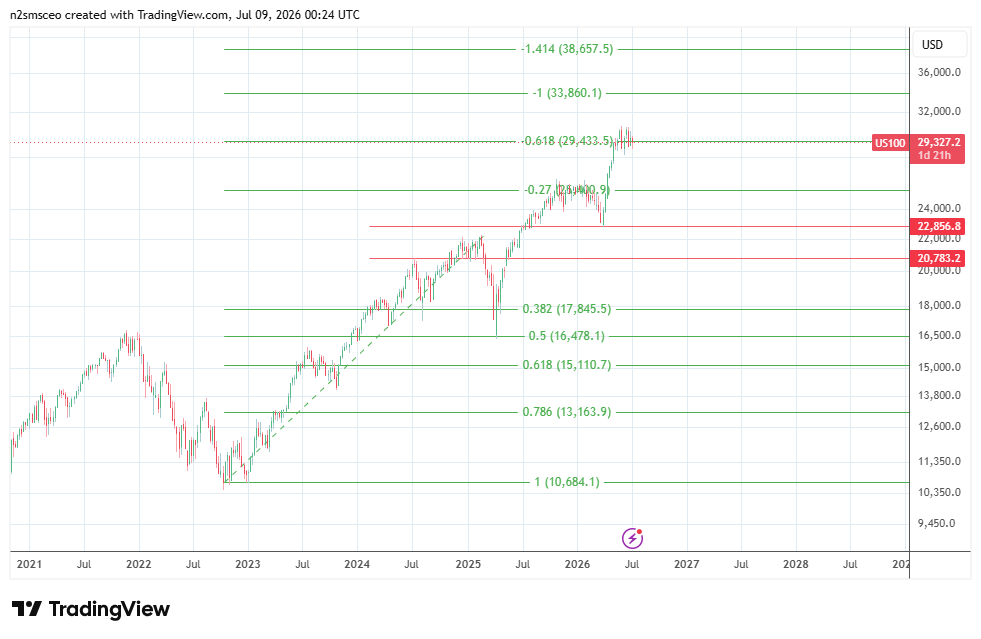
However, a break of the 29433 resistance allows for a continuation of the uptrend, targeting the 33860 resistance that is formed by the 100% Fibonacci extension. 38657 is the next target in line on the weekly chart.