



- The Nasdaq 100 index fell surprising despite a softer US CPI report amid profit taking and risk aversion from geopolitical escalations.
The Nasdaq 100 came under pressure despite softer US Consumer Price Index (CPI) data for May, as the threat of renewed hostilities following US President Trump’s “hard attack” threat against Iran stoked risk-off sentiment, spooking the equity markets.
The focus of today’s CPI report was on the core CPI monthly component, as it is the one the Fed closely watches. That printed at 0.2%, down from the prior 0.4% in April and below the market expectation of 0.3%—other components of the data set aligned with expectations.
The expectation among investors in US indices was that softer inflation data would support the risk-sensitive Nasdaq index, given lower US bond yields and Fed hawkish expectations. Rather, the markets were spooked by the US President’s threat, which was enough to send the Nasdaq 100 reeling by 2.27%.
Furthermore, there were fears that the markets had already priced in the softer reading, as the geopolitical mood in May was largely de-escalatory, with crude oil prices trading below $100 for most of the month.
The Nasdaq 100 index itself had surged heavily in the last 6 weeks, with many AI and technology stocks seeing valuation re-ratings that led to significant gains in stock prices. The geopolitical shock of the day was a trigger for investors who had benefitted from the price advances to book profits rather than extend their exposure.
A Deeper Dive into the Current Nasdaq 100 Fundamentals
Despite the cooling US CPI print, US Treasury yields did not decline much, leaving technology stocks a much-needed boost. Investors are still weighing the impact of last week’s stronger-than-expected Non-Farm Payrolls report, which showcased a resilient US labor market and may not need support from Federal Reserve rate cuts. That in itself is a Nasdaq-negative narrative.
This situation leaves the Nasdaq in the hands of two competing narratives:
- Strong US employment that supports the higher-for-longer rate narrative.
- Softer inflation, which ultimately builds a case for future Fed easing.
There has to be a decisive winner between these two competing fundamentals before the Nasdaq will decide where to pitch its tent.
Furthermore, the AI stocks that did so well and delivered fantastic earnings are starting to face questions about their capex budgets and future valuations. Some of the posers from institutional desks are:

- Is growth already priced into the valuations, and if yes, by how much?
- Will the current earnings justify the current multiples?
- If the economy slows, will AI companies continue to splash money on capex and other R&D initiatives?
While not signaling bearishness, these questions lead to range-bound market scenarios.
Nasdaq 100 Price Catalysts
The following catalysts will determine the next major directional push on the Nasdaq 100:
1) Federal Reserve Communication: Fedspeak and the next interest rate statements could provide clues as to the scale and timing of any rate moves, whether dovish or hawkish.
2) US Bond Yields: One of the main drivers of the performance of tech stocks is the US 10-Year Treasury Note’s yield. If yields rise, it pushes investment flows away from equity markets and into bond markets and other US-denominated assets in anticipation of a Fed rate increase. Conversely, a decline in the US long-term bond yields would be supportive of the Nasdaq.
3) US Producer Price Index (PPI) Data: The Producer Price Index is usually directly impacted by rising energy prices. In other words, producers feel the pinch of rising input costs, such as fuel costs, first, before transmitting these costs down the supply chain to the consumer. So traders typically look to the PPI for signs of more entrenched disinflationary trends.
4) Earnings Expectations
The question of whether corporate earnings justify current valuations, especially those of AI stocks, will be answered as the year rolls on and future earnings reports are released. In between, occasional commentary and headlines about certain growth and valuation metrics filter into the market and can provide clues about whether high valuations can be maintained.
Nasdaq 100 Technical Outlook
The medium-term outlook for the Nasdaq remains bullish, as the weekly chart shows an uptrend. However, the pullback has breached the 29433 support formed by the 61.8% Fibonacci extension of the 10 October 2022 – 17 February 2025 price swing.
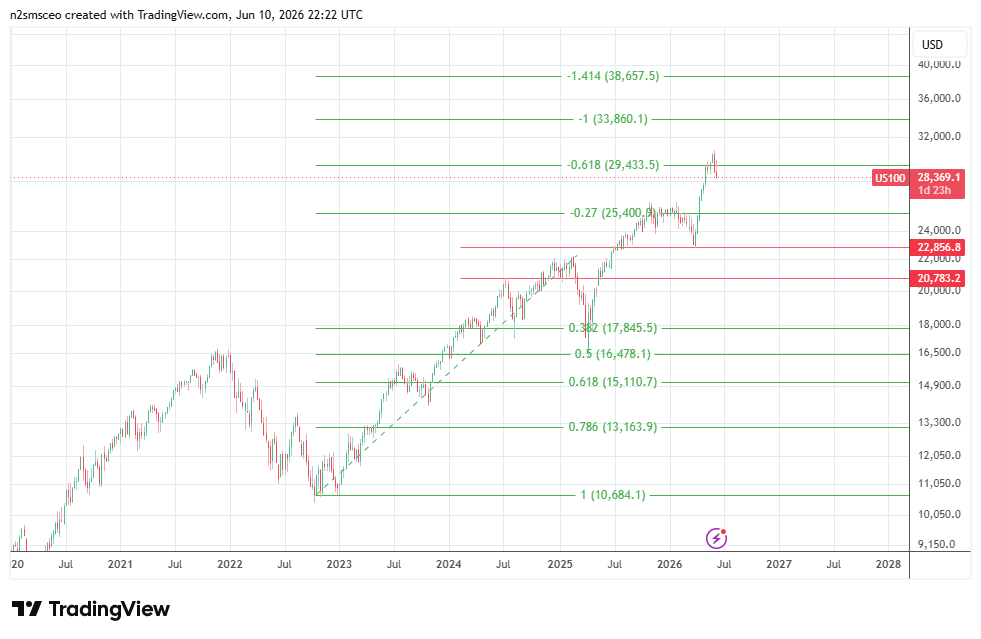
This pullback will first contend with the 25400 support (27% Fibonacci extension) before challenging the 22856 low of 30 March 2026. The 8 July 2024 high at 20783 is the next downside target if the bears overcome the 22856 price pivot.
On the flip side, the bulls need to properly uncap the 29433 barrier to expose the next upside targets at 33860 and 38657, which are the 100% and 141.1% Fibonacci extension levels of the aforementioned price swing.