




- The Nasdaq 100 pulled back slightly after the NFP report, but the overall bias remains bullish on the back of the AI rally.
After the AI rally pushed Nasdaq valuations to record levels, the index has come under renewed pressure. Following the stronger-than-expected US non-farm payrolls reported in June 2026, the report, by misguiding market expectations, bolstered the resilience of the US labor market and weakened the case for any further flare-up. On the back of this outcome, US long-term bond yields rose sharply, putting pressure on equities and driving demand for the US dollar and USD-denominated assets. Furthermore, the increase in bond yields pulled investment flows away from stock indices towards the bond market. The scenario has pressured the high-growth technology shares, especially the AI-related and semiconductor stocks that were behind the recent rally.
Current Setup and Live Chart
The Nasdaq 100 Index thus begins the new week in a high-volatility regime, as it remains caught between inflationary expectations driven by geopolitical risks and concerns over possible Fed tightening on the one hand, and the powerful long-term AI-led push on the other. The upbeat Non-farm Payrolls report has staved off recessionary concerns. It indicates that the US labor market remains robust, boosting consumers’ spending power and keeping the US economy on a sound footing. This is not a condition that supports any near-term Fed rate easing. Rather, it reinforces the recent Fed tilt towards hawkishness, as the job data indicate that the US economy does not need lower interest rates.
Therefore, the recent weakness in the NASDAQ 100 index can be attributed to:
- Increasingly hawkish interest rate expectations.
- Elevated oil prices are driving inflationary concerns.
- Some profit-taking in AI stocks that had recently soared.
- The unresolved geopolitical tensions in the New East are the root cause of the innovative oil prices.
Nasdaq 100 Macro Drivers
1. Changing Interest Rate Expectations
The evolving Fed interest-rate expectations are now the largest macro threat to the NASDAQ 100 index. A reassessment of the Fed’s monetary policy pathway is underway following the stellar jobs report. The data showed that the US labor market remains resilient, a sign that the economy is on a strong footing. This scenario means that the Fed does not need to reduce interest rates to support the US economy. Furthermore, given recent inflationary pressures caused by elevated oil prices, US bond yields have surged. Elevated oil prices constitute a high cost that can compress company earnings. Higher interest rates will discount future earnings and also lead to higher borrowing costs, which not only makes it more expensive to borrow money for stock trading but also makes it harder for companies to secure cheaper credit for their operations.
2. AI adoption is still a dominant factor
Discounting the recent NFP report, the dominant growth engine for the Nasdaq 100 index remains the AI stocks. These stocks recently rallied sharply on expected demand for AI infrastructure, which is driving record spending by AI companies. Nasdaq-listed companies that offer cloud computing services, as well as major semiconductor makers, are expected to benefit from the $1 trillion in demand for their offerings. The recent sell-off is being viewed as a market correction following the rally rather than an end-of-cycle collapse.
Long-term, the Nasdaq retains an upside bias as long as capex on AI infrastructure remains robust, enterprise adoption of AI continues to expand, and corporate earnings support high valuations.
3. Oil prices and geopolitical risks
The geopolitical tensions between the U.S. and Iran have created a large-scale oil supply disruption due to the blockade of the Strait of Hormuz. The resulting spike in energy prices is fueling inflationary fears and adding a layer of market volatility to the Nasdaq 100 index. The internal commentary by the Nasdaq team has clearly identified the US-Iran war and the resultant oil shock risk as the main reasons behind the index’s decline in March. The index therefore remains sensitive to changes in oil prices.

This Week’s Price Catalysts
US inflation expectations
The US inflation data for May will be released this week. Investors will be closely watching the numbers to see whether inflation will continue to rise, as the previous month’s data showed, or begin to decline. Any changes in the inflationary trend, whether upward or downward, will have a direct impact on the price direction of Nasdaq growth stocks.
Treasury yields
The direction of US bond yields will also dictate the NASDAQ’s short-term movement, as the two are highly correlated. Falling US bond yields will support the recovery in the NASDAQ, while rising bond yields could extend the recent decline seen post-NFP.
AI earnings and guidance
The earnings and guidance commentary around AI stocks will continue to serve as a price catalyst for the Nasdaq in the short term. Investors will continue to scrutinize these, as well as headlines around the capital expenditure that many AI stock companies are currently undertaking. What investors want to see is not just quarterly earnings, but evidence that capex will generate sustainable returns in the medium and long term.
Base case: The bias in the base case scenario is for the Nasdaq to remain volatile, albeit cautiously bullish. The Nasdaq will see a period of consolidation as investors weigh the impact of strong AI fundamentals against a less dovish stance, which has led to less dovish Fed interest rate expectations amid higher energy prices.
Bull case: This is the week for the release of the inflation data. Softer inflation data, a decline in US long-term bond yields, and lower oil prices will improve risk appetite on the Nasdaq. This will allow the fundamentals of AI stocks to play out through the index, prompting investors to shift back into large-cap technology stocks. This is a perfect scenario for a relief rally, as institutional positioning still tilts towards more favorable AI narratives.
Bear case: If this week’s US inflation data shows red-hot prints, we can expect US bond yields to rise as well, which would trigger an evaluation reset in the Nasdaq. There will be additional profit-taking on mega-cap technology stocks, and we could see a return of risk-off sentiment, which is Nasdaq-negative.
Nasdaq 100 Technical Outlook
The Nasdaq 100 index is currently testing the 29433 resistance formed by the 61.8% Fibonacci extension of the 10 October 2022 – 17 February 2025 price swing. Failure to break this level leads to an extension of the pullback, which targets the 27% Fibonacci extension at 25400 next. If the bulls fail to defend this level, the recent low at the 23000 psychological support, which was seen as the low of 30 March 2026, becomes the next available downside target.
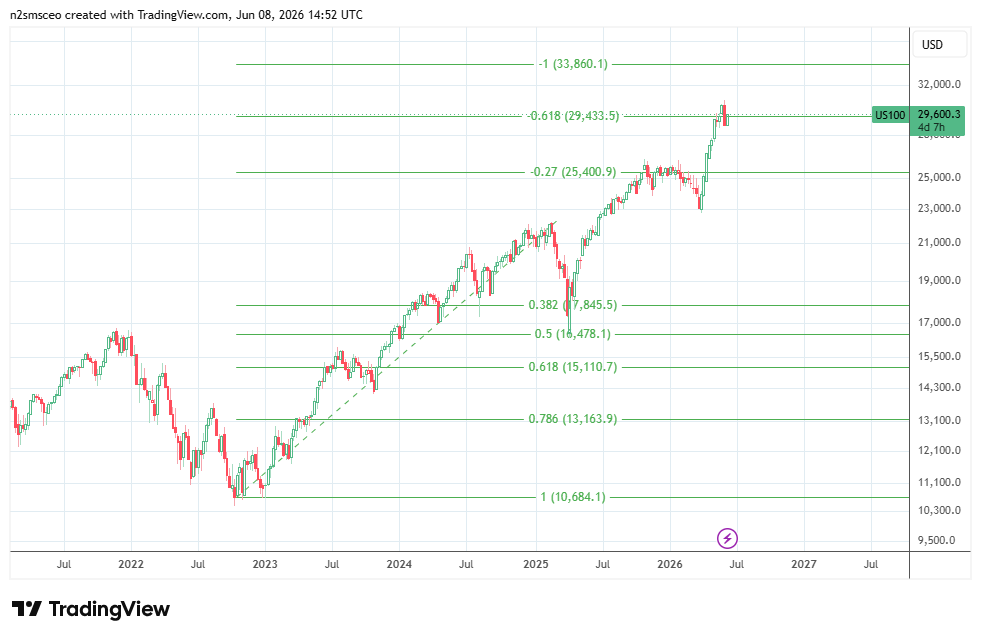
On the flip side, an advance towards the 100% Fibonacci extension at 33860 cannot be ruled out if the bulls manage to uncap the current resistance at 29433.