



- The FTSE 100 has regained bullish momentum after reclaiming the key 10,340 resistance level, supported by improving risk appetite following the easing of U.S.-Iran tensions and the resulting decline in oil prices. While the index remains constructive above its long-term moving average near 10,350, a decisive break above 10,523 is needed to confirm further upside toward 10,600 and 10,695.
The FTSE 100 rises on Tuesday as easing geopolitical tensions make oil prices weaker, supporting risk appetite. The US-Iran peace deal drives oil to a three-month low, driven by the end of the conflict and the reopening of the Strait of Hormuz.
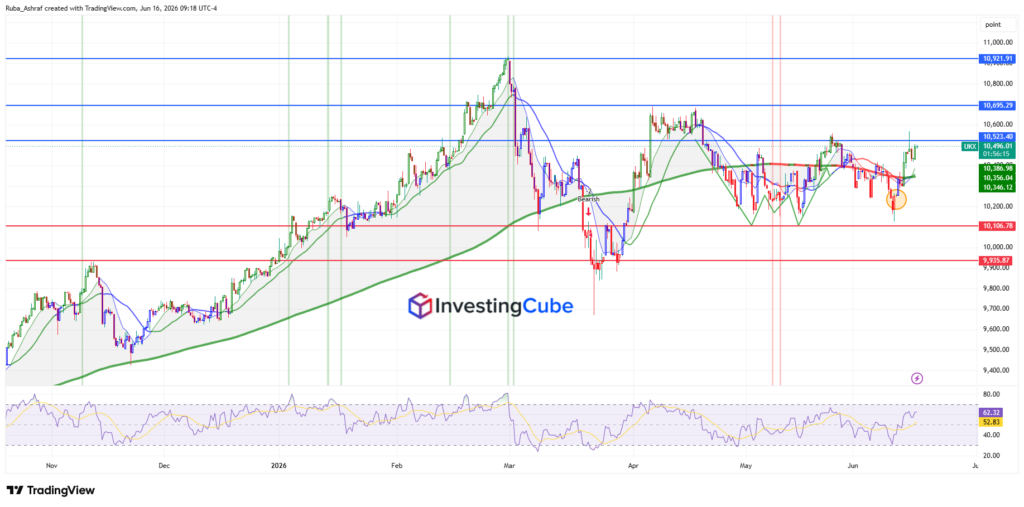
Looking back at last week’s FTSE 100 technical outlook, risk appetite was subdued. The index was trading below its long-term moving average near the yellow circle highlighted on the chart, with prices hovering around 10,237.
At the time, we expected that any easing in U.S.-Iran tensions would put downward pressure on oil prices and help revive risk sentiment, creating room for UK equities to recover. Our outlook highlighted 10,340 as a key level that needed to be reclaimed to confirm that buyers had regained control of the market.
That is precisely what unfolded after Washington and Tehran announced the signing of a peace deal, triggering a rebound in risk appetite and allowing the FTSE 100 to break back above this critical resistance zone.
Current Technical Picture for FTSE 100:
Currently, the FTSE 100 is trading around 10,497, eyeing a key resistance area at 10,523. This level has previously acted as an important barrier and is once again attracting selling pressure. Despite this, the broader technical structure has improved significantly. The index has reclaimed both its short-term and long-term moving averages. This indicates that bullish momentum has returned following the sharp recovery from last week’s lows.
At the time of writing, the long-term moving average is near 10,250 and has turned back into a major support level. As long as prices remain above this area, the broader recovery remains intact.

Moving averages are giving a positive signal. The price action is above the long-term moving average, and the shorter-term averages have crossed back above and are trending higher, pointing to improving market momentum. This means that the recent rally is driven by real buying interest and not just a temporary relief rally.
The RSI is hovering near 62, comfortably above the neutral 50 mark but below the overbought territory. This indicates that the bullish momentum is strengthening without yet reaching levels of overstretched structure.
Potential Scenarios:
- Bullish Scenario: If buyers manage to secure a decisive break above 10,523, the next upside target would likely emerge around 10,600. A sustained move beyond that level could open the door for a retest of 10,695, which represents a significant resistance zone from previous highs. Such a breakout would confirm the continuation of the current recovery trend and signal that risk appetite remains supportive for UK equities.
- Bearish Scenario: A rejection from the current resistance zone, followed by a break below the long-term moving average near 10,350, would weaken the bullish outlook. This could expose the index to a deeper pullback toward 10,237, while a further deterioration in sentiment could bring 10,106 into focus as the next major support level.
Banks and Defense Stocks Lead the FTSE 100 Recovery:
The FTSE 100’s advance was supported by strong performances from some of its largest constituents. It highlights investors’ renewed willingness to increase exposure to economically sensitive sectors. Banking stocks were among the key beneficiaries of the improving risk backdrop, with HSBC and Barclays gaining 1.6% and 2.1%, respectively. The sector’s strength suggests growing confidence that easing geopolitical tensions could support economic activity and stabilize market conditions.
Aerospace and defense shares outperformed all major sectors, rising 2.4%. Rolls-Royce led the FTSE 100 leaderboard with a 2.5% gain, while BAE Systems added 2.2%. The sector continues to benefit from robust defense spending expectations across Europe, allowing it to attract investors even as broader geopolitical risks begin to ease.
The picture was less encouraging in the mid-cap space, where company-specific developments drove significant losses. Wealth manager Rathbones plunged 16.6% to a one-year low after announcing a 12-month pause on onboarding new clients, raising concerns about near-term growth prospects. SDCL Efficiency Income Trust fell 22% after proposing a wind-down of its business, while recruitment specialist SThree slipped 0.5% following a decline in first-half net fees amid subdued hiring activity.