



- The USD/TRY continues to inch higher on the back of the Lira's managed depreciation regime, with additional pressure from geopolitics.
Current Setup and Live Chart
USD/TRY is once more on the back foot this Wednesday, after the US Dollar regained some of the momentum it lost following Tuesday’s US Consumer Price Index data. The pair remains locked within an environment where resilience in the US Dollar, persistent domestic inflation and heightened geopolitical uncertainty are acting as headwinds to the Lira, while the Central Bank of the Republic of Türkiye (CBRT) maintains tighter monetary conditions and has taken certain policy steps that have restored confidence in its monetary policy framework.
The Turkish Lira remains in a structural depreciation regime, with the CBRT actively taking measures to manage depreciation and prevent outsized moves.
Macro Drivers for the USD/TRY
1) Elevated Local Inflation
Persistently elevated local inflation has continued to weigh on the Turkish Lira. Despite slight moderation from peak levels, consumer price pressures remain well above the CBRT’s long-term policy target. Consequently, the Lira continues to suffer from a decline in its purchasing power, which has also increased demand for foreign currencies among the population. This also presents a complicated monetary policy scenario for the CBRT, even as inflationary expectations remain elevated. The pressure from the renewed geopolitical escalation complicates the inflationary scenario.
2) Higher Oil Prices
Turkey is a net energy importer. This renders the country vulnerable to situations that cause marked elevation of oil prices. The renewed conflict between the US and Iran has sent oil prices soaring from just above $70/barrel to $87 as of writing. Along with the closure of the Strait of Hormuz over the weekend, this has added another layer of risk for the Turkish economy. Typically, higher crude oil prices increase energy import costs, leading to imported inflation that worsens the already persistent local inflationary scenario and creates current account pressures. The increase in demand for US dollars to pay for the higher energy product costs (priced in dollars) puts the Lira under additional pressure.
3) Safe-haven USD Demand
The renewed geopolitical escalation has heightened risk aversion in global markets, driving safe-haven demand for the US dollar. This safe-haven demand comes from direct demand for the currency itself as well as from capital influx into dollar-denominated assets. The Turkish Lira and lira-denominated assets are viewed as high risk. During periods of risk aversion, capital will flow away from high-risk emerging-market currencies into US dollar-denominated assets.

Price Catalysts for the USD/TRY
1) CBRT policy communication: CBRT guidance on inflation, exchange rate policy, or future rate decisions is an important price catalysts that impact the TRY’s side of the equation. Furthermore, any communication regarding special policy measures to support the Lira will be regarded as key to restoring some level of investor confidence that has been degraded.
2) Brent crude prices: Oil prices will remain a key external risk source for Turkey due to the country’s dependence on energy imports. Additional gains in crude oil prices will pressurize the Lira for the reasons mentioned above.
3) US economic data: As noted earlier, the cooling of US consumer prices provided a relief rally for the Lira, but these rallies are only expected to serve as dip-buying opportunities. Stronger-than-expected US economic data will influence US long-term bond yields and the USD’s overall direction, especially against emerging-market FX.
USD/TRY Forecast Scenarios
Base case: USD/TRY to remain bullish on the back of elevated energy prices, persistent local inflation, and capital flows into the US Dollar being buoyed by safe-haven demand due to renewed geopolitical tensions.
Bull case: marked elevation in oil prices (Brent crude > $100), a rise in US bond yields, and an intensification of geopolitical tensions. This scenario sees a marked rise in energy import costs, imported inflation that worsens pre-existing local inflation, and increased demand for US Dollars, adding further strain to the CBRT’s already stretched FX reserves.
Bear case: geopolitical resolution, falling oil prices, softer US economic data, and further investor confidence in the CBRT’s disinflationary programs. These will only lead to a retracement in USD/TRY, not a reversal of the uptrend.
USD/TRY Technical Outlook
Tuesday’s retreat fund support at the trendline and the 46.9000 intraday support. A rejection of the bounce at the current resistance of 47.0369 retested the 61.8% Fibonacci retracement level at 46.9200. The bounce is currently retesting the 47.0369 resistance. If the bulls uncap this barrier, we could see a further push towards the 47.0873 resistance, followed by the 47.1529 price mark, corresponding to the 27% and 61.8% Fibonacci extension levels of the 9 July – 13 July upswing.
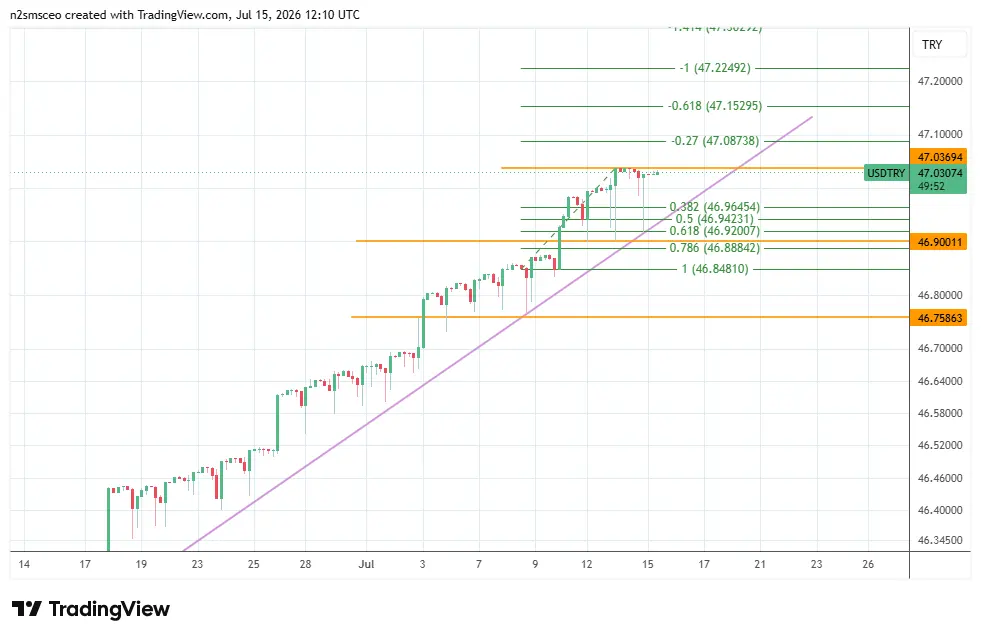
On the flip side, rejection at this resistance will favor a retracement to retest the trendline support. If this trendline support is broken, a further push lower will retest the 46.9001 support mark. If this pivot fails, a further support target is seen at the 46.8481 price mark, the current low of 9 July.