



- The USD/TRY surged to new record highs above 45.20 after the FOMC decision that has been viewed as a hawkish hold by the markets.
Current Setup and Live Chart
USD/TRY continues to trade in a managed depreciation regime. The Lira remains under pressure, but its weakness is being actively managed by the Central Bank of the Republic of Turkey through strategic interventions at both the liquidity and monetary policy levels.
On Wednesday, 29 April, the USD/TRY soared to new record highs after the US Dollar attracted strong bids in the wake of the FOMC’s hawkish hold. This move sent the pair towards 45.1862, before a slight intraday retracement brought it back to 45.1738 as of writing.
The CBRT had held its 1-week repo rate steady at 37.00% on 22 April, as the bank remains in a wait-and-see mode. The CBRT remains cautious as it monitors the impact of the US-Iran war on inflation.
USD/TRY Macro Drivers
1. CBRT’s Policy
Reuters reports indicate that Turkey’s central bank continues to hold the policy rate at 37.00% while using other policy tools to slow the Lira’s depreciation. The policy thrust is managed depreciation for the Lira, not a Lira reversal.
2. Inflation
Inflation remains a structural driver for the Lira. Before the US-Iran war, Turkey was already grappling with high local inflation. A Reuters report indicates that Turkey’s February inflation number came in a 2.96% MoM and 31.53% YoY, which limits the CBRT’s policy tool flexibility. This has left the Lira vulnerable.
3. Reserve Depletion due to Interventions

The CBRT has managed the Lira’s depreciation to prevent disorderly moves, but this has come at a cost. Heavy interventions by selling dollars for the local currency have produced short-lived Lira squeezes. But this has only served to produce new dip-buying points for traders and eventually led to higher grinds by the pair. As long as inflation expectations remain elevated, the foreign currency reserves will remain stretched.
USD/TRY Catalysts
Oil and geopolitics: These remain the factors that determine inflation expectations for 2026. Any renewed oil spike will feed into the local Turkish inflation story and put external balance pressures on the TRY; all negative for the TRY.
CBRT communications: Watch for updates on funding conditions and liquidity. Tighter funding conditions will support the TRY marginally, but will only lead to modest pullbacks in USD/TRY. If funding conditions are loosened, the USD/TRY is supported.
Local inflation expectations: If inflation expectations deteriorate, they elevate the TRY risk premium and lead to a dramatic weakening of the TRY.
USD/TRY Forecast Scenarios
Base case: USD/TRY will continue its slow grind higher as long as inflationary expectations remain elevated. This is consistent with the broader pattern seen in the last year. Dip-buying at the trendline (see chart) is to continue.
Bull case (USD/TRY higher): the breakout move that will lead to a surge in the pair remains embedded in the oil/inflation shock. Any headlines about policy loosening will lead to a faster, but more disorderly, Lira depreciation.
Bear case (USD/TRY lower): The trigger for a relief rally in the Lira is a tighter CBRT liquidity policy and lower oil prices. This will favor a pullback or correction in USD/TRY but will not produce a reversal unless inflationary expectations are dramatically lowered.
USD/TRY Technical Outlook
The ascending trendline remains the key support for the USD/TRY and the dip-buying marker. The latest dip from the record highs is just short of this level and the 45.0395 support. If these pivots hold firm, a bounce is likely with a push to retest the record high being the next logical action. If the 45.1862 record high is breached, additional resistance could come in at the 45.2630 price mark, which is the 27% Fibonacci extension of the 15 April – 24 April upswing.
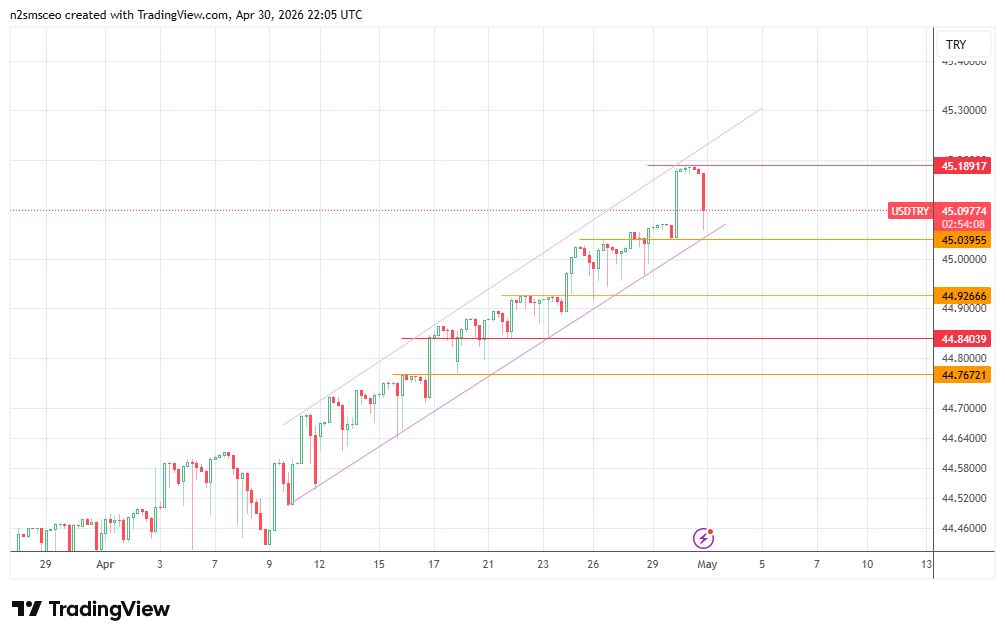
On the flip side, a breakdown of the 45.0395 support also takes out the trendline, unlocking an opportunity for a deeper retracement towards the 44.9266 support and the prior low of 24 April 2026. Below this level, the 21-23 April lows at 44.8403 become a new downside target.