


- The US dollar has cracked under pressure as the Japanese government intervenes aggressively
- USD/JPY stares at the possibility of a deeper decline if US economic data signals weakness
- BoJ Governor Kazuo Ueda's tone has left uncertainty over the next tighter policy measures, leaving rate differential favouring the dollar
After trading within a rather constrained range for much of April 2026, the USD/JPY pair registered a significant decline on April 30, dropping about 2.5% and slipping below the 158 threshold. This sudden shift has prompted questions about whether the long-dominant uptrend in the dollar-yen pair is beginning to reverse.
Why Did the Dollar Collapse Against the Yen?
The immediate trigger for this sharp decline was not a sudden weakening of U.S. economic data, but rather a direct and impactful intervention from Japanese authorities. Finance Minister Satsuki Katayama indicated a readiness to act decisively in the foreign exchange market, aiming to counter unilateral speculative pressure against the yen.
These comments, widely reported across market wires, contributed to increased pressure on the dollar-yen pair, initiating a swift unwinding of short positions on the yen. As reported by Reuters, the Japanese government executed a substantial yen-buying operation, designed to support the currency.
Earlier that day, Japanese Finance Minister Satsuki Katayama had set the stage by issuing a warning that the moment for decisive action was nearing. Following the exchange rate’s peak at 160.73, Vice Finance Minister Atsushi Mimura delivered what many interpreted as a final warning to speculative traders.
This strategic blend of strong verbal warnings and subsequent direct market intervention surprised many heavily short-positioned traders. It triggered a wave of liquidations, pushing the pair downward, nearing the 156.50 level.
Policy Divergence and External Pressures
While intervention rhetoric provided the spark, underlying factors contributed to the setup. The Bank of Japan maintained rates at 0.75% in its late April meeting but delivered a divided vote, with three members favoring a hike.
It also raised its inflation forecast while lowering GDP expectations for fiscal 2026, citing Middle East tensions and energy price effects. Governor Kazuo Ueda’s cautious tone left some uncertainty about the timing of the next tightening step.

On the U.S. side, the dollar had shown resilience, supported by a still-wide interest rate differential and steady economic data. However, the broader U.S. Dollar Index softened modestly on April 30, reflecting some position adjustments ahead of upcoming data releases.
Is This the Start of an Extended Reversal?
Assessing whether the day’s decline signifies the onset of a prolonged reversal necessitates close observation of various unfolding developments. A true policy shift, perhaps clearer indications from the BOJ for accelerated tightening, or even further direct intervention, might provide additional support for yen strength.
Nevertheless, the current interest rate differential continues to favor the dollar. Moreover, any resurgence in energy prices or continued resilience in the U.S. economy could potentially constrain further downside movement.
USD/JPY Forecast
USDJPY sellers are currently in control as per the RSI reading at 35.98, and immediate support now rests at the pivot is at 157.00. The first resistance will likely be at 157.90. Moving past that level will open the pathway to test 159.00. On the downside, the first support will likely be at 155.55. Going down below that level, could send the action to test 154.05.
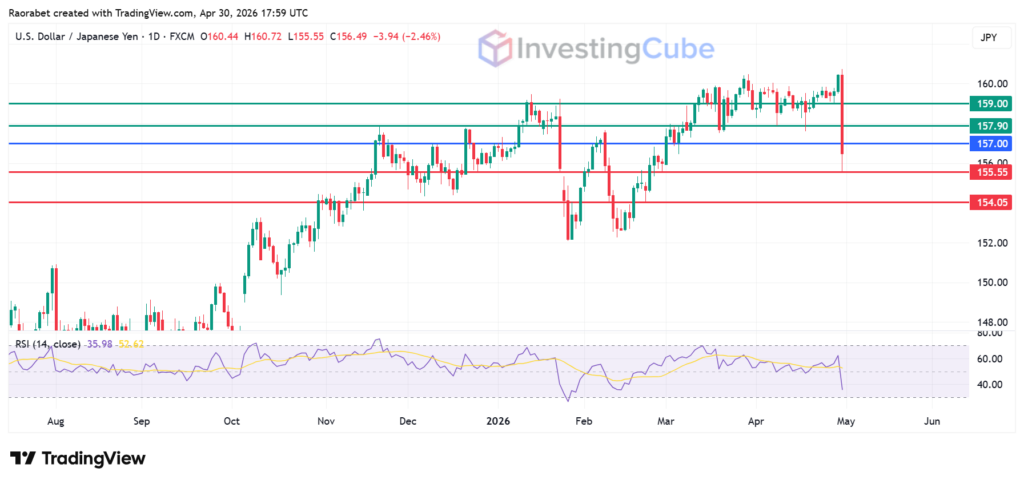
USD/JPY on the daily chart on April 30, 2026 showing the key levels of support and resistance. Created on TradingView
The sudden 2.5% drop was driven by direct currency intervention from the Japanese government. After the pair crossed the 160.00 threshold, Japanese officials executed a massive yen-buying operation to counter extreme currency weakness and deter speculators.
Market participants are keenly observing forthcoming central bank policy announcements and the latest U.S. inflation data. Any unanticipated shifts in U.S. interest rate expectations or changes in the Bank of Japan’s stance are expected to considerably shape future price dynamics.
It may mark the beginning of a tactical correction, but a sustained reversal requires either actual intervention or faster BOJ tightening. The interest rate gap still supports dollar strength, limiting the scope for a deep trend change without new catalysts