


- The direction of oil prices in response to the geopolitical situation will keep driving the CAD/INR's direction.
The CAD/USD pair is trading higher on the day, but only marginally, ahead of the Bank of Canada’s interest rate decision. The pair is currently trading higher for the fourth day in a row, as renewed geopolitical escalations have driven oil prices higher. This has led to a boost in the Canadian dollar, a commodity-linked currency, at the expense of the Indian rupee, the currency of the world’s third-largest oil importer.
Ahead of the Bank of Canada’s interest rate decision, the pair is trading within a regime defined by two macro themes: diverging interest rate expectations and rising global energy prices driven by geopolitical escalation.
Canada’s oil sands hold the world’s second-largest oil reserves. Canada is one of the largest crude oil exporters in the world. The Canadian dollar is in a position to benefit from the rise in energy prices. Conversely, high oil import costs due to rising oil prices weigh on the Indian rupee-dollar exchange rate.
The Bank of Canada has indicated it will retain a data-dependent approach to interest rate decisions as inflation within the country moderates. On the other hand, the Reserve Bank of India continues to manage rupee volatility amid headwinds from imported inflationary risks.
Macro Drivers for the CAD/INR
1) Higher Oil Prices; Opposite Outcomes
The CAD/INR pair is a classical case of a macro driver with opposing outcomes. While higher energy prices lead to higher export revenues, improved terms of trade, increased foreign exchange flows, and stronger physical receipts for Canada, they produce higher import costs, a wider current account deficit, a rise in imported inflation, and an increased demand for foreign currency for India. This is a situation that directly strengthens the Canadian dollar and weakens the Indian rupee.
2) BoC Rate Expectations
The Bank of Canada is widely expected to keep interest rates steady at 2.25%, marking a pause in its easing cycle. This expectation comes as policymakers in Canada continue to emphasize that inflationary risks have not totally subsided. On the other hand, the RBI is expected to continue smoothing any excessive price volatility in Europe while prioritizing financial stability. Against this backdrop, interest rate expectations are unlikely to overshadow the current tailwinds emanating from higher oil prices.

CAD/INR Price Catalysts
1) Crude oil prices: Crude oil is the single most important price catalyst for the CAD/INR. The directly opposing outcomes for the constituent currencies make it easy to trade the pair based on oil price direction. Higher oil prices extend the uptrend, while lower oil prices will favor a pullback.
2) Middle East Geopolitics: The markets will be looking closely at the state of the US-Iran geopolitical tensions, focusing specifically on whether the Strait of Hormuz will remain closed or will be reopened for shipping. Other areas of focus include military deployments, the state of diplomatic efforts, and the extent of supply disruption if the Strait of Hormuz remains closed. Escalation favors the uptrend, while diplomacy gives the rupee a reprieve.
3) Canadian and Indian economic data: Data from both Canada and India will determine, to a lesser degree, the direction of the pair in the near term, probably more on an intraday basis as the overall trend determinant is currently the geopolitical situation and the oil price direction. Investors will monitor central bank communication, inflation, employment, and industrial production data.
CAD/INR Forecast Scenarios
Base case: The pair remains on a bullish trajectory as elevated oil prices continue to support Canada’s oil export-driven economy. Conversely, India’s rupee will continue to struggle under the weight of higher import bills.
Bull case: If oil prices rise above $100, this will intensify the bull case scenario. This scenario is driven by an escalation in the geopolitical situation, which will further boost Canada’s export revenues at the expense of India’s import-cost hikes. This scenario will favor a reclaim of the February highs.
Bear case: rapid de-escalation of the geopolitical landscape will lead to lower oil prices, favoring a capital push into Indian markets and a drop in oil revenues for the Canadian economy. This will favor a pullback on the CAD/INR to retest recent support levels at 66.20
CAD/INR Technical Outlook
The pair is currently testing the 68.67 resistance mark. A break of this level unlocks access to the 70.48 resistance and high of 19 May as the next upside target. If this upside barrier is uncapped, the bulls will have clear skies to test the 27% Fibonacci extension at 72.62.
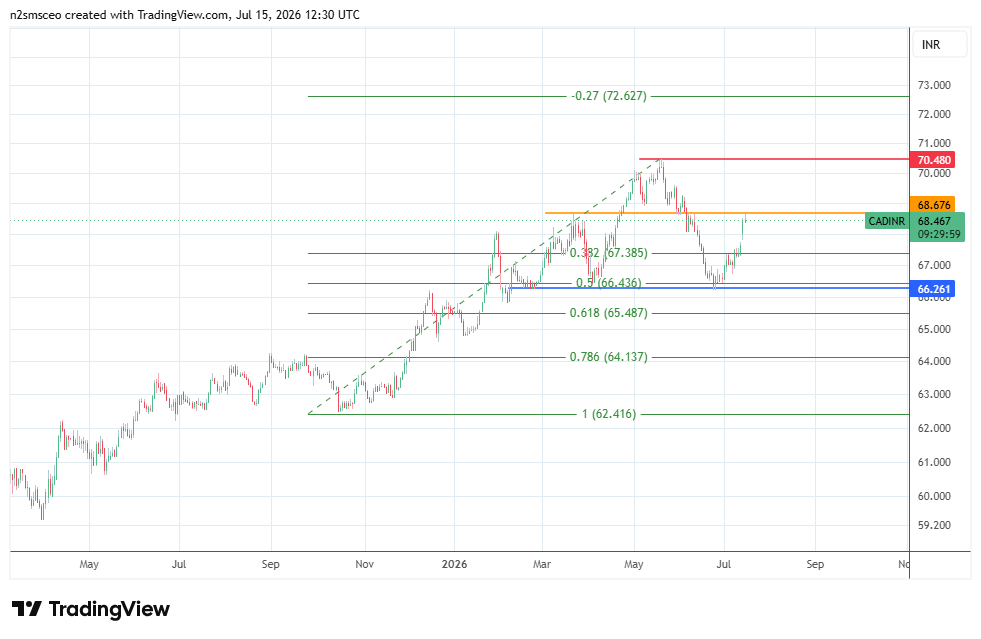
On the other hand, rejection at 68.67 allows for a retracement that targets potential downside pivots at 67.38 and the 66.32 low of 25 June 2026.