




- Silver price is set to decline further after Fed left interest rates unchanged while clearing any rate cut language in the statement.
FOMC’s Holds Rates Amid Massively Divided Vote
The Fed left interest rates unchanged at 3.50%-3.75%. This decision was already fully priced in by the markets, so there were no surprises. The key surprise was the divided vote, which saw up to four Fed board members clamoring for a removal of any references to potential rate cuts in the foreseeable future. This was described as the most divided Fed vote in 34 years and is a sign that any pathway towards easing has become more uncertain.
As far as price action across several rate-sensitive assets was concerned, the hawkish hold elicited a classical reaction. US bond yields and the US dollar traded higher, while stocks and indices were softer, and non-yielding metals such as silver and gold also retreated further.
Reuters reports confirmed the picture above, indicating that US equities declined while short-dated Treasury yields rose as traders pared back expectations of a 2026 rate cut.
How Risk-Sensitive Assets Have Traded from March 2026 till Date, Pre-FOMC
Since March 2026, the financial markets have been trading under one significant risk event: the US-Iran war. This war has led to several regional spin-offs that have impacted financial markets.
a) The energy markets: Brent crude and natural gas are the two markets mostly impacted, as far as tradable CFD assets are concerned. This is not just about the disruption of production and exports, but also about the critical shipping artery through which the world’s 3 largest crude oil importers access their oil imports. This has led to significant distortions in energy markets and in associated industries such as aviation, travel, road transportation, and tourism.
b) Equities: Global stock markets have been heavily impacted by the risk-off, risk-on sentiment generated by the constantly evolving war headlines. This is in addition to the specific sectoral impacts the energy shock has had.
c) Metals: Gold and silver have also shown heavier-than-usual volatility. Both assets are no longer trading as pure safe-haven assets; they are showing two-way volatility, with prices oscillating between resistance and support levels and large whipsaws. The choppy nature of price action presents a unique scenario not seen in decades.
Asset Outlook Post-FOMC Heading into May 2026
The Language
Post-FOMC, the market’s interpretation of the Fed’s call was that of a hawkish hold. This means:

- firmer dollar
- higher yields
- tighter financial conditions for longer than expected.”
The divided vote was interpreted as indicating that the barrier to cuts had risen significantly. The markets took that as a sign that the bar for cuts has risen materially. Investment bank Morgan Stanley now expects the Fed to defer rate cuts until 2027, while staying put throughout 2026.
Stocks: Deferred rate cuts mean that financial conditions will be tighter for longer. No cheap capital for equity purchases, and potential for margin compression from the tighter financial conditions make for selective bearishness. Some stocks will have sound fundamentals to outperform the equity markets.
As expected, the broad response was more caution than a strong decline. The S&P 500 index shed 0.04% while the Dow lost 0.57%. The Nasdaq was roughly flat. The decline was felt more in rate-sensitive sectors, while oil stocks outperformed due to higher energy prices. The Dow is particularly vulnerable due to a high concentration of cyclicals, which are usually sensitive to higher input costs.
Gold/Silver: These are trading in a two-way market, but sentiment remains soft amid the rise in US Treasury yields post-FOMC. Gold fell to one-month lows, but recovered most of those losses on the day as dip-buyers sought bargains.
The energy shock is more of a macro driver than a pure reaction to FOMC expectations. Silver is an industrial metal with cyclical exposure. Therefore, the response of gold and silver to the FOMC will also have to contend with the oil shock headlines.
EUR/USD: The post-FOMC bias supporting the US Dollar put pressure on the pair. However, the markets had to wait until Thursday’s ECB decision to decide fully on which side to lean. The 30 April ECB decision changed the tone for the pair. While the European apex bank left rates unchanged, the wording of the statement kept the option of a June rate hike very much alive. Indeed, ECB Chair Lagarde indicated that policymakers discussed a rate hike “at length” as inflation had hit 3%. The markets are now pricing in at least three rate hikes over the next year, which means they perceive the ECB as more hawkish than the Fed. The differential in central bank expectations provided intraday support for the Euro, which rose 0.5% on the day.
For GBP/USD, there aren’t many domestic UK drivers to counteract the US Dollar’s fundamentals. For the Sterling, the markets have a cautious outlook. This suggests selling on strength until a clearer path towards the Fed’s monetary policy is evident.
USD/JPY: Though seen as having the clearest post-FOMC trend among its peers, it carries an intervention risk. The steep selloff on 30 April, as the pair crossed the 160 yen mark, was widely reported as an intervention by Japanese financial authorities.
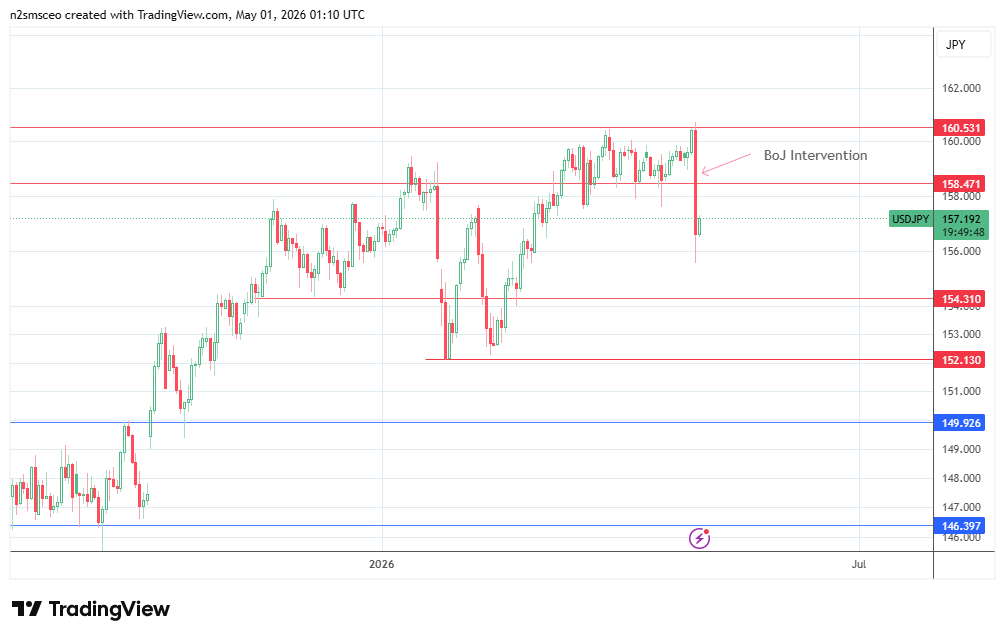
The macro still favors a bullish USD/JPY, but the upside reward pales once the pair hits price levels that attract the attention of Japanese financial policymakers.