



- GBP/EUR stalls near 1.20 after the BoE hike.
- Support 1.1900 to 1.1950; targets 1.2050 and 1.2100.
- Watch UK inflation and the December ECB meeting.
InvestingCube chart · Yahoo Finance data
The Bank of England finally made a move. On November 5th, the Bank of England raised the Bank Rate to 4.00%. This is the first time the Bank of England has raised the Bank Rate in over three years. Sterling jumped and then stalled. The exchange rate of GBP/EUR currently trades at approximately 1.20; the Bank of England has not traded at this level for 19 months. Is this a breakout or merely a pause? The chart below indicates the levels that are important.
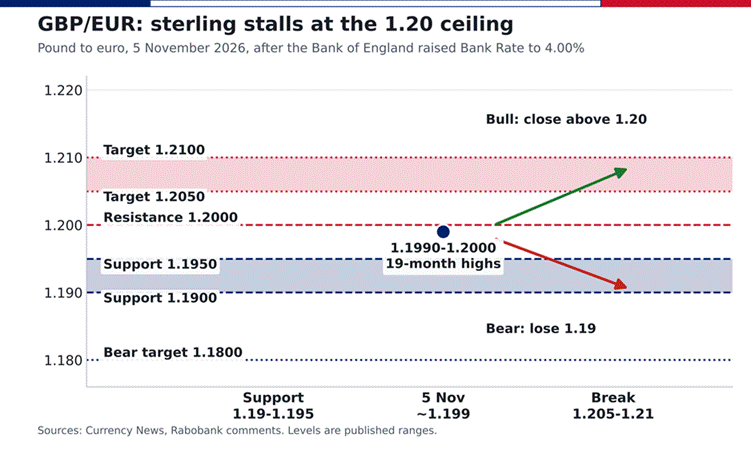
Figure 1: GBP/EUR key levels in the colours of the Union flag. Data as of 5 November 2026.
Reading the Chart
Begin by looking at the small dot located centrally on the chart. This represents where GBP/EUR was trading at approximately 1.199. Directly above the dot, there is a horizontal red dashed line representing 1.2000. This is the first level of resistance. Buyers tried to push prices past this point but were unsuccessful in closing above it. To the left of the dot, there is a blue area extending vertically from 1.1900 to 1.1950. This area is considered to be support. Sellers have been having difficulty pushing through this level. If the buyers are able to successfully clear the resistance level of 1.2000, then they will most likely head toward the pink area extending vertically from 1.2050 to 1.2100. This is what we call the “target zone” for the buyers. The green arrow indicates that direction.
Conversely, if the buyers fail to hold on to the support level of 1.1950, then the sellers will likely move prices down toward the next major round number which is represented by the lower-most dotted line at 1.1800. What does this mean for you? You should wait for the price to close above 1.2000 at the end of each day. Do not enter into positions based solely upon a temporary price spike above 1.2000. When prices close above 1.2000, it tells us that the buyers are serious. Therefore, until prices close above 1.2000, it remains a ceiling. Would you like to know how traders identify such levels?
Try our Fibonacci retracement guide.
Why Sterling Is Firm
The vote was 8 to 1. Catherine Mann wanted a bigger rise of half a point. Governor Andrew Bailey said “inflation risks remain elevated”. Higher rates draw savers and funds into a currency. That is why the pound rose on the news. Traders expect more hikes in 2027. The Bank did not promise them, though. That mix keeps sterling firm but not flying. Growth is holding up too. UK services activity hit an eight-month high, and hiring rose for the first time in over two years. Check the next inflation report at the Office for National Statistics. A hot number would back more hikes.
The Euro Has Its Own Story
Eurozone inflation rose to 4.0%, according to Eurostat. That keeps an ECB hike in December on the table. So, the euro gets some support. French budget worries weigh on it, though. Core inflation held at 2.5%, so the picture is mixed. Even so, our EUR/CHF analysis says the euro may struggle to find its footing against the franc.

Compare the euro across pairs before you trade. The ECB reference rates show the daily official fix. Our EUR/PLN forecast covers the zloty.
Three Scenarios
- Bullish: a daily close above 1.2000 targets 1.2050, then 1.2100.
- Bearish: a close below 1.1900 opens 1.1800.
- Neutral: a range between 1.1900 and 1.2000.
In the short run, expect to see noise regarding the December ECB meeting. Rabobank believes that the ECB will likely make “no more than one additional rate hike” during the current rate cycle. However, market participants believe that the ECB will raise rates again. Over the long run, this discrepancy between Rabobank’s views and those of the market matter. See how the euro trades against another central European currency in our EUR/HUF forecast. Keep your risk small. Never trade without a stop loss in place. A fast move can come within minutes of a data release. Where will you put your stop if 1.20 holds again?
Frequently Asked Questions
Why is GBP/EUR near 1.20?
The Bank of England raised Bank Rate to 4.00% on 5 November. That lifted sterling to 19-month highs near 1.1990 to 1.2000.
What is the key GBP/EUR resistance?
1.2000 is resistance. A sustained break opens 1.2050 and 1.2100.
Where is GBP/EUR support?
Support sits at 1.1900 to 1.1950, with 1.1800 as the next round number.
What is your outlook on GBP/EUR?
Anonymous · no sign-up · results from the last 30 days · not investment advice