


Archived Article This article was published more than 5 months ago. The market data, prices, forecasts, and analysis were accurate at the time of publication but may have changed since then. Please use this article for historical reference only and refer to our latest content for current market information.
- Oracle stock surges 12% as Q3 FY2026 revenue hits $17.19B. Cloud infrastructure jumps 84% on AI demand, offsetting $124.7B debt and 18% workforce reduction news.
Oracle Corporation (NYSE: ORCL) has effectively silenced a brutal six-month stretch of bearish sentiment, with shares surging 12.03% in early Wednesday trading following a stellar Q3 FY2026 earnings report. The stock, which had previously been cut in half since last September, hit an intraday high of $171.76 as investors aggressively priced in the company’s accelerating role in the global AI infrastructure race.
Oracle AI cloud boom: $553 billion RPO and OpenAI stargate deal drive growth
While the income statement beat expectations, the primary driver of the rally was the disclosure of $553 billion in Remaining Performance Obligations (RPO), a staggering 325% year-over-year increase.
A critical component of this growth is the $300 billion Stargate cloud deal with OpenAI, positioning Oracle as a primary compute backbone for large-scale AI training. To mitigate its heavy $124.7 billion debt load, Oracle is utilizing a “bring your own chips” model, requiring major customers to front hardware costs, which allows for rapid scaling without further straining the balance sheet.
Oracle’s financial pressure points: debt, headcount reductions, and margin risks
Despite the market’s enthusiasm, institutional analysts are closely monitoring Oracle’s long-term margin sustainability as the company navigates a high-stakes transition. While AI infrastructure is driving top-line growth, the underlying fiscal health and operational shifts present a complex picture for investors:
- The cost of insuring Oracle’s debt via five-year credit default swaps (CDS) hit record highs of 166 basis points this month, signaling heightened investor concern over a debt load that has ballooned to $124.7 billion.
- Alongside its growth narrative, reports indicate Oracle may lay off 12% to 18% of its global workforce. Management has framed this “operational leaning” as a strategic shift, noting that AI-driven code generation allows for smaller, more efficient product teams.
- To fund its data center expansion, Oracle’s capital expenditures reached $48.25 billion this quarter, resulting in a trailing free cash flow of negative $24.7 billion.
Oracle stock technical breakout: reclaiming the narrative
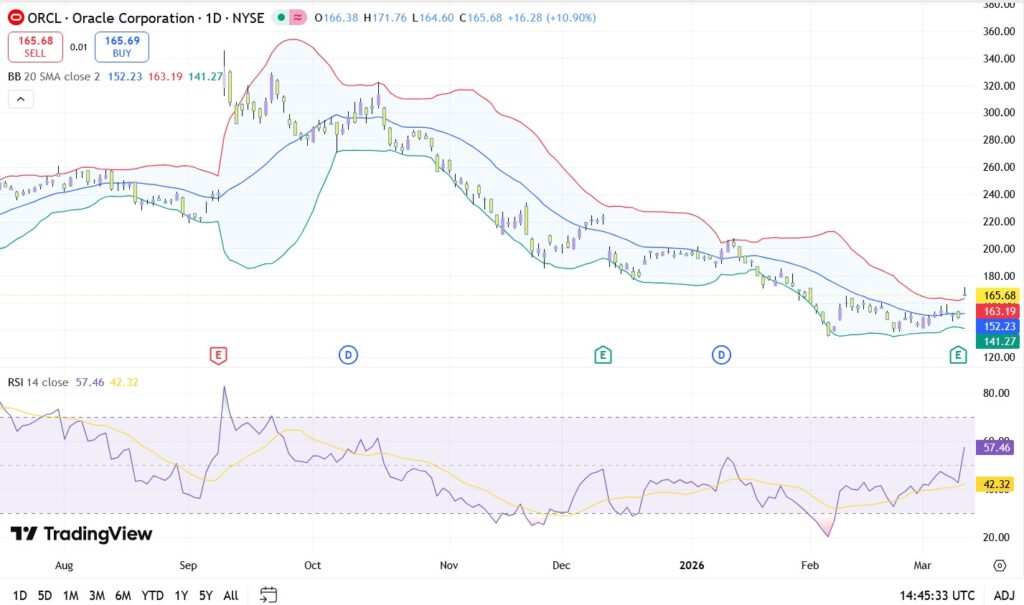
The daily chart reveals a significant “gap up” that has dramatically shifted the short-term technical landscape:

- The stock opened at $166.38 and quickly rallied toward $167.37, a sharp reversal from the year-to-date downtrend.
- The RSI has surged to 58.57, breaking out of the oversold territory seen in early February and signaling a strong influx of bullish momentum.
- The move was largely catalyzed by Oracle raising its fiscal 2027 revenue target to $90 billion, signaling that AI demand is currently outstripping the company’s supply capacity.
Oracle Stock Outlook: Can AI Cloud Deals Offset Debt and Deliver Long-Term Profit Growth?
Oracle has successfully interrupted a bearish narrative by proving it is a central player in the AI compute race. However, one exceptional quarter does not close the book on the company’s structural challenges.
The massive debt load remains a permanent fixture on the balance sheet, and the concentration risk associated with the OpenAI relationship cannot be ignored. While internal operations are beginning to stabilize, whether these multi-billion dollar AI contracts can translate into the long-term margins and free cash flow that investors actually want remains to be seen.
Oracle FAQs
OCI revenue jumping 84%, Larry Ellison’s argument that Oracle is a “disruptor” rather than the “disrupted” is gaining traction. The stock’s 12% rally today suggests the market is beginning to value Oracle more like a high-growth cloud utility and less like a stagnating database firm, despite the risks of negative free cash flow.
Oracle is leveraging a “bring your own chips” model to force customers to front hardware costs, aiming to hit its $90 billion revenue target for 2027 without further straining its $124.7 billion debt load.
The reported layoffs of up to 18% of the global workforce are a strategic pivot to replace legacy headcount with AI-driven automation, a move designed to protect margins and free up capital for data center expansion.