


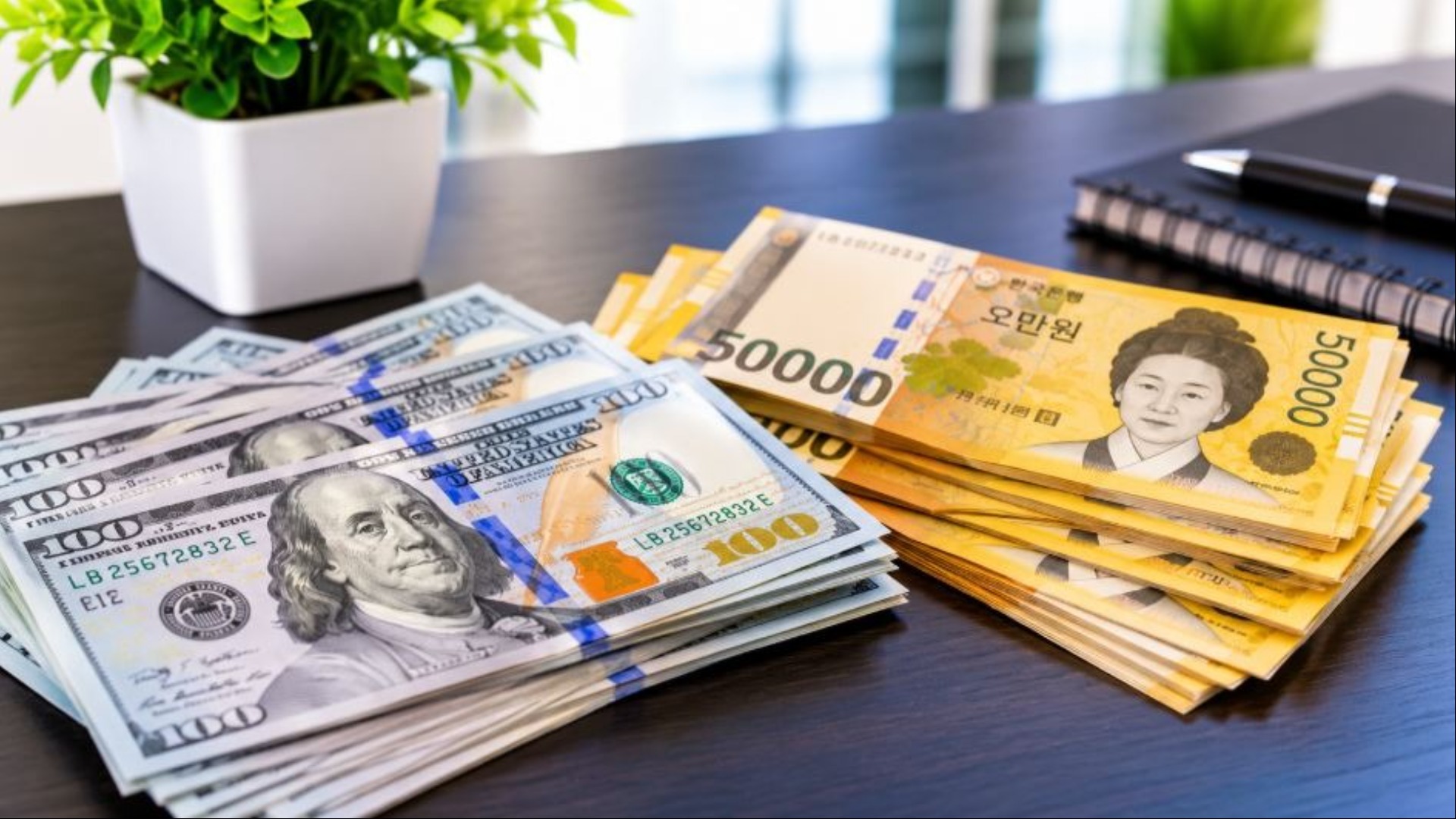
- USD/KRW has been in range this week. Could the new rate hike and the booming chip industry help reverse course?
- 1₩1,340.00 Weekly range low · SupportPair traded in a tight range this week between 1,340 and 1,345
- 2₩1,345.00 Weekly range high · ResistanceUpper bound of the tight trading range seen this week
TradingView Lightweight Charts™ · Yahoo Finance data
The USD/KRW pair didn’t move much today, seemingly shrugging off the Bank of Korea’s interest rate decision. The South Korean won barely reacted to the announcement, holding around 1,343-1,344 at the time of writing, with only small intraday swings.
The big question now is whether today’s action can actually shift the pair’s path. What fundamentals truly matter? And can South Korea’s big semiconductor boom really kickstart a won recovery?
Could the Rate Hike Shift the Trajectory?
The Bank of Korea (BOK) raised its benchmark interest rate by 25 basis points to 3.25%. This was the third increase since July. Stronger-than-expected domestic economic growth, inflation stubbornly above the 2% target, and ongoing financial stability worries all contributed to the decision. 32 of the 34 economists polled by Reuters expected the move, so it looks like the BOK’s guidance, not the hike itself, is what truly matters.
While a single 25-basis-point hike probably won’t shift the USD/KRW exchange rate much-markets already priced it in-the BOK’s signals about future increases will matter a lot.
Hints of more hikes could boost the won, but any suggestion the hiking cycle is winding down might weaken it. The BOK did revise its GDP growth projections higher, now expecting 3.9% for 2026 and 4.1% for 2027. They also hinted at another possible rate increase, perhaps to 3.50% in early 2027.

Will the Chip Boom Help?
South Korea’s semiconductor industry should also help the won by bringing in more dollars. In the first 20 days of November alone, chip exports almost quadrupled year-over-year, accounting for nearly half of all exports. This steady dollar flow from semiconductor sales, as exporters convert their earnings into won-has helped ease some of the upward pressure on the exchange rate.
Additionally, year-end dividend and tax payments from major chip manufacturers like Samsung Electronics and SK Hynix will likely boost demand for the won over the next few weeks.
Analysts note the large trade surplus, along with a record current account surplus, which is pushing down the USD/KRW. Governor Shin Hyun-song also mentioned the won seems undervalued when looking at effective exchange rate metrics.
Beyond central bank rate headlines, foreign investment flows into the KOSPI stock market are important to watch. Recent outflows of foreign capital from South Korean shares, as investors worry about AI valuations, have boosted dollar demand as they convert their won holdings. That in turn pushes up the USD/KRW.
But the ongoing current account surplus, driven by strong export revenues, especially from semiconductors, provides ongoing support for the won. When these export earnings are converted into won for payments like dividends, bonuses, or taxes, the currency often strengthens.
The USD/KRW pair traded in a tight range this week, staying close to 1,340-1,345. The dollar edged up just 0.7% over the past five sessions, a sign that market positioning remains cautious.
South Korea’s export momentum got a lift from strong global demand for artificial intelligence semiconductors. That’s why the Bank of Korea raised its growth forecasts for 2026 and 2027.
The chip boom certainly provides a solid base and could lead to a gradual strengthening of the won. However, for a lasting reversal, we’ would also need to see stable global risk sentiment and fewer foreign investors pulling out of equities.
What is your outlook on USD/KRW?
Anonymous · no sign-up · results from the last 30 days · not investment advice