



- Start with a plan, not a tip.
- Open demat and trading accounts, then buy small.
- Check current tax rates before you sell.
This week, the Nifty 50 dropped 451 points in just one day. The following day, the Nifty 50 rose again. If that made you anxious about your finances, that’s great! That indicates you are taking your financial future seriously. And, this is why all beginners should create a plan prior to making their first trade. This is a simple guide to help beginner investors understanding the Indian Stock Market. It provides a step-by-step process of how to begin investing in stocks in India. Additionally, it will teach you how to start trading in India and what to do so as to prevent yourself from making the most frequent errors.. If you want a wider view first, read our beginner’s guide to investing in stocks.
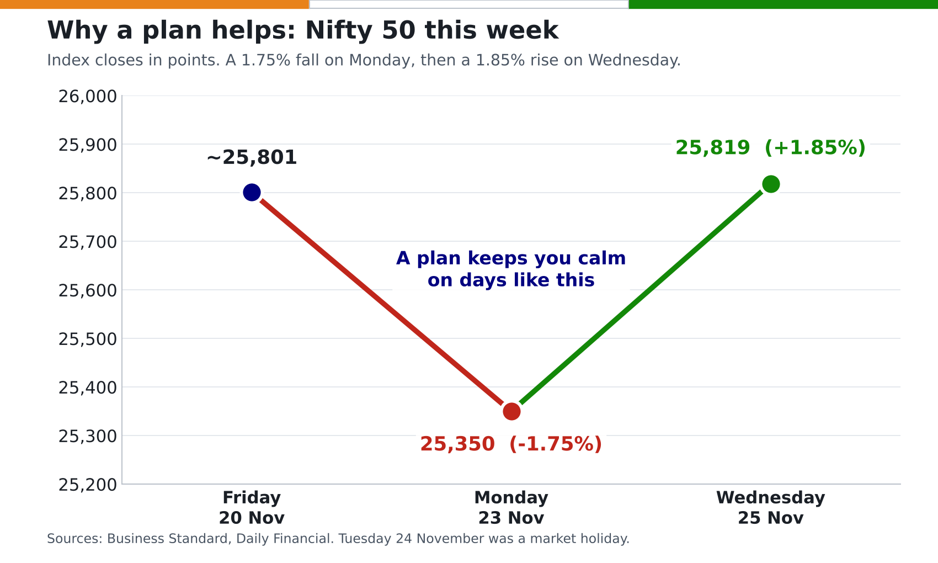
Image 1: The Nifty 50 this week. The index closed near 25,801 on Friday, fell 1.75% to 25,350 on Monday, then rose 1.85% to 25,819 on Wednesday. Tuesday was a market holiday. Big swings like this are normal, and a plan helps you stay calm.
Stock Market Basics for Beginners in India
A share represents a very small portion of a company. Purchasing a share means you have acquired a small percentage of ownership in that business. Your share may increase in value if the company continues to grow. Some companies will also provide you with dividend payments. Beginner’s guide to the stock market in India begins with two major exchanges; the National Stock Exchange (NSE) and the Bombay Stock Exchange (BSE). Both exchanges are regulated by the Securities and Exchange Board of India (SEBI). The Nifty 50 is a benchmark index which includes the top 50 largest companies traded on the NSE. The Sensex is another major index that tracks 30 of the largest companies traded on the BSE.
You can learn more on the NSE website. Good money habits matter too. Our guide on financial literacy is a good place to start.
Companies come in different sizes.
Large caps are big and steady. Mid-caps and small caps are smaller and riskier. This is called market cap. Our guide to market cap shows how to work it out. Beginners often do best with large, well-known firms.
An index is like a “basket” of stocks. An index tells you what’s going on in the stock market. If someone says “the stock market went down,” they are usually talking about an index. Your stocks could be going up or down while the index is going up or down. Also, keep in mind that stocks can go down just as easily as they can go up. Therefore, you could potentially lose money. This is why having a plan is important.
Supply and demand determine how much things cost. Other factors include current events, profit levels, interest rates, gas prices, and global occurrences. Prediction of every price change is not necessary; rather, you should develop a strategy and be patient.
How to Start Trading in India: Demat and Trading Accounts
To start trading in India you need three things. A demat account holds your shares in electronic form. A trading account lets you place orders. A bank account links to both. Many brokers open all three together. Our guide on trading account vs demat account covers the differences and fees. Pick a broker registered with SEBI. You can check this on the SEBI investor site.
To begin with, you will require your PAN card, Aadhaar card, bank account, and mobile number. The KYC check is completed through an online process which typically takes between one and two days. There are differences in fee structures among various brokers; therefore, it is advisable to compare them prior to selecting one. Additionally, you should review the app, support, and charges associated with each broker. It is possible to establish the accounts via your smartphone.
How to Buy Shares in India Step by Step
Here is how to buy shares in India, from the first click to your first order.
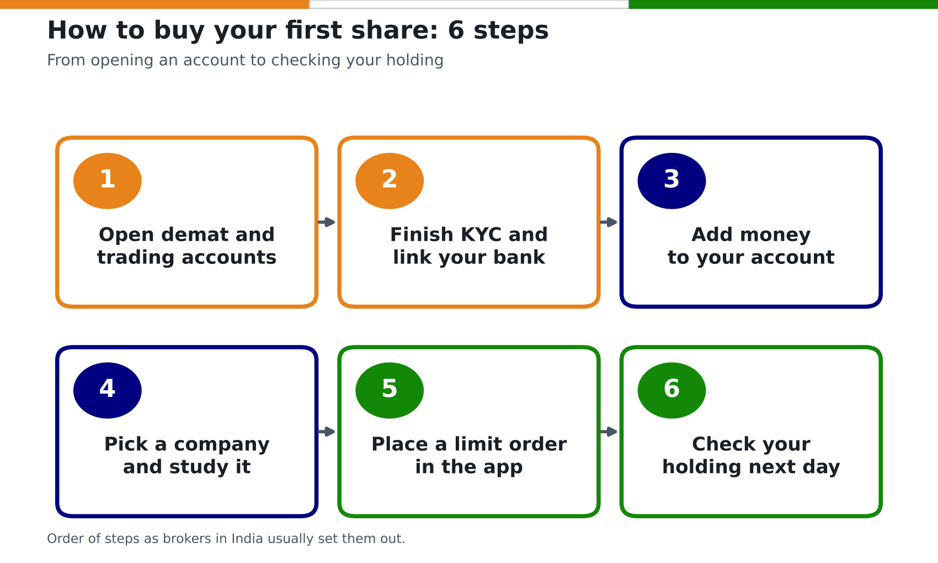
Image 2: The six steps to your first share. First open your accounts and finish KYC. Then add money, pick a company, place a limit order and check your holding the next day. Follow them in order.
- Open an account with a broker who is registered with the Securities and Exchange Board of India (SEBI). Enter all of your information into the app.
- Finish KYC. Provide your PAN and Aadhaar number. Complete the KYC process using an OTP (one-time password). Link your bank account to the system.
- Add money. Send funds from your bank by UPI or net banking.
- Pick a company. Read its results. Check its debt, profit and price.
Our P/E ratio guide helps here.
- To make a purchase, select the item from available stock, enter the amount desired, and determine if you want to set a maximum cost for the purchase (limit order) or buy immediately at the current price (market order). Limit orders are recommended for beginners.
- Check to see if you have purchased the shares. The shares will be available for you to use on the first trading day after you placed the order. You can view the shares that you purchased under “Holdings” in your app.
Don’t spend all your cash in a single purchase. Divide it. Begin with a smaller amount. Purchase just one or two shares to begin. Learn how to operate the app prior to risking larger amounts.
How to Invest in Stock Market in India for Beginners: Strategies That Work
The best strategy for beginners is simple. Invest a fixed sum on a fixed date every month. This is called dollar cost averaging. You buy more shares when prices fall and fewer when prices rise. Our guide to dollar cost averaging shows how it works. This week’s Nifty drop is a good test. If you had a plan, you did not panic.
Do not put all your money in one stock. Spread it across sectors and company sizes. This is called diversification. Our guide on portfolio management and diversification explains the basics. Keep some money in safe places too, like a bank deposit, for emergencies.
Try a basic rule.
Choose an amount you want to invest each month. Select two or three strong companies to invest in. Invest a small portion of your chosen monthly amount into those companies each month. Check on the progress of your investments every six months, rather than on a daily basis.
Invest in good companies that will be successful over time. It takes many years for good companies to become established and profitable. Do not pay attention to what people are saying on social media. Perform your own research. Only invest money that you do not plan on needing for a minimum of five years.

Why bother at all? Inflation eats cash. Prices rise every year. Our guide on how to calculate inflation shows the maths. Over long periods, stocks have often beaten inflation. That is not guaranteed.
Timing matters a little. The market runs from 9:15 am to 3:30 pm. Prices swing wildly in the first 30 minutes. Many beginners wait a little before placing an order.
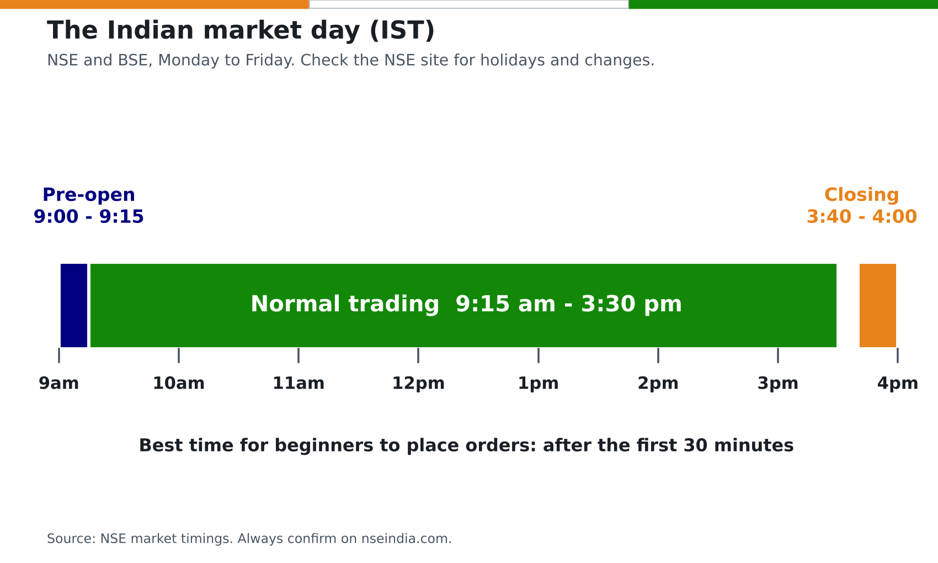
Image 3: The Indian market day. Pre-open runs from 9:00 to 9:15 am. Normal trading runs from 9:15 am to 3:30 pm. The closing session runs from 3:40 to 4:00 pm. Check the NSE site for any change.
Costs, Taxes, and Rules to Know
Investing is expensive. Your broker will take money from you in the form of commissions. Many apps have a set price for each transaction. There is no commission charged on delivery trades. Additionally, the Indian government takes some of your earnings through Securities Transaction Tax. There are other expenses like exchange fees, GST and stamp duty. You should ask your broker to provide you with a comprehensive list of all applicable charges prior to beginning to invest.
Taxes vary depending on how much time you keep your investments. Profits made from stocks that were purchased less than one year ago would be considered Short-Term Capital Gains (STCG). On the other hand, profits made from stocks that were kept for more than one year would be considered Long-Term Capital Gains (LTCG). Both types of capital gains have different flat rates. In addition, LTCG has a yearly exemption limit. However, both rates can change over time. Keeping your investments for longer periods of time may reduce the amount of tax that you owe. It is recommended that you speak with a tax professional regarding specific rules.. Always check current rules on the Income Tax Department site.
Costs reduce profit. It may seem like a very small cost for each transaction, however, when you are buying and selling stocks frequently, the total cost can grow quickly. Buying and holding stocks will result in lower expenses than trading stocks on a daily basis.
Dividends are treated as income for tax purposes. Please save all contract notes and annual reports, as you will require these documents to complete your tax returns.
Also know the rules. They are set by SEBI. KYC must be completed. Only trade with registered brokers.
Your shares sit with a depository such as NSDL. Never share your OTP or password.
Common Mistakes Beginners Make in the Indian Stock Market
Everyone makes errors at first. Here are the common ones.
- Following tips from social media.
- Putting all your money in one stock.
- Trading too often. Fees and taxes add up.
- Buying out of fear of missing out.
- Selling in panic after a fall like Monday’s.
- Ignoring costs and taxes.
- Chasing hot stocks right after they jump.
- Buying a stock you do not understand.
- Using borrowed money before you understand the risk.
Don’t do these things and you’re already on top of the majority of first-time investors. If you do make a mistake, don’t worry about it, just remember it and keep moving forward. Are you ready to get started? Open up your account, put together a plan for how you want to invest and start out small. What is the next thing you’ll be doing today?
Frequently Asked Questions About Investing in Indian Stocks
How much money do I need to start investing in India?
You may begin by looking at the cost per share. There are many stocks that sell for less than Rs 100 per share. Begin with an amount that you are comfortable losing, then slowly increase that amount each month. Some brokers will allow you to make monthly investments of small amounts.
What is the difference between NSE and BSE?
Both are stock markets. The National Stock Exchange (NSE) has higher trading activity and the Nifty 50. The Bombay Stock Exchange (BSE) was established earlier than the NSE and has the Sensex. Many large corporations list their shares for sale on both exchanges, and those shares sell at roughly the same price.
Is it better to invest in stocks or mutual funds in India?
Mutual funds are a way for you to invest in numerous stocks, and the fund itself will be managed by someone else. Mutual funds may be best for individuals who have limited amounts of time to devote to managing their investments. Investing in stocks provides investors with a greater degree of control over how their money is invested; however, investing in stocks requires an investor to spend more time than would be required if they were to invest in a mutual fund. There are many investors that utilize both mutual funds and stocks.
What are the market timings in India?
The National Stock Exchange (NSE) and Bombay Stock Exchange (BSE) conduct operations Monday through Friday. Trading hours begin with a pre-opening period that runs from 9:00 to 9:15 AM each day. Normal trading takes place during the hours of 9:15 AM to 3:30 PM. Both exchanges are closed on all federal/national holidays. After-market orders can be placed, and these orders will be executed on the following business day.