



- Real estate pays through rent and rising value.
- High rates make costs bite; check net yield.
- Start small with REITs, then compare with stocks.
Real estate investment can be defined as purchasing real estate (or real estate related) to generate either rental income or an increase in its worth. This is what it’s all about. This document will show you how to invest in real estate, even as a beginner. There are many simple mathematical equations, real-life expenses and real-life risks discussed throughout this document. As of late, interest rates have increased, so keep this in mind when reviewing the information contained within this document. Beginners to real estate investing don’t require large amounts of capital. Instead, they require a plan. Are you new to finances? Start with our financial literacy guide.
What Is Real Estate Investing?
Real estate is land, building(s) and/or room(s) that are rented out. Also included in the definition of real estate is any claim that can be made against property (e.g. shares in a real estate investment trust). You have two methods to generate income from your real estate investments. First, you receive rental income. Second, you sell the asset for a higher price than what you originally paid for it. Most investors prefer to generate income using both methods. Rental income helps pay the expenses associated with holding the asset. Over time, the value of the asset will grow. Real estate typically moves at a slower pace than equities and has higher trading costs. There are two categories of real estate investment. Direct ownership occurs when you own the deed to the property. Indirect ownership occurs when you own shares or units of an investment vehicle (such as a real estate investment trust) that owns the property.. See how it fits a wider mix in our portfolio management and diversification guide.
Rental yield indicates how hard a property will work for you.
For instance, if you purchase a home for $200,000, and it generates a monthly rent of $1,200, then your yearly income from the property would be $14,400. To find out the gross yield, divide $14,400 by $200,000. In this case, the gross yield would be 7.2%. After finding the gross yield, subtract all of the expenses associated with owning the property such as property taxes, insurance, repairs, etc., plus the cost of having no tenant in the property for at least one month. In this example, these expenses would total $5,940. Therefore, after subtracting the expenses from the yearly rental income, you are left with $8,460. Your net yield would therefore be 4.2%. Always refer to the net number as it is the amount that will actually reach your bank account.
The first advantage is the potential for appreciation of your property. If you purchase a house for $200,000, and its value increases by three percent annually, the home will increase in value to approximately $206,000 within one year. There are no guarantees when it comes to growth. The values of properties may remain stagnant for several years. Therefore, do not rely heavily upon the growth aspect of your investment.
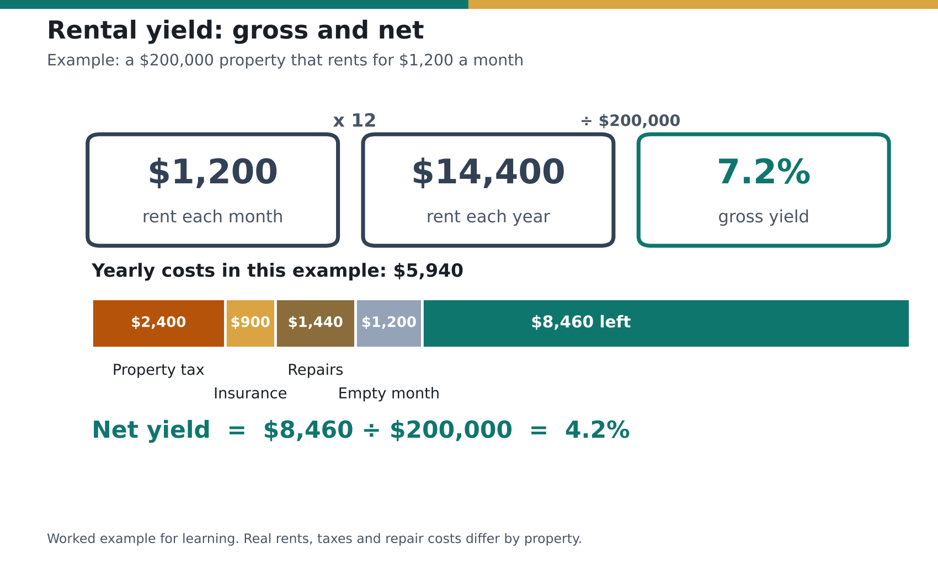
Image 1: The yield example. Three boxes show $1,200 a month, $14,400 a year and a 7.2% gross yield. The bar below splits $5,940 of yearly costs into tax, insurance, repairs and an empty month. The teal part is what is left.
Ways to Invest in Real Estate: Buy-to-Let, REITs, Crowdfunding, and Flipping
Buy-To-Let is when you purchase a property with the intention of renting it to others. When buying a rental property, you are purchasing an investment that will require your time, effort, and money to manage. In addition to being responsible for finding tenants, making repairs, and covering the cost of vacant periods, you will also need to have more cash than if you were buying a primary residence. Most mortgage companies will require a larger down payment for rental properties than for primary residences. In addition, interest rates on rental properties are typically higher than those on primary residences. Therefore, it would be unwise to invest all of your available funds in a single rental property. Our dollar cost averaging guide shows how to build a position slowly.
REITs are companies that own property and pay out income. You buy them like shares. The SEC explains that a REIT owns and usually manages income-generating property. You can start small and sell fast. We will cover this in a future How to Invest in REITs guide.
Crowdfunding pools money from many people to fund a deal.
You can often start with a small sum. But your money may be locked for years. The SEC warns that crowdfunding carries real risks, including losing everything you put in.
Flipping is when you buy something, make improvements to it and then sell it in a short period of time. This can be very lucrative. On the other hand, this process can quickly become costly and have disastrous results. Costs increase, values decrease, and time continues to tick away. People who have experience in construction and excess funds are suited for this type of business. For most people who are new to this field, they should stay away from this form of real estate investing initially. You cannot expect a fast sale.
Flipping is an investment strategy that involves purchasing real estate, making improvements to it, and then quickly reselling it. Flipping has the potential to produce high returns. However, it can quickly become unprofitable. When expenses increase, property values decrease, and time runs out, flipping becomes difficult to be successful. Individuals who have construction experience and some money to invest are suitable candidates for this type of investment. Beginners to the real estate industry would be wise to refrain from participating in flipping initially. Do not rely on a rapid resale.
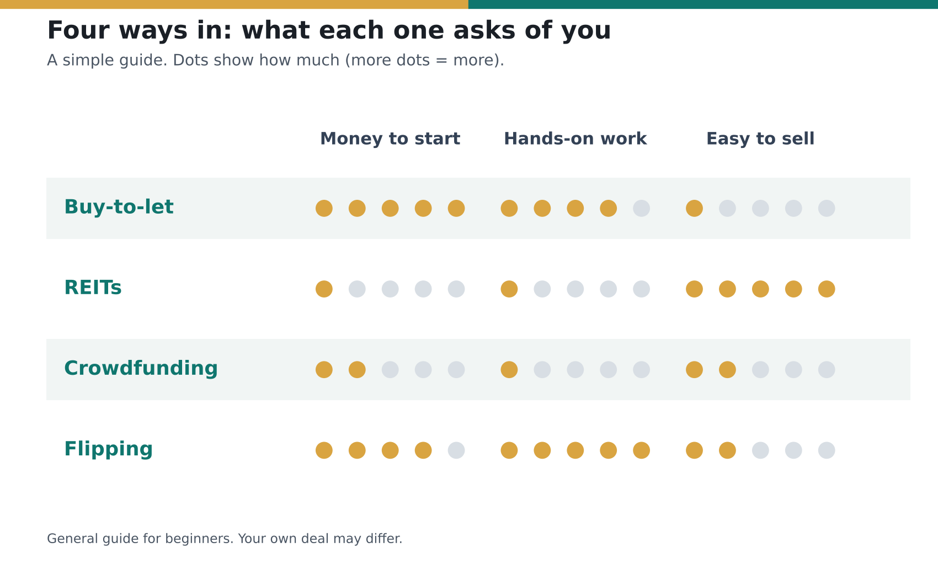
Image 2: Four ways in. Gold dots show how much each route asks of you. Buy-to-let needs the most money and is hard to sell. REITs need little money and sell easily. Flipping needs the most hands-on work.
How to Invest in Property Step by Step
Here’s an easy way to get started with investing in real estate. This method works well for people who are just starting out with investing in real estate.
- Set a goal. Do you want income, growth or both?
- Check your money. Pay off costly debt. Keep an emergency fund.
- Learn the costs. Count tax, fees and repairs.
- Compare loans. Check the rate and the total cost.
- Choose a route. Pick buy-to-let, REITs or crowdfunding.
- Run the numbers. Work out the net yield before you commit.
- Take your time with step three.
The CFPB lists all the costs of buying a home, from closing fees to moving costs. Many people can remember some of the plans. You should write down your thoughts. One page of a plan is better than a general concept. Give this method a try for the first year. Learn and save money during months 1-3. Compare Real Estate Investment Trusts (REITs) and loan options during months 4-6. Make a small REIT investment, or increase your savings for a down payment during months 7-12. Review your progress every three months.
How to Invest in Real Estate with Little Money
You do not need $200,000. REIT shares trade like stocks, so you can start with the price of one share. REIT funds spread your money wider. Our best ETFs guide lists funds by category. Some crowdfunding sites will allow you to make small contributions. Another option is to rent out an extra bedroom in your home, which would lower your expenses. This type of arrangement has become known as “house hacking.” In addition, you may consider pooling money with family members using a formal, written agreement. Prior to entering into any such agreements, it would be wise to consult with an attorney. Also, do not use borrowed funds to pay for the initial down payment. Begin with a smaller amount of money and contribute regularly on a monthly basis.

Costs and Risks of Real Estate Investing
Costs come in layers. Expect these:
- A deposit and closing fees.
- Property tax and insurance.
- Repairs and upkeep.
- Empty months with no rent.
- Agent or management fees.
Tax laws vary from country to country, as well as state to state.
It is always wise to consult with your tax advisor prior to purchasing property. Rental income regulations and capital gains on the sale of property may be complicated.
Interest rates matter most today. In Freddie Mac’s survey on 19 November, the average 30-year mortgage rate was 7.28%. Look at the third image. A $160,000 loan at that rate costs about $1,095 a month. Add $495 of other costs and the total is $1,590. Rent of $1,200 leaves a gap of $390. So many beginners need extra cash, or must wait. Rates can fall, too. If they do, you may refinance. But do not build your plan on that hope. Bond yields set the mood too, as our 10-year Treasury yield report shows.
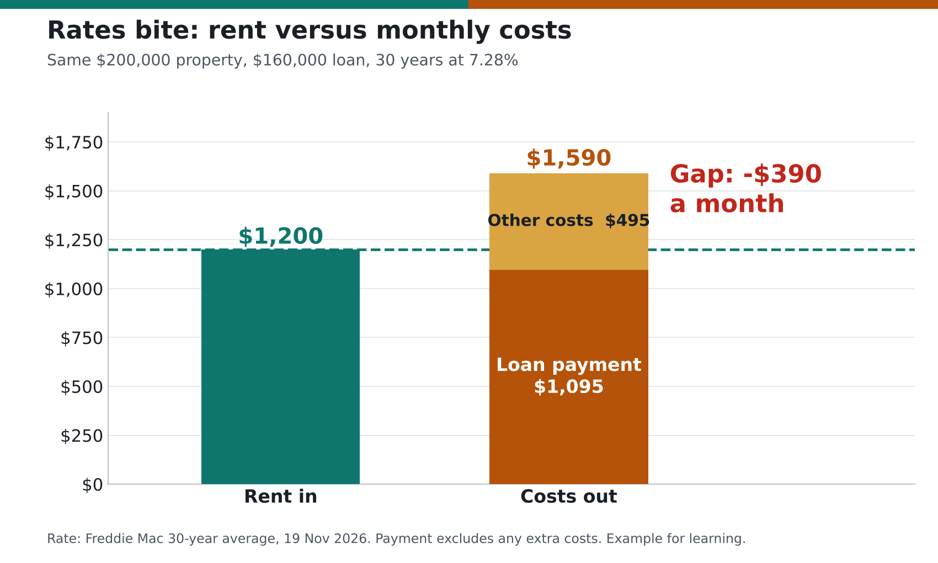
Image 3: Rates bite. The teal bar is $1,200 of rent. The tall bar is $1,095 of loan payment plus $495 of other costs. The gap is $390 a month in this example.
Other risks are plain. Prices can fall. Tenants can leave. You may not sell fast. Inflation can lift your costs. Learn the maths in our inflation rate guide. Leverage has a risk of its own. When you borrow to buy something, you could potentially make more money. On the other hand, you could lose more money. You should spread your risk by investing in multiple places. Investing in only one home in only one city would be considered a “concentrated bet.” You should do your own research before making decisions. Do not use only one person’s advice or opinion. Do not invest any money that you might need in the near future.
Real Estate vs. Stocks: Which Is Better for Beginners?
Neither wins for everyone. Stocks are easy to buy and sell, and you can start small. Real estate needs more money and time. In return it offers rent and control. Debt can boost gains. It can also boost losses. Our guide on how to invest in stocks is a good first read.
Stocks come with simple checks. The P/E ratio guide shows one. Property has its own check: net yield. Here is a quick view.
- Stocks: low cost to start, easy to sell, no repairs.
- Real estate: more money, slow to sell, rent and control.
In addition, time matters. It will take you hours per month to manage a rental property. It may only take you minutes per month to manage your shares. Dollar-cost averaging can be used successfully for both types of investments. Many individuals own both types of investments. Combining these types of investments can help reduce risk. Start by learning about the type of investment that is easiest for you to understand.
Frequently Asked Questions About Real Estate Investing
How much money do I need to start investing in real estate?
How much money does it take? This depends on how you want to invest. For example, if you want to buy into a real estate investment trust (REIT), all you need to know is the price of one share. If you are looking to purchase a home to rent out (buy-to-let), you will need a deposit, closing costs and a cash reserve to cover repairs. Lenders typically require 20% down on investment properties. In addition, you should have at least three to six months’ worth of living expenses in cash. Lastly, begin by investing only what you are prepared to lose.
Is real estate a good investment when interest rates are high?
It’s possible, but it takes more work. Because loans are more expensive, there’s less cash available to make payments. You’ll need to have high rent, a large down payment and very little or no debt. Some people will wait. Others will invest in real estate investment trusts (REITs). You need to calculate the costs of investing in real estate prior to making a decision. Never go over your budget when investing.
What is rental yield and how is it calculated?
Rental yield is annual rent expressed as a percentage of the purchase price. Gross yield is the total amount of annual rent received divided by the purchase price. To determine net yield, you must first subtract any expenses incurred from the gross yield. A home with a value of $200,000 that rents for $1,200 each month will have a gross yield of 7.2 percent. You should compare this number to the interest rate on your loan.
Can I invest in real estate without buying a property?
Yes, you have several ways to invest in real estate. One way is by purchasing REIT shares or REIT funds. Another way is to utilize a crowd funding site. However, all options involve risk. REIT funds include numerous properties and therefore spread out your risk. Prior to investing, make sure you understand the fees and regulations. Also, determine who manages the site. Be patient. Think long-term.