



Archived Article This article was published more than 5 months ago. The market data, prices, forecasts, and analysis were accurate at the time of publication but may have changed since then. Please use this article for historical reference only and refer to our latest content for current market information.
Current Setup and Live Chart
IAG is trading as a stock proxy for travel demand and energy costs amid macro tape volatility. Airline stocks typically see margin compression when energy costs rise. When these happens, the airline companies are usually forced to raise ticket prices. Studies conducted by various organizations and stakeholders in the aviation industry indicate that airline passengers generally react negatively to rising ticket prices. This is more pronounced in the leisure travel segment, leading to lower passenger demand and posing a double jeopardy for airline stocks.
Oil prices fell during the NY session, prompting a corresponding jump in IAG’s share price. This came after the UK and France announced they would host talks on the closure of the Strait of Hormuz, a move markets interpreted as a risk-on, de-escalatory move. The IAG share price closed the session 3.19% higher.
IAG Share Price: Macro Drivers
Indeed, the stock is trading in a two-way fashion, with two opposing macro forces pulling on the stock as follows.
1)Oil shock: On the one hand, rising energy costs have translated into higher costs for Jet A1 aviation fuel and higher charges from jet engine makers. The rise in energy costs was driven by the geopolitical situation in the Middle East. This is a major headwind for airline stocks and the IAG share price.
2) Company Fundamentals: On the other hand, IAG’s fundamentals are actually strong. The company is coming off strong earnings that beat profit estimates, with a commitment of €1.5bn of shareholder returns over 12 months. This commitment also includes a €500m buyback program that will continue to the end of May 2026.
IAG Share Price Catalysts
1.Jet fuel direction: This is currently the biggest price catalyst for airline stocks. The cost of aviation fuel is directly tied to the cost of a barrel of crude oil. If crude oil falls, it drags down the cost of aviation fuel, which is a positive for the IAG share price. The reverse is also true.

2.Pass-through ability: An airline’s ability to pass on costs, such as higher fuel prices, to consumers. Fair hikes, route adjustments, and capacity tweaks are other measures airlines deploy to cut costs. If the new prices stick with the public, this is seen as a positive for the stock.
3.Operational disruption: War zones where rockets or surface-to-air missile defense systems are deployed are unsafe for civilian aviation. Middle East routes are facing severe disruptions and cancellations. Headlines around these could lead to the repricing of risk premia in the civil aviation sector.
Weekly Forecast Scenarios
Base case: The stock is expected to face choppy stabilization as oil prices cool amid recent de-escalatory headlines. Furthermore, the stock’s strong fundamentals will provide support on dips, except if energy costs spike again.
Bull case: A full-fledged rebound towards established supply zones if energy costs continue to decline. Furthermore, other fundamentals, such as passenger demand heading into the holiday travel season, will boost this case scenario.
Bear case: a downside resumption is expected if the price of jet fuel spikes again or if Hormuz disruption headlines worsen (failure of the UK-France-hosted peace talks)
In other words, the IAG share price is fully exposed to oil prices because the airline depends on jet fuel. If oil prices are down, there’s potential for a relief rally. If oil prices are up = renewed pressure on the IAG share price.
IAG Share Price: Technical Outlook
The recovery move is about to test the 399.4 resistance level, which was formed by the prior highs on 10 September and 26 November 2025. If this barrier is uncapped, further recovery towards the 429.4 resistance and prior high of 3 November 2025 cannot be ruled out.
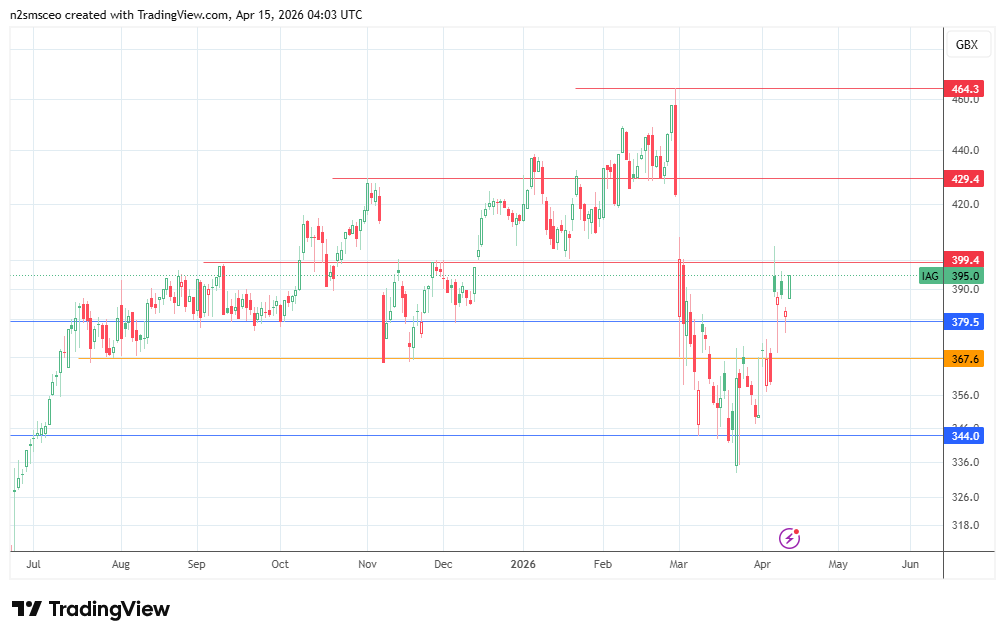
On the other hand, rejection at the nearest barrier keeps the stock range-bound. However, a collapse of the 379.5 support will trigger a downside move targeting the 367.6 support and prior lows from July 2025 and November 2025. 344.0 is the secondary support if there is a further decline.