



Compound interest is defined as interest that is calculated on both the original investment amount and the interest that has been accumulated over time. It is an interest-calculation method in which previously earned interest, along with the principal, can be reinvested. The principal of the new interest can be invested to generate new interest based on both amounts.
This is also known as compounding, and it’s a principle that can be used in the financial markets. For instance, in terms of forex trading or any type of trading, compound interest can be calculated based on any investments or trades that are made using the original capital for the trade, along with the new interest, to generate a higher amount that will allow the use of the same lot size, but which now equates to a higher amount than the previous trade.
1. What Is Compound Interest?
What is compound interest?
Compound interest also works for investment or trading purposes within the financial markets and can be used to grow capital and profits over time.
For instance, a $1,000 investment that generates a 5% return ends with $60 in interest in the first investment cycle. In the next investment cycle, the initial investment is now $1,050. A 5% return is generated, which creates earnings of $52.50. This is now $2.50 more than the interest or profit earned in the first investment round. The total profit from the investment and capital used in the second investment round now brings the trader to $1,102.50. A 5% return on this third round of capital generates $55.125 in profit. This is now $5.125 higher than the first investment round’s profits, and $2.625 higher than the second investment round’s profits. It also makes available $1,155.625 of capital for the fourth round of investment. That is how compound interest works: it generates more capital and interest with each investment round.
2. Compound Interest vs. Simple Interest
There is a fundamental difference between simple interest and compound interest. Simple interest is calculated on the original principal or investment amount only. Compound interest, on the other hand, is calculated based on the original principal/investment amount plus all accumulated interest/profits/returns from each investment cycle. As such, compound interest produces higher returns over time even when the original investment period and the rate of return remain the same.
Example: $10,000 invested at 5% annually, assuming an annual compounding, without any additional deposits or withdrawals or fee/commission deductions.
| Investment period | Simple interest: final value | Compound interest: final value |
|---|---|---|
| 5 years | $12,500.00 | $12,762.80 |
| 10 years | $15,000.00 | $16,288.90 |
| 20 years | $20,000.00 | $26,533.00 |
When the investment period lengthens, the difference in returns starts to become increasingly evident. Compound interest is built to reward patient investors due to the maginified power of investing with capital and previously accumulated interest.
3. The Compound Interest Formula Explained
Compound interest formula:
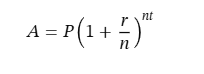
- A stands for the amount of money that has accumulated (principal and interest)
- P is the initial principal amount (starting deposit or loan)
- r: annual interest rate, usually expressed as a decimal (e.g., 5% = 0.05).
- n: The no. of times interest is compounded per year. (e.g., monthly = 12, quarterly = 4, annually = 1).
- t: The total number of times the money is invested or borrowed, expressed in years. i.e., the number of investment rounds
The more the funds are subjected to compounding via investment rounds, the greater the potential to generate a larger final value down the road.
4. How to Calculate Compound Interest Step by Step
Calculating compound interest starts with identifying the principal (initial investment amount), the annualized interest rate, the investment period, and the compounding frequency (number of compounding periods per year). The calculation below shows how to calculate annual and monthly compound interest using an initial capital of $10,000 at 5% over 10 years.
Example: $10,000 at 5% for 10 years
| Input | Value |
|---|---|
| Initial deposit | $10,000 |
| Annual interest rate | 5% |
| Investment period | 10 years |
| Annual compounding frequency | 1 |
| Monthly compounding frequency | 12 |
Annual compounding:

- Annual compounding means interest is added to the account once a year.
- Final balance after 10 years: $16,288.90.
- Total interest earned: $6,288.90.
Monthly compounding:
- There are 12 months in a year, so monthly interest means that interest is added to the account 12 times each year.
- Final balance after 10 years: $16,470.10.
- Total interest earned: $6,470.10.
In this example, monthly compounding gives about $18.12 more interest than annual compounding because of the higher frequence of interest addition to the principal. This suites the FX trading industry well, and a trader can aim for a monthly compounding that will take a $10,000 account to earn good interest down the road. The calculation assumes that the nominal annual rate remains constant, with no new withdrawals or deposits and no fees whatsoever.
5. How Compounding Frequency Transforms Returns: The FX Example
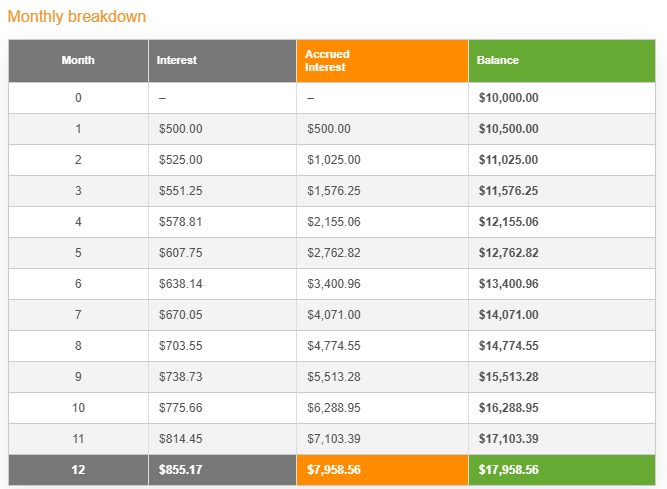
Compounding frequency will determine how often any accumulated interest is added to the initial investment amount of principal. There are different compounding schedules: daily, monthly, weekly, quarterly, semi-annual and annual. Using the same nominal annual interest rate, taking on more frequent rounds of compounding will produce a higher annual return. The snapshots below indicate how a $10,000 initial investment into an FX account, subjected to monthly compounding at 5% interest, works out over the course of 12 months in a year.
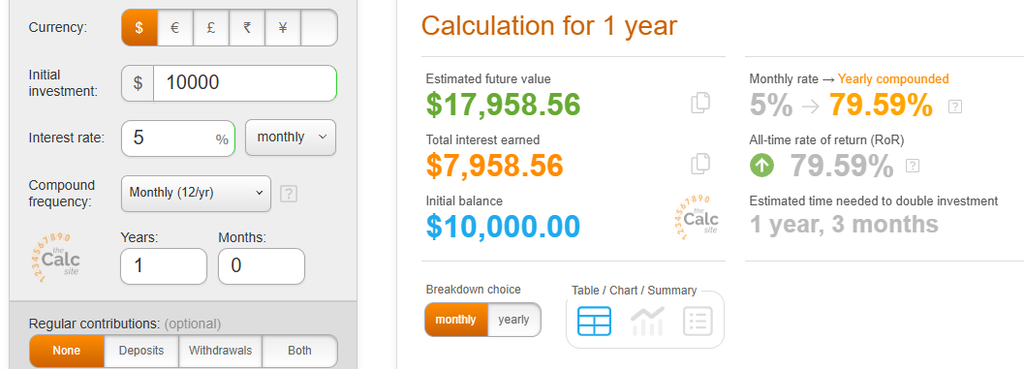
Here is the monthly breakdown that shows how $10,000 became $17.958 over the course of a year:
6. Compound Interest: Theme of Practice Questions (GCSE Level)
What are the GCSE-level questions that students will generally encounter when it comes to compound interest? These are questions around:
- interest earned after X number of years.
- total value of the investment after X number of years.
- interest value after X number of years on when the rates change.
- calculating the annual interest rate using the initial investment sum and the final value.
7. Frequently Asked Questions About Compound Interest
Is there a method to work out compound interest quickly?
To quickly work out compound interest, identify the starting investment amount, the investment period, and the interest rate, then use these parameters to calculate the amount after the investment period with compound interest. A quick estimate can be done using the Rule of 72, which helps identify the approximate time it takes for the initial investment to double.
What is the Rule of 72?
Here is how the Rule of 72 works: divide 72 by the annual interest rate. This tells you how many years it takes for an initial investment to double, assuming compound interest. If you use an annual rate of 6%, the investment would take 72 divided by 6, which is 12 years, to double. This formula assumes compounding continues during this period and that the rate of return remains constant.
Can you use compound interest as a forex trader?
It is possible to use compound interest as a forex trader. In this case, you have to set your investment period timer, which could be 1 year, 2 years, or 5 years, as well as the initial investment amount, instead of using the same fixed rate of return.
Work out what percentage of the account is in each lot size and how your take-profit and stop-loss settings will match the returns you make. Of course, this assumes that the trader is actually profitable. If the trader is profitable, it is possible to compound a $1,000 trading account into a specified sum. The Rule of 72 can also be used to work out how long it takes for the investment to double.
Is compound interest the same as APY?
The answer is no. Compound interest describes how interest can accumulate over time, while APY is the effective return after compound interest is accounted for. APY makes it easier to compare different service products once fees and conditions are factored in.