



- The IEA has forecast a supply overshoot of 1.7 million barrels per day over demand forecasts, favouring more bearishness on Brent crude.
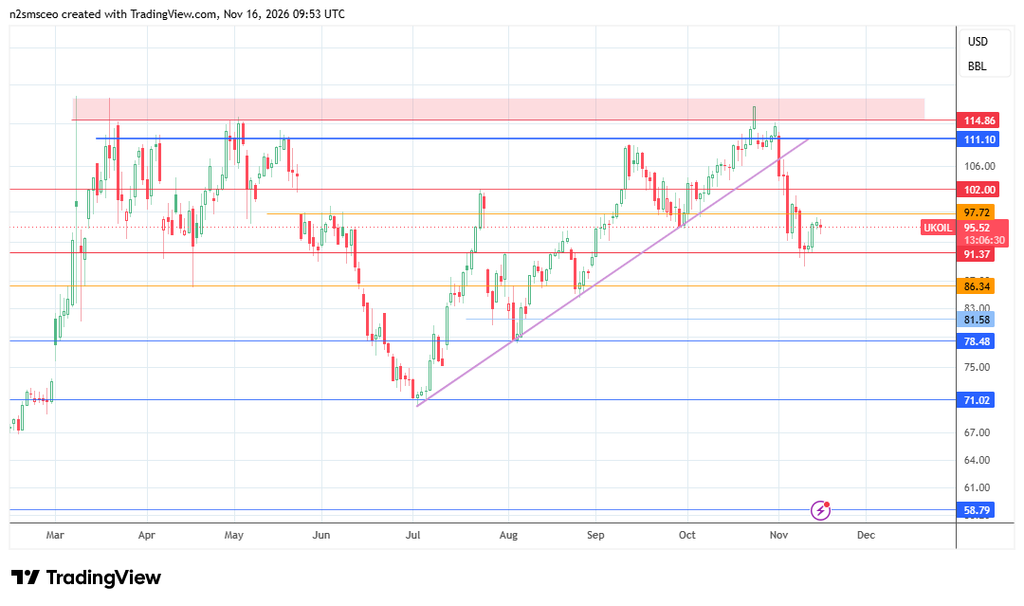
- 1$91.37 Support8 April and 28 May lows, lower consolidation boundary
- 2$97.72 Resistance4 June 2026 high, upper consolidation boundary
- 3$86.34 Next support17 April and 26 August lows, breakdown target below 91.37
- 4$100.00 Psychological level · Key levelBull case recovery threshold after dropping below $100 per barrel
- 5$102.00 Upside targetNext upside target on an uncapping of 97.72 resistance
- 6$81.58 Downside targetAdditional downside target below the 86.34 support level
TradingView Lightweight Charts™ · Yahoo Finance data
Current setup
Brent crude is down 1.16% in early London trading, as markets extend last week’s substantial selloff amid a shift in the fundamentals governing the asset. Brent crude is currently being quoted at $95.27 per barrel.
The drop in oil prices came as the International Energy Agency (IEA) revised its global oil supply forecasts. The IEA now expects global supply to exceed demand in Q4 2026, a significant shift away from earlier forecasts that had predicted a supply deficit. This surprise upside revision to global supply, combined with recent de-escalatory negotiations around the Middle East conflict, has shifted market dynamics and allowed oil prices to drop below the $100-per-barrel mark.
However, shipping disruptions across the Strait of Hormuz remain in place, continuing to complicate the medium-term outlook for Brent crude.
Brent Crude: Macro Drivers
1. IEA’s Supply Surplus Forecast
The International Energy Agency’s supply surplus overshoot for the first quarter of 2026 is now a major bearish catalyst for oil prices. Low oil supply is expected to average 105 million barrels per day in Q4 2026, according to EIA, which is a 1.7 million-barrel-per-day overshoot above demand forecasts. This focus is a significant shift away from its previous supply-deficit forecasts. If production and exports continue to outstrip consumption, bearish pressure on Brent crude continues.
2. Recovering Middle East Exports vs Hormuz Shipping Risks
Exports of crude oil and shipments in the Middle East are recovering, helping to offset current supply concerns stemming from the blockade of the Strait of Hormuz. The IEA notes that exports through Hormuz are moving closer to pre-war levels, even as Saudi Arabia increased its October production sharply by 10.5 million barrels per day. However, this is being counterbalanced by the continuing fragility of the geopolitical situation; reports of new tanker attacks and mine activity in the area continue to hit the news wires and indicate the vulnerability of supply transportation routes. Any escalation of the war, especially on the military front, as well as a failure of the IEA-supply overshoot forecast, could restore the geopolitical oil risk premium.
3. Chinese Demand
China is the world’s largest crude oil importer and Chinese demand continues to exert a strong fundamental influence on crude oil prices. October refinery throughput from China showed a 2% month-on-month and an 8.1% year-on-year decline, which raises concerns about consumption strength. Any weakening of China’s industrial activity could reinforce the IEA’s projections.
4. Emergency Stockpile Releases
The IEA’s report also indicated that 70 million barrels of emergency crude stockpiles would become available in the market by the end of Feb 2027. This additional supply could further ease any market tightness and provide much-needed relief to markets typically pressured during winter. The U.S. has also extended its Jones Act shipping waiver for 90 days, allowing foreign vessels to ship oil exports through domestic ports. However, costs of tanker freight oil shipping via alternaive routes remains high, which could limit the relief from this factor.

Brent Crude Forecast Scenarios
Bull case: Recovery above $100.00
A significant escalation in the geopolitical situation, as well as deterioration in shipping conditions around the Strait of Hormuz and alternative routes, could drive crude oil prices on the Brent benchmark market above $100/barrel. In this scenario, targets at $102 and higher could become visible.
Base case: Consolidation between $91.37 and $97.72
A case for consolidation could be made if the current bearish outlook is equally countered by continued geopolitical risks, especially if the recovery in Middle East exports stalls and Chinese demand picks up. This would lead to consolidation between $91.37 and $97.72.
Bear case: Break below $94.00
The IEA update favors a bear-case scenario. Further recovery in Middle East exports amid weak Chinese refinery demand would reinforce this outlook. This supports a breakdown of the $91.37 support levels, unlocking targets at $86.34 or lower.
Technical Outlook
Brent crude is currently consolidating between the 97.72 resistance (4 June 2026 high) and the 91.37 support (8 April and 28 May lows). A breakdown of this support ushers in the 86.34 support (17 April and 26 August lows), with 81.58 and 78.48 (5 August low) serving as additional downside targets.
On the flip side, an uncapping of 97.72 brings in 102.00 as the next upside target, with 111.10 and 114.86 coming into the mix on an additional recovery.
What is your outlook on Crude Oil Brent?
Anonymous · no sign-up · results from the last 30 days · not investment advice