



Archived Article This article was published more than 5 months ago. The market data, prices, forecasts, and analysis were accurate at the time of publication but may have changed since then. Please use this article for historical reference only and refer to our latest content for current market information.
- Shell share price is still trading within the context of the oil price risk premium due to its status as a player in the upstream oil sector.
Current Setup and Live Chart
Shell is a major oil producing company, which gives it direct exposure to oil price shifts. Currently, the Shell share price is functioning as a high-beta stock that acts as a direct crude oil price proxy. This means that it is trading with outsized moves in direct response to the oil shock risk premium, just the same way that Brent crude price action is being directed by geopolitically-driven volatility.
Two opposing forces are currently acting on the Shell share price. These are:
- Operational exposure to the geopolitics of the Middle East, with potential for headline risks and increased volatility from war-associated infrastructural damage. This is a potential headwind for the stock.
- Higher prices for crude oil and refined products, which increases earnings and cash returns. This is supportive for the stock.
The Shell share price has experienced a sharp upside re-rating which has occurred in tandem with the oil risk premium. Currently, the Shell share price is in a retracement along with Brent crude, as ceasefire talks continue in an attempt to end the US-Iran war.
The recent history of the Shell share price dating back to 9 January indicates that the stock closed at 30.50 euros on 9 January and rose to 41.05 Euros as at close of trading on 31 March 2026. That is the current high for the year and corresponds to the period of maximum escalation of the conflict.
The month of April saw a retracement, which has extended into May with the Shell share price closing at 35.89 Euros on 8 May 2026.

Shell Share Price: Macro Drivers
1) Oil Price Volatility to the Upside
Higher oil prices provide support for the company’s earnings and cash returns, especially when its downstream operations are considered along with its crude oil production activity (upstream operations). Therefore, the Shell share price is supported when oil markets experience volatility, due mostly to expansion of its margins from trading and downstream operations in the current state of market dislocation. There have been past instances where this has occurred; the Libyan war of 2011 that led to prices rising from $45 to $140 in 8 months is a clear example.
2) Production Diversification
A Reuters report quotes Shell’s Brazil CEO as referring to the ongoing Middle East conflict as an “enormous opportunity” to attract oil production investment into Brazil, a country located away from known conflict-prone areas and therefore positioned to ensure supply stability. Shell as a company is also actively indicating that it intends to diversify its production base, which has the potential of removing the headwinds from its exposure to war-associated infrastructural damage. However, this is not expected to be a near-term macro driver.
3) Shareholder Returns
The fourth-quarter 2025 earnings result indicates that the company will pay shareholders an increased dividend of $0.372/share. Additionally, the company will embark on a new $3.5bn buyback program, which is expected to be completed before the release of the Q1 2026 results. Typically, investors tend to put money into big oil names that actively convert some of the increased earnings from higher oil prices into dividend payments to shareholders.
Shell Share Price Forecast Scenarios
Base case: The base case scenario sees the price remaining choppy even while supported. We are more likely to see a return of some mildly bullish action even in the face of two-way volatility, with buyers appearing on dips and sellers fading the rallies. This bias remains as long as crude oil prices remain elevated, with heightened volatility still in place.
Bull case: The bull case scenario calls for a retest of the late March highs, even as oil remains on bid and the Hormuz supply risk remains in place. Escalatory war headlines such as a stalling of ceasefire talks (see latest headlines from US President Trump’s weekend comments) keeps the oil risk premium in place, favouring a higher Shell share price.
Bear case: Continued profit-taking and mean reversion will follow a sharp fall in oil prices. This occurs if the war headlines point to de-escalation. Furthermore, a deep risk-off broad market selloff will override the supportive effect of higher oil prices, but this will be more of a retracement and not a full reversal. This scenario will see Shell share price rotating to deeper support zones, as seen in the chart below.
Shell Share Price: Technical Outlook
The retracement move from the 31 March top at 41.05 attempted a pushback to the upside, which was rejected at 38.67 and followed by a further extension of the retracement to the 35.66 support. The support bounce needs additional momentum to reclaim 38.67. If this barrier is uncapped, a retest of the 41.05 resistance will be in the works. A further push north takes out this barrier and aims for the 27% Fibonacci extension of the 9 January – 31 March upswing at 44.41.
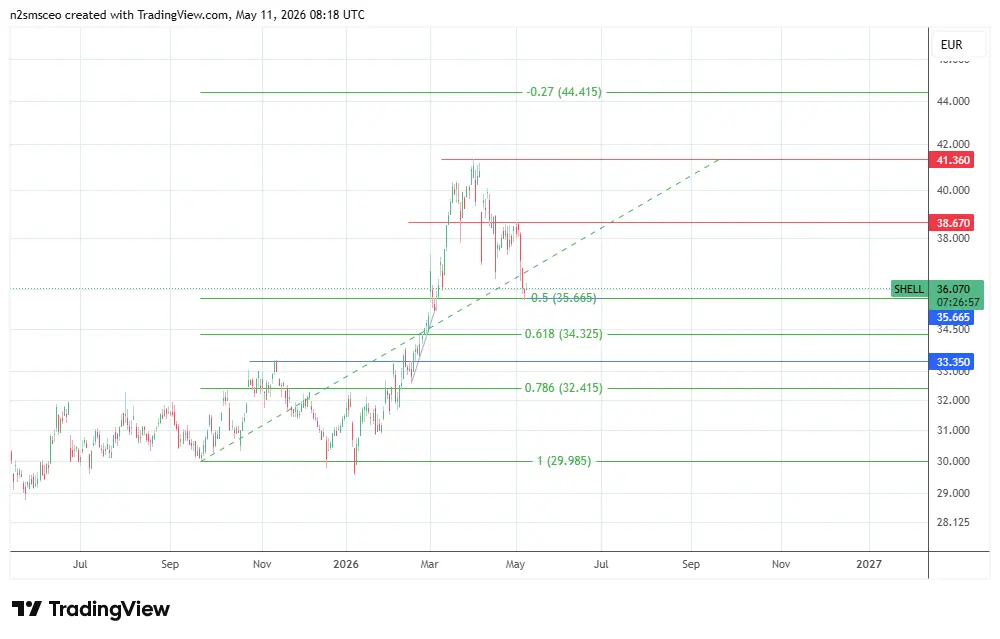
On the flip side, if the 35.66 support and 50% Fibonacci retracement level is degraded, a move towards the 12 November 2025 high at 33.35 cannot be ruled out. This move would have to defeat the 61.8% Fibonacci retracement at 34.32 to be actualized. Further south, the 32.41 support (the low of 17 February) only becomes a valid target if 34.32 gives way.