




Current Market Environment
The Dow Jones Industrial Average is trading in a highly volatile macroeconomic environment, where headlines change daily.
The equity markets started the week on a positive note after a series of tweets by US President Donald Trump indicated that a peace deal was near. With such de-escalatory comments providing a renewed basis for Fed rate cut bets amid falling bond yields and declining energy prices, the Dow hit new record highs, albeit without much conviction. This has left investors scrambling to rebalance their portfolios as the markets navigate between strong corporate fundamentals on one hand and the oil shock risk premium on the other.
Recent trading activity on the Dow Jones has centered on the Middle East conflict, which has driven higher oil prices, rising inflation, and shifting expectations for Federal Reserve policy.
Macro Drivers of the Dow This Week
1. Middle East Geopolitics and Oil Prices
The geopolitical situation and oil prices are the major driver of the Dow. This is for two reasons. Firstly, the Dow plays host to industrials and cyclicals, which heavily rely on crude oil as a manufacturing input. Higher energy prices raise manufacturing costs and reduce margins. Secondly, rising oil prices raise inflationary expectations, shifting Fed policy projections towards the hawkish end of the spectrum. Higher borrowing costs and tighter financial conditions also compress the margins of listed companies and raise the cost of borrowing for investments into equities.
2. Federal Reserve Expectations
Following the Fed’s hawkish hold on 29 April, markets have significantly repriced Fed rate expectations. The pendulum has swung from expectations of easing in Q4 2025 to a near-term hike. Investment research firm Nomura has ruled out any rate cuts in 2026.
The recent US CPI and PPI reports indicate a swing towards hotter-than-expected inflation. This has raised the prospect of higher-for-longer rates.
3. Corporate Earnings

Corporate earnings of companies listed on the Dow remain a major driver of the Dow Jones index. Earnings reports have so far exceeded expectations in many sectors, despite the geopolitical climate. One source of these earnings boosts remains AI stocks, where demand continues to outstrip the supply of AI infrastructure. This is expected to be a significant tailwind for the Dow in 2026. Furthermore, increases in infrastructure investment, defense spending, and AI adoption are expected to affect the corporate earnings of companies listed on the Dow in 2026.
The impact of corporate earnings has so far helped counterbalance the headwinds the oil shock risk premium has brought to equity markets. In the near term, the direction of the Dow will be decided by the battle between corporate performance and the energy-driven global macro risk-off sentiment.
Dow Jones Weekly Forecast Scenarios
Bull Case: If oil prices continue to retreat and Middle East geopolitical tensions de-escalate, this will reduce inflationary expectations. US bond yields will stabilize and hopes for eventual Fed easing will be revived. In this setting, targets between 47500 and 48500 cannot be ruled out.
Base Case: Oil prices remain stable, albeit elevated. If the Fed maintains its cautious stance and growth continues at a moderate pace on the back of supportive corporate earnings, the Dow could continue to trade in a range between 45800 and 47200. Several data sets are expected this week and beyond, so investor caution will most likely drive this scenario.
Bear Case: A resurgence in oil prices and a marked increase in inflationary expectations could spur further selling. This is because Fed tightening becomes more likely as inflation rises. There has to be a significant escalation in geopolitical tensions for this scenario to become more prominent. A selloff towards 44,000-45,000 cannot be ruled out here.
Dow Jones: Technical Outlook
The index has reached new highs after breaching the 50531 resistance. However, the day’s candle has opened lower and is now testing this price level, which acts as new support. The bulls need to reject this pullback move and target a push north towards the 27% Fibonacci extension level of the price swing from 19 June 2025 to 11 February 2026 at 52885.
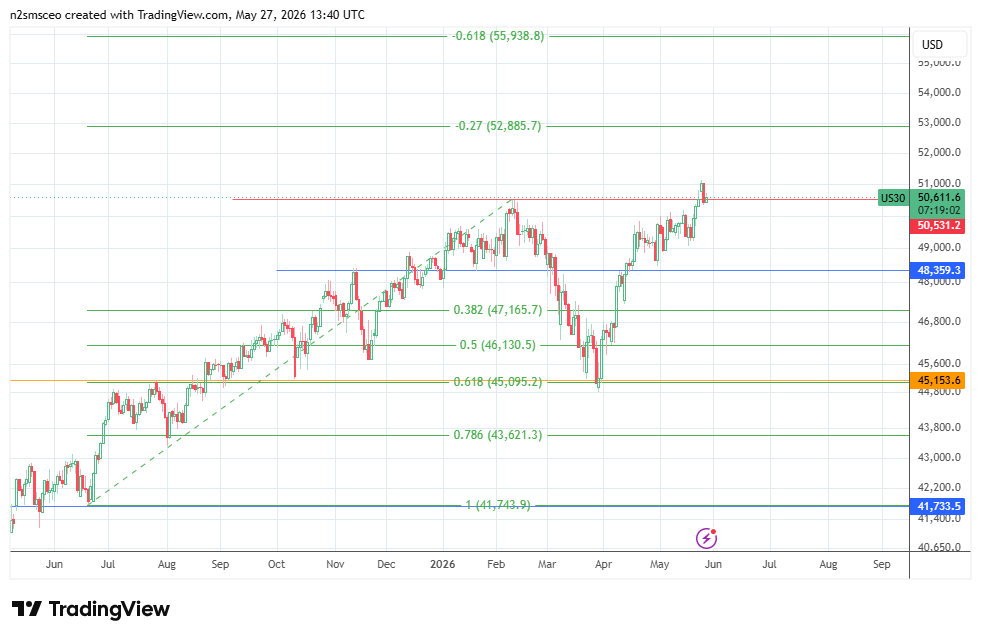
On the flip side, a retreat below the 50531 support brings the next pivot at 48359 into play as the downside target. A further decline would push towards the 46130 support, formed by the 50% Fibonacci retracement, followed by the 45153 price mark and the lows of 10 October 2025 and 31 March 2026.