



- Dow Jones holds near record highs as earnings beats collide with cautious guidance and a looming Fed decision, keeping traders selective rather than aggressively bullish.
- Heavyweight Dow components including Boeing, UnitedHealth, Microsoft, and Apple dominate earnings focus, with guidance now more important than headline EPS beats.
- DJIA trades in a late-cycle tension zone, with strong technical structure intact but upside momentum capped until earnings and Fed signals provide confirmation.
The Dow Jones Industrial Average is trading near record territory this Tuesday, with futures steady as investors digest an expanding flow of corporate earnings and position cautiously ahead of the Federal Reserve decision later in the week. US cash markets have not yet opened, but price action in futures reflects a market that is confident in earnings resilience, yet unwilling to press risk aggressively at elevated levels.
This earnings season has delivered more beats than misses, but the tone has shifted. Strong results are no longer enough on their own. Traders are increasingly focused on guidance, margins, and how corporate America is navigating a high-rate environment that shows signs of cooling, not cracking.
At the same time, record-high gold prices above $5,000 and silver trading north of $110 underline persistent demand for hedges, reinforcing the uneasy balance between risk appetite and late-cycle caution across markets.
Dow Jones Earnings Week: Results Are Good, Reactions Are Selective
This phase of earnings season is exposing a clear split inside the Dow. Companies with pricing power and operational discipline are holding up well, while more cyclical names are leaning cautious in their outlooks. The market is forward-looking now, and it is not paying up for backward-looking beats.
What stands out this earnings week is not disappointment, but restraint. Guidance is conservative, capital spending plans are measured, and executives are clearly aware that demand is holding, not accelerating. That keeps the Dow supported, but it also caps momentum near record levels.
With key Dow constituents such as Boeing and UnitedHealth reporting today, and heavyweight names like Microsoft, Apple, IBM, Caterpillar, and Honeywell on deck later this week, traders are hesitant to chase strength aggressively. This market wants earnings confirmation and forward guidance, not hope.
Why the Dow Jones Is Stalling Near 50,000 Despite Strong Earnings
What makes the current Dow Jones setup unusual is not just proximity to 50,000, but the collision of catalysts happening at once. Earnings are coming in strong enough to defend valuations, but not strong enough to silence macro doubt. Inflation is cooler, but not gone. The Fed is closer to easing, but still guarding credibility. At the same time, fiscal risk and policy headlines remain capable of flipping sentiment intraday.
That leaves the Dow suspended between conviction and caution. Buyers are present, but selective. Sellers are active, but not in control. The index is being pulled higher by momentum and liquidity, while gravity builds underneath from stretched positioning and unresolved fiscal risk. This is why price action feels compressed, reactive, and emotional. It is not indecision. It is positioning ahead of resolution.
Federal Reserve in Focus as Rate Expectations Stay Delicate
The Federal Reserve is widely expected to keep rates unchanged, but the decision itself is secondary. Markets are focused on tone, risk balance, and any signal on how confident policymakers are that inflation is cooling sustainably.
Bond yields have stabilized rather than fallen, continuing to pressure equity valuations, particularly for blue-chip indices like the Dow. A dovish tilt would support further upside, while renewed emphasis on unfinished inflation risks could trigger a sharp repricing. With growth optimism and valuation concerns colliding, the Dow remains highly sensitive to every nuance in Fed communication.
Dow Jones Technical Analysis
The daily chart continues to show a structurally strong trend, but momentum is cooling near the upper end of the range. Volatility remains elevated, suggesting expansion, not exhaustion.

Dow Jones Resistance
- 49,850 to 50,000 remains the immediate ceiling
- A sustained daily close above this zone opens the door toward 50,600
Dow Jones Support
- 49,200 aligns with short-term trend support
- 48,560 marks a deeper demand zone and lower volatility boundary
- Below that, structure weakens quickly toward the 47,800 area
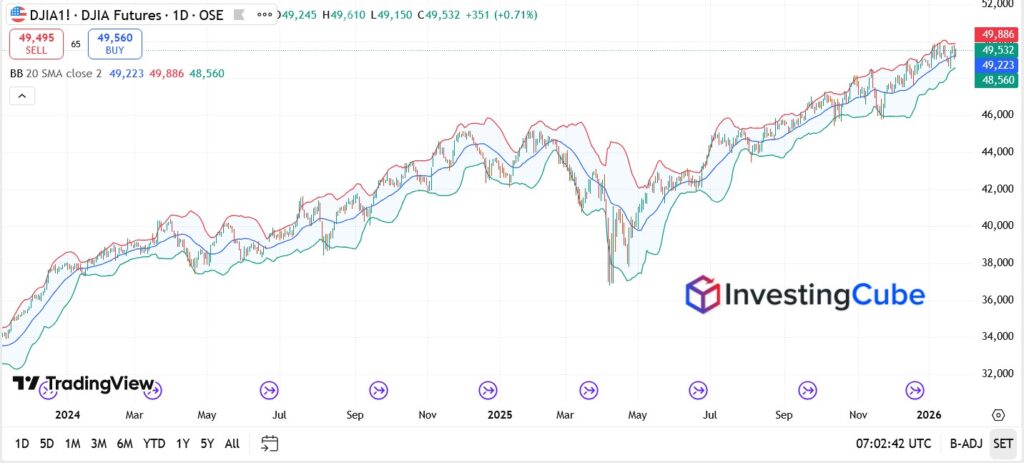
As long as price holds above 48,560, pullbacks remain corrective rather than trend-breaking.
Dow Jones Outlook: Late-Cycle Tension, Not a Trend Break
The Dow Jones is not rolling over, but it is no longer forgiving. Earnings are decent, macro data is mixed, and the Fed remains the wild card. This is the phase where positioning matters more than conviction.
Chasing breakouts into resistance has become expensive. Fading panic into support continues to work, for now. The index is compressing energy, and history suggests that this kind of tape rarely resolves quietly.
The Dow is not whispering euphoria or collapse. It is warning that the next move will punish complacency on both sides.
Possibly, but it is not guaranteed. The Dow is trading less than 1 percent below 50,000, with sentiment cautiously bullish but heavy. Immediate resistance sits around 49,500–49,600. A strong US cash open and a clean break above that zone could trigger a momentum push toward 50,000. However, elevated RSI readings suggest the risk of a near-term rejection. The index may test 50,000, but holding above it remains the bigger challenge.
Markets appear to have largely priced in relief after tariff threats linked to the Greenland issue were dialed back. That has helped stabilize futures ahead of the US open. However, headline risk remains elevated. Any surprise policy shift or social media update during trading hours could still trigger sharp intraday volatility, even if the broader trend stays intact.
The 49,500 area is increasingly seen as a battleground, not a confirmed breakout. With the temporary US spending bill set to expire at the end of January, debt ceiling risk is starting to compete with the Dow 50,000 narrative. Some institutional desks expect the index to be drawn toward 50,000 first, followed by higher volatility or a correction if fiscal negotiations deteriorate into February.