


- The FTSE 100 remains under pressure below key technical levels, despite pockets of strength from earnings in major sectors.
- Upcoming earnings releases will be crucial in determining whether the index stabilizes or extends its downside move.
London’s equity benchmark FTSE 100 edged higher on Tuesday, trying to end its six-day losing streak. This move took place after BP’s stronger-than-expected first-quarter revenues, which lifted energy stocks. The blue chip FTSE 100 index rose 0.4% to 10,367.61 early yesterday. On the other hand, the mid-cap FTSE 250 slipped by 0.2% for the fourth day in a row.
The FTSE 100 is considered an energy- and commodity-heavy index, with a high concentration of large-cap oil, gas, and mining companies. This has allowed the index to benefit from the surge in crude oil prices, as many of its constituents, particularly the major players, reported stronger-than-expected profits in the first quarter of 2026.
Higher crude oil prices mean higher profits for oil, gas, and mining companies. The BP shares rose 3.1% after reporting its first-quarter profit of $3.3 billion. It’s more than doubled year-on-year. Rival Shell edged higher by 2.3%, with analysts expecting a solid year-on-year performance.
On the other hand, Tullow Oil (TLW.L) jumped 12% as the company signaled stronger-than-expected production, forecasting full-year output at the top end of its guidance following a solid start to the year.
The extended rally in crude oil prices is being driven by ongoing tensions between the US and Iran, as well as uncertainty surrounding the situation in the Strait of Hormuz. Higher oil prices for a longer time will reinforce the bullish case for oil & gas producers. On the one hand, rising energy prices support oil producers’ revenues. On the other hand, their profitability remains highly sensitive to fluctuations in underlying commodity prices.
The largest British lender, Lloyds Bank, reported on Wednesday that its first-quarter earnings rose by 33%, beating analysts’ forecasts. This surge in earnings, driven by increasing lending income, offset a 151 million pound charge. These charges reflected a deterioration in the economic outlook due to the Iran conflict
FTSE 100 Technical Outlook:
Despite solid earnings in the energy sector, the FTSE 100 remains trading below its long-term moving average; however, it did manage to tick higher yesterday, snapping a six-day losing streak.
The UKX (FTSE 100) is currently in a complex technical environment with strong fundamental support from commodity heavyweights coming up against a broader bearish trend.
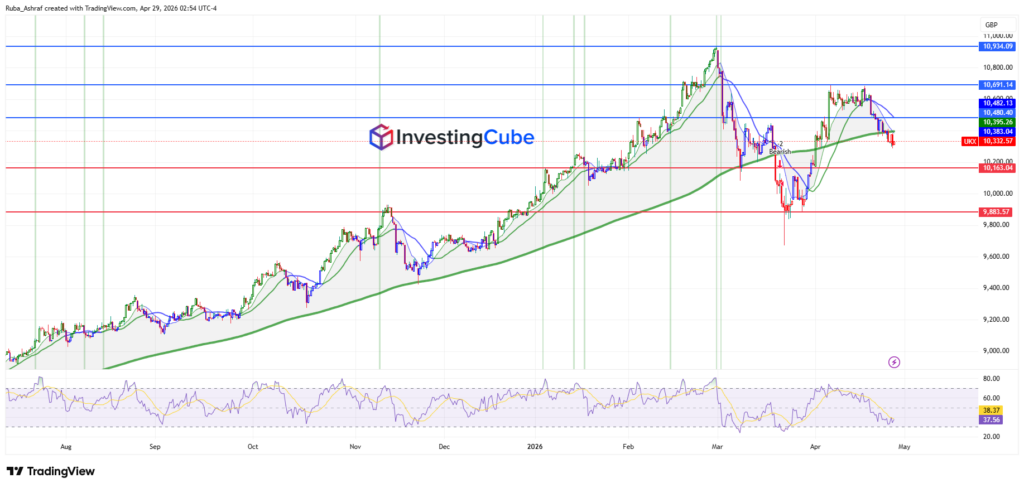
From a technical perspective, the broader trend had been bullish, as seen in the steady climb supported by the long-term moving average. That structure, however, has been challenged after the sharp sell-off from the recent highs near 10,900, which marked a clear shift in momentum.

At the time being, price action is struggling around the 10,380-10,400 area. This area acts as an immediate resistance zone. The index is also trading below the short-term moving averages, which are turning lower. This indicates that near-term momentum remains bearish.
Looking at the RSI, it is trending lower and currently sits in the high-30s, indicating weak momentum, but it’s not in oversold territory. This leaves room for further downside if selling pressure persists.
Potential Scenarios:
Bearish scenario: A sustained break below the 10,380 level and the long-term moving average could open the door for a move toward 10,163, with further downside extending to 9,883 if bearish momentum accelerates.
Bullish scenario: if the price manages to hold above the long-term moving average and reclaim the 10,480 resistance level, this could signal a recovery toward 10,690 and potentially a retest of the highs near 10,934.
The energy sector is providing a temporary floor, but the technicals say the index is not “out of the woods” just yet. Watch for a confirmed close above the 200-MA on the daily to call the bearish trend over.
Earnings Watchlist (Late April / May 2026):
Traders have to keep an eye on these upcoming releases, which will likely determine if the index can finally reclaim that 200-MA:
- SSE PLC: (Utilities/Renewables Sector) This will show if the “green energy” transition is offsetting high grid costs.
- Taylor Wimpey: (Real Estate Sector) This will validate an early warning sign of how high interest rates are impacting the UK consumer.
- Standard Chartered: (Banking Sector) Key for understanding global trade sentiment and EM exposure.
Earnings releases influence the FTSE 100 by affecting the share prices of its constituent companies. Strong results from major firms can lift the index, while weak earnings may drag it lower.
The FTSE 100 is heavily influenced by sectors like energy, financials, and mining. Earnings from large companies in these sectors often play a key role in driving the index’s overall performance.