


- The EUR/INR has the potential for a limited upside push amid the renewed geopolitical escalation in the Middle East.
Current Setup and Live Chart
The EUR/INR is trading within a regime of diverging monetary policy expectations between the European Central Bank and the Reserve Bank of India. Additionally, the Euro’s sensitivity to Eurozone growth and the rupee’s responsiveness to India’s resilient economic outlook are expected to play a role in determining the monetary policy path and guiding markets towards the pair.
The European Central Bank (ECB) recently hiked rates by 25 bps. The single area is also noted for being a net energy importer, but with less exposure to India’s oil markets due to the diversification of its energy import sources (it does not get its oil via the Strait of Hormuz). India is the 3rd-largest net oil importer in the world and receives its imports via the Strait of Hormuz. This renders India more sensitive to elevated oil prices than the Eurozone. However, the rupee is backed by its current strong domestic growth outlook and intervention by the Reserve Bank of India (RBI).
The EUR/INR closed the week slightly lower, but remains in a recovery trend following the bounce from the 106.98 support. It ended the week at 108.87.
EUR/INR Macro Drivers
1) ECB Monetary Policy Expectations
The ECB recently hiked its interest rates. However, the latest commentary from ECB policymakers, especially ECB Chair Christine Lagarde at the Sintra central bankers forum, indicates that the apex bank will maintain a data-dependent approach to future policy decisions as inflation gradually inches towards its targets. This is a sign that the ECB may not adjust rates for some time. Apart from monetary policy, markets will also be looking at Eurozone inflation, the Eurozone’s growth outlook, and labor market conditions as potential determinants of the Euro’s price direction.
2) India: A Story of Economic Resilience
India is in a phase of strong growth, as the country invests heavily in upgrading its domestic infrastructure and domesticating its procurement in areas such as defense and power generation. India is one of the fastest-growing major economies, despite the market upheaval created by the oil-shock risk premium. The uptick in domestic consumption is driving strong demand, allowing manufacturing activity to expand to meet it. The country’s GDP growth is also robust, and the recent RBI stimulus is expected to attract strong foreign investment (both direct and portfolio-based). The rupee is expected to receive structural support from these factors.
3) Oil Prices

Both the EU and India rely on energy imports. However, India is more susceptible to the effects of elevated oil prices due to its near-total dependence on shipping through the Strait of Hormuz. The recent escalation in the conflict following the 3-week truce between the US and Iran threatens to reimpose the oil shock risk premium. Higher energy prices raise India’s import bills, increase demand for the Euro and US Dollars via the flight of foreign portfolio funds from local stock markets, and require sourcing additional FX to pay for higher energy import bills. Inflationary pressures and a wider current account deficit are secondary effects. Oil prices are a key factor in determining the price of EUR/INR.
Near-Term Price Catalysts
1) Eurozone economic data: Key data such as the PMI surveys, flash inflation estimates, and industrial production are key macroeconomic indicators that will shape ECB policy expectations and consequently, the Euro.
2) Indian inflation and growth data: On the Indian side of the equation, growth and inflation data will be part of domestic macro releases that could provide clues regarding RBI policy and the direction of future capital flows.
3) Oil prices: the susceptibility of the Eurozone and India to oil price movements is well noted, with India showing more vulnerability. The oil price movements will directly impact the rupee’s performance in the near term.
EUR/INR Forecast Scenarios
Base case: a neutral-to-mildly bullish EUR/INR is expected, as relative Euro stability amid elevated oil prices is likely to provide modest support. At the same time, India’s strong macroeconomic fundamentals exert a counterbalancing influence, capping the upside move. Furthermore, Europe’s susceptibility to elevated oil prices means that the single currency cannot exert a strong upside push on its own when pitted against the rupee, unlike the US Dollar, which benefits from higher oil prices.
Bull case: stronger-than-expected Eurozone data prints and a sharp rise in oil prices (more damage to the rupee’s side than Euro support) will produce a bull case scenario.
Bear case: the trigger here will be softer Eurozone data, declining oil prices, and stronger Indian macroeconomic releases. Furthermore, any supportive moves from the RBI could reinforce this scenario and force the EUR/INR lower.
EUR/INR Technical Outlook
The pair is now testing the trendline breached by the 18 June candle, which now serves as dynamic resistance. If the bulls can take out the trendline and the 110.25 resistance formed by the prior highs of 27-30 January 2026, the next target will be 112.58, where the 27% Fibonacci extension of the 22 October 2025 – 22 January 2026 upswing is located. This is also the site of the recent highs of 12-21 May 2026. Further continuation of the uptrend will follow the uncapping of this barrier, unlocking access to the 115.56 resistance (61.8% Fibonacci extension).
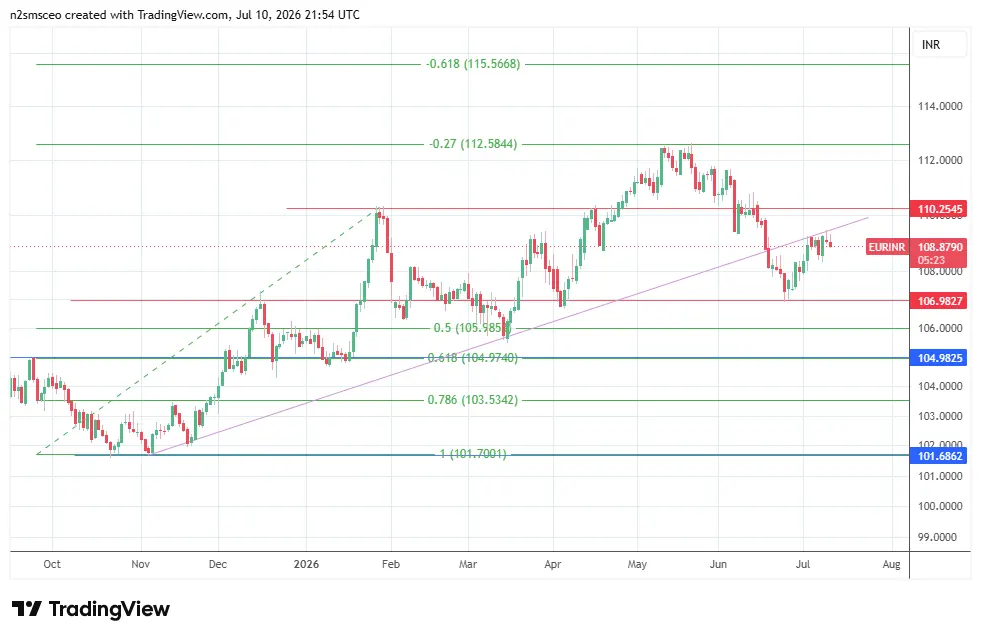
On the flip side, rejection at the trendline and downside extension targets the 24 June 2026 low at 106.98. If this support buckles under bearish pressure, the next downside target is 105.98, the 50% Fibonacci retracement level. Below this level, the 24 September 2025 high and the 8 January/15 January double bottom at 104.97 become the next viable targets.