




- Risk-associated assets sold off sharply in the aftermath of the Fed rate decision that is now pointing to a potential end-2026 rate hike.
On Wednesday, 17 June 2026, the US Federal Reserve delivered its first interest rate decision under new leadership. The Federal Reserve released a more hawkish-than-expected policy outlook. As a result, financial markets experienced heightened volatility as investors and traders were forced to reassess their outlooks on interest rates and other assets.
As expected, the Federal Open Market Committee (FOMC) did not alter the interest rates. However, policymakers effectively signaled a rate hike later in the year due to persistent inflationary pressures.
US bond yields rose sharply, prompting renewed demand for the US dollar and US-denominated assets. Equities sold off, leading to declines in the major US indices as traders repriced interest rate expectations toward the hawkish side.
How the Fed Rate Decision Shifted Markets
The main driver of today’s market action was the Fed’s updated policy outlook, the dot plot.
The updated guidance now calls for at least one rate hike towards the end of 2026, indicating policymakers’ concerns that inflation remains a key risk despite a robust labor market and economic growth. The market expectation had been for the Fed to provide a clearer pathway to rate cuts, given the dissipation of the oil-shock risk premium following the US-Iran truce announced over the weekend. Instead, the Fed doubled down on its hawkish stance at the last policy meeting, reinforcing its message of restoring price stability and its resolve to keep financial conditions restrictive should inflation fail to hit the Fed’s target.
The Fed Decision and Specific Assets
a) Nasdaq 100
Technology and growth stocks sold off as rising US bond yields made long-term growth assets less attractive relative to bonds. This forced investors who were long these stocks to bank profits from the recent tech- and AI-stock-driven rally, once more highlighting the sensitivity of these stocks to interest-rate expectations.
b) Treasury Yields

The US 10-year Treasury Note surged in direct response to the repricing of interest rate expectations towards the hawkish end of the spectrum. Typically, bond yields rise when the Fed indicates that monetary policy will remain restrictive for longer than traders had previously anticipated. As Treasury yields rise, equities tend to come under pressure, especially in technology and other risk-sensitive sectors.
c) US Dollar
The US dollar typically benefits from hawkish repricing, and this occasion was no different. Typically, hawkish repricing draws capital from international equities and emerging market FX towards the US Dollar and USD-denominated assets.
d) Gold
The situation with gold is not usually straightforward, as it is currently caught between two macroeconomic drivers. On the one hand, gold is heavily sensitive to geopolitics. The current geopolitical mood is de-escalatory, following the announcement of the US-Iran truce. This is a gold-positive event. On the other hand, hawkish repricing of Fed rate expectations and the attendant rise in US bond yields are supposed to draw capital out of the non-yielding metals.
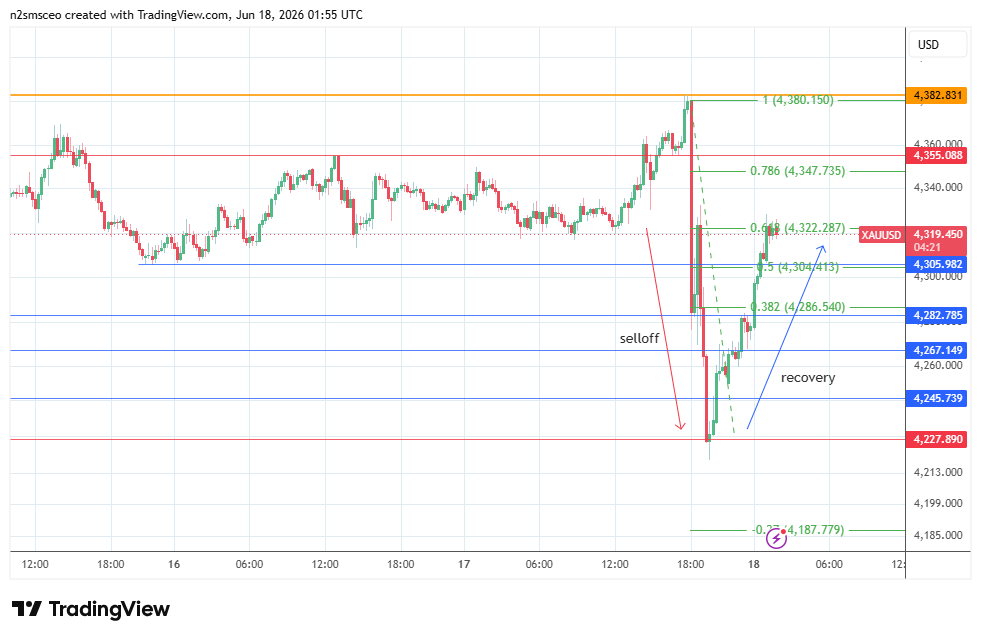
FedThe price action seen so far has shown a knee-jerk sell-off in gold, but this has been followed by a near-total recovery in the hours following the Fed rate decision. The direction of gold ultimately will be decided by which of the two competing macro drivers wins out.
Takeaway
The overriding sentiment following today’s Fed rate decisions is for a higher-for-longer interest-rate environment. Economic growth and the US labor market remain strong and resilient. Still, the Fed’s concern about inflation has led to a stance that has reduced expectations for near-term policy easing.