



- Brent crude maintains its position between $95-$96, leaving it on the edge of its stringest weekly performance since mid-July.
Current Setup and Live Chart
Bias: bullish.
Brent crude surged this week to the $95–$96 per barrel price zone. It is on track to post its strongest gains since US-Iran hostilities renewed at the end of the ceasefire framework in mid-July. The strong upward push stems from market perception of a prolonged supply disruption due to the closure of the Strait of Hormuz.
This week, the US resumed selected strikes on Iranian targets, worsening the geopolitical risk premium. A Reuters report indicates that half of the world’s crude oil is produced in zones currently affected by conflict. The ongoing conflict has not only reduced production but has also impacted shipping to the world’s largest energy-consuming nations.
Production in other areas is also suffering. Rystad Energy reported that Canadian oil sands production may drop by 300,000 barrels per day due to maintenance activities. Crude oil inventories are at 12-month lows, making it hard to offset such production shortfalls.
Primary Drivers of Brent Crude
1) Strait of Hormuz disruption
Shipping traffic through Hormuz remains in a disrupted state. Latest shipping reports indicate that shipping traffic remains below its 10-day average. This week, Kpler data indicates that only two large vessels have crossed the Strait, far below pre-war levels. This factor is now the largest driver of the geopolitical risk premium.
2) Renewed US-Iran escalation
The latest military exchanges between the US and Iran that occurred this week have been the most intense in recent months. This raises fears of potential damage to energy infrastructure, which could further shutter regional exports.
3) Inventory Depletion

With production and shipping shortfalls, depleted inventories mean there isn’t enough stored crude to offset these supply-side deficits. The latest US EIA Crude Oil Inventories report showed a shortfall of 4.5million barrels, a sharp drop from the 100,000 barrels seen in the week ended 21 August 2026. Market consensus had seen only an inventory deficit of 400,000 barrels. A prolonged disruption will further strain already depleted inventories.
Brent Crude: What Matters Next
The primary price catalyst for Brent crude remains the shipping traffic data through the Strait of Hormuz. Data showing stronger shipping flows could push prices down to $90 per barrel or lower. Attacks targeting energy infrastructure, or data showing further declines in traffic, could push Brent to $100 per barrel.
Kpler publishes ship tracking data and is a resource for tracking shipping flows across Hormuz.
Brent Crude: Weekly Forecast Scenarios
Base case: Brent crude remains supported above $90 as long as the status quo persists. Price could remain in the $95-$96 range, with volatility producing wicks that could extend ±$2 from the $95 median.
Bull case: disruption intensifies, which could see Brent break above $100. Escalation of military strikes and damage to energy infrastructure could push Brent toward $105.
Bear case: credible de-escalation and the restoration of shipping across Hormuz could unwind the geopolitical premium, sending Brent lower toward $85–$90.
Brent Crude: Technical Outlook
The trendline maintains dynamic support that has held since 2 July. As long as price stays above the 86.34 support, the current uptrend holds. Bulls need to break 97.72 resistance to open the path to reclaim the 23 July high at 102.00. Above this level, the bulls have a clear path to the 4 May high at 114.86.
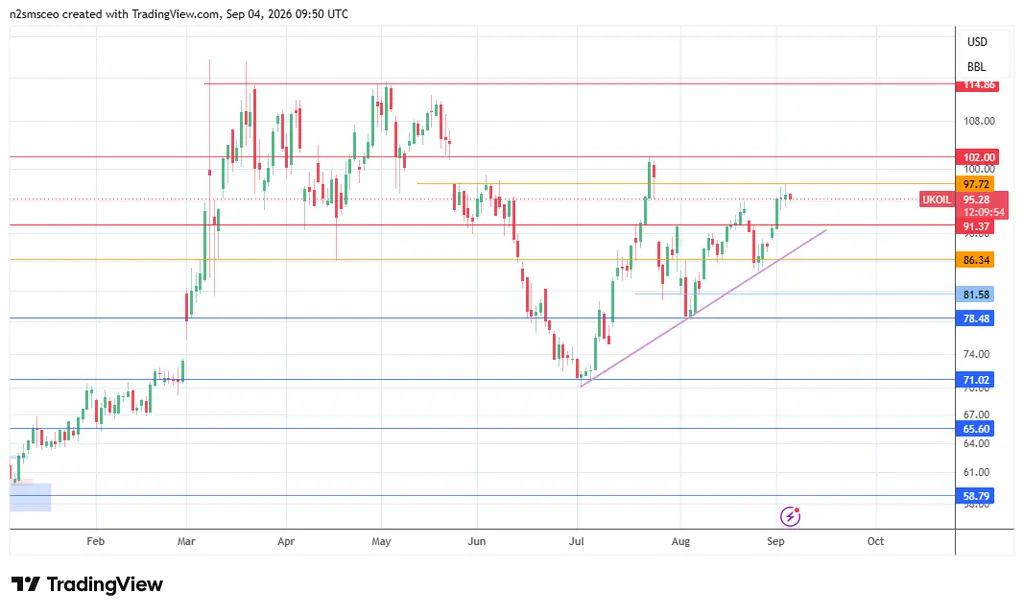
On the flip side, a retreat below the 86.34 support and trendline makes a case for a retrace towards 81.58 (28 July low), leaving the 78.48 low of 5 August as a further downside target on a deeper pullback.