



- Amazon shares plummeted as much as 9% on Friday, February 6, following the revelation of a massive $200 billion capital expenditure plan for 2026, a 50% jump that far exceeded Wall Street's expectations.
- Despite the sell-off, Amazon Web Services (AWS) delivered its fastest growth in 13 quarters, with revenue surging 24% to $35.6 billion.
Why Amazon Stock Fell 9% Despite Strong Earnings Results
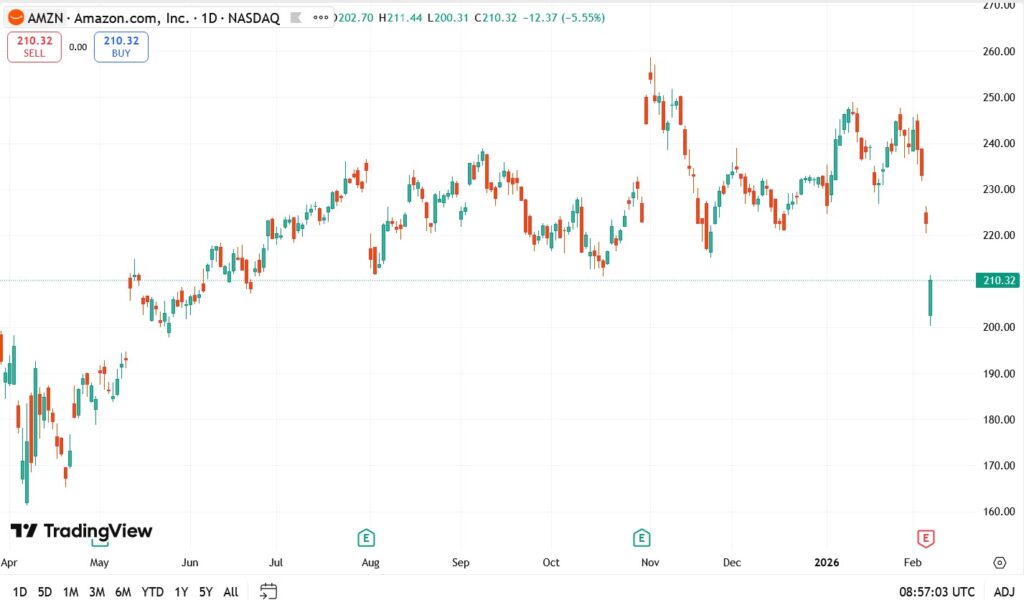
Since the start of 2026, the Amazon (AMZN) price chart has transformed into a high-stakes battlefield. After trading near a 52-week high of $258.60 in late January, the stock experienced a sharp “jaw-dropper” on Friday, February 6, tumbling as much as 9% to a low of $200.31. This crimson-tinted sell-off effectively wiped out the gains of the new year, leaving investors to grapple with a stark reality: Amazon didn’t have an earnings problem this quarter; it had a “price-tag” problem.
As reported by Reuters, the reason for this sudden descent lies in valuation fatigue. While the company posted a record-breaking top-line beat of $213.4 billion, the market is no longer rewarding “nice” quarters; it is demanding proof of returns.
The current dip reflects a “January hangover” where the euphoria of 2025 has been replaced by cold investor anxiety over whether Amazon’s aggressive infrastructure blitz can actually meet the astronomical expectations set for the 2026 fiscal year.
Why Big Tech Is Spending $650 Billion on AI Infrastructure in 2026
This massive outlay is part of a broader “mind-boggling tide of cash” sweeping through Silicon Valley. As reported by Bloomberg, Amazon’s $200 billion target contributes to a combined $650 billion capital expenditure forecast for 2026 across the “Big Four”, Alphabet, Amazon, Meta, NVIDIA and Microsoft.
To put the scale into perspective, each of these companies is projected to spend more in 2026 alone than they did over the previous three years combined. This level of investment has no parallel this century, rivaling only the historic build-outs of the US railroad networks in the 19th century or the interstate highway system.
For investors, the concern is no longer just Amazon’s balance sheet, but whether this collective “winner-takes-most” sprint for AI dominance is creating a capital-heavy trap that will distort broader economic data for years to come.
AWS Cloud Expansion Signals Long Term Upside for Amazon Stock
To understand why Amazon remains a favorite for long-term bulls despite the price drop, one must look at the “star” of its portfolio: AWS. The cloud unit achieved a rare feat in Q4, with growth accelerating to 24%, outpacing even the company’s booming advertising business. AWS is no longer just a storage platform; it is becoming the “operating system” for Physical AI.

By doubling its power capacity and securing massive agreements with the likes of BlackRock and the U.S. Air Force, Amazon is positioning itself to monetize AI at a scale its competitors are struggling to match.
Amazon Technical Forecast
From a technical lens, AMZN is testing a critical support zone that could define its trajectory for the rest of Q1.
- Immediate Support: $200.31. This level (the February 6 low) is the current fortress for the bulls. A daily close below this could signal a slide toward the $185.00 psychological floor, invalidating the 2025 uptrend.
- Resistance Zone: The stock is currently capped by the 9-day EMA at $222.69. To regain its bullish mojo, the pair must reconquer this level and aim for the pre-earnings “gap-fill” at $235.00.
Conclusion: The 2026 Verdict
Amazon’s 9% slide is a high-stakes “reset” that has washed out much of the late-2025 hype. While the $200 billion capex plan and the light operating profit guidance present genuine headwinds, the fundamentals of the AWS reacceleration suggest the company is far from reaching its ceiling.
For investors, the current dip below $210 will be remembered as the ultimate litmus test: if Amazon can prove that its AI infrastructure can generate the $20 billion in incremental FCF predicted by UBS for 2028, this correction may be viewed as the best entry point of the year.
Despite record revenue, shares tumbled nearly 10% because of an unprecedented $200 billion spending plan for 2026. Investors are worried that this aggressive AI build-out will crush the company’s free cash flow in the short term.
Yes, Wall Street analysts largely view the current 9% post-earnings decline as a prime buying opportunity. While the record $200 billion capex plan for 2026 caused temporary fear, Amazon Web Services (AWS) is accelerating with its fastest growth in 13 quarters. With the stock now trading at its cheapest forward P/E in a decade, firms like Bank of America and Citi maintain “Buy” ratings with price targets up to $300.
Despite the 9% post-earnings plunge, the consensus among Wall Street analysts remains a “Strong Buy.” While the record-breaking $200 billion capex plan for 2026 has spooked short-term investors worried about free cash flow, institutional firms like Bank of America and Wedbush have reiterated their bullish outlooks, with price targets ranging from $275 to $310.