



- HSBC share price continued its strong sell-off this week.
- The company published encouraging financial results.
- The stock is approaching a death cross pattern.
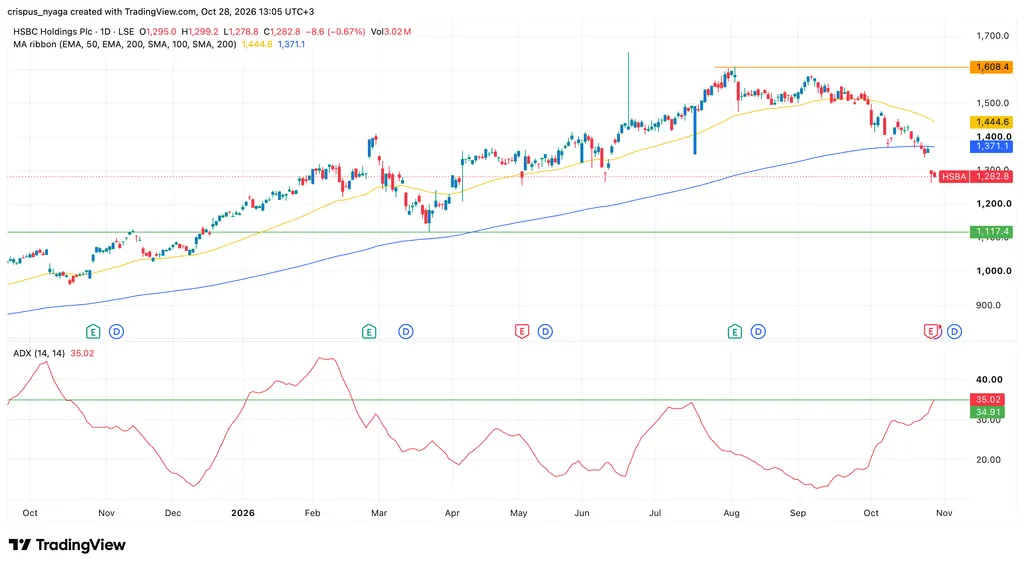
HSBC share price dropped for the second consecutive day as market participants reacted to its financial results. It tumbled to 1,281p, its lowest level since June and 20% below the year-to-date high, a sign that it has moved into a technical bear market. It is also nearing a death cross, suggesting it has more downside.
HSBC Share Price Technicals Suggest it Has More Downside
The daily chart shows that the HSBC stock has been in a strong sell-off this month, with the situation continuing to get worse. A closer look shows that the spread between the 50-day and 200-day Exponential Moving Averages (EMA) has continued to narrow, suggesting that a death cross may happen soon. A death cross often leads to more downside over time.
More technicals points to more weakness. The Average Directional Index (ADX) has jumped to 35, its highest point since February 16. A soaring ADX indicator is a sign that the downward momentum is accelerating. The Relative Strength Index (RSI) has continued falling.
Therefore, the path of the least resistance for now is bearish, with the next important target being 1,200p. A move below that level will point to more downside, potentially to the key support of 1,117p, its lowest level in March this year.
Eventually, the stock will bounce back since the company has more upside, thanks to its high dividend yield and its gaining market share in Asia.

READ MORE: Palantir Stock Near $200 Ahead of November 2 Earnings as US Growth Faces Test
HSBC Stock Dropped Despite Solid Earnings
The ongoing HSBC share price retreat has coincided with its recent financial results, which showed that its business continued improving last quarter. Its profit before tax (PBT) rose by $2.3 billion to $9.6 billion. This increase was partly because the company announced a $1.4 billion legal provision last year.
HSBC made over $18.6 billion in revenue during the third quarter, with its net interest margin hitting 1.57%.
Therefore, the stock is likely falling because of the company’s rising costs. While its operating expenses improved to $8.8 billion, this was because of the non-recurring legal provision. The management blamed the costs to the rising inflation, higher spending on technology and its performance-related accrual. HSBC expects that its NII will be at least $46 billion this year.
Fundamentally, HSBC, under Georges Elhedery, seems like an ideal investment. It has a dividend yield of 4.36%, higher than other UK banks. Also, the company continues to reduce its outstanding shares through buybacks, while the Basel 3.1 standards will help it benefit by between 40 and 50 basis points. It announced a new share buyback plan on Tuesday.
READ MORE: Lloyds Share Price Technical Analysis: 100p Holds Firm Ahead of Budget Week and Q3 Results