


- The Glencore share price could remain supported after the company's stellar earnings report and rising industrial metal prices.
Current Setup and Live Chart
The Glencore share price is currently being dictated by two of the currency market’s biggest trends:
- A long-term structural demand for industrial metals, powered by the global energy transition.
- The geopolitically driven elevation in commodity prices
The UK-based company has a highly diversified commodity portfolio, with exposure to both mining interests (cyclical) and counter-cyclical trading opportunities. It has just reported first-half core earnings of $10.1 billion and shareholder returns of $3.5 billion.
Within the context of current geopolitical uncertainty and volatility in energy markets, the structural demand for traditional and industrial metals continues to play into the company’s strength. Chinese economic activity is a principal driver of the company’s mining business. Ongoing industrial demand amid the geopolitical tensions makes the company’s stock an excellent defensive play during periods of market disruption. The company’s investment profile in copper coal and other industrial metals give it a balanced risk profile that allows the Glencore share price to find support even in the face of geopolitical uncertainty.
The Glencore share price reflects the benefits from the company’s diversification via its unique business model: dual earnings from a diversified mining portfolio and a vibrant commodity marketing/trading division. The recent volatility from the geopolitical crisis has caused severe price swings in the metals and energy markets. This has provided a supportive environment for the company’s trading desk. Currently, the company’s stock is range-bound, testing highs last seen in December 2022.
Macro Drivers for the Glencore Share Price
1) Commodity Trading
Glencore’s commodity trading desk remains a significant driver of the company’s profits. The trading desk has generated significant revenue from the elevated volatility of many assets, such as crude oil, copper, coal, zinc, nickel, and refined products. The renewed geopolitical tensions in the Middle East have created tremendous trading opportunities, providing stronger-than-normal trading revenue. Glencore’s trading desk earnings diversification gives the company an advantage that several of its peers and competitors do not possess, which is a supportive factor for the Glencore share price.
2) Copper Demand: A long-term Investment Case
Strategically, copper remains one of Glencore’s most important metal plays. Demand for copper continues to be driven by rapid investment and expansion in AI data centers, as well as the electricity grid expansion being undertaken by many countries. Rapid expansion in EV production and development of new renewable energy infrastructure projects continues to drive demand for the red metal. Many emerging markets are also undergoing rapid development, with increased demand for the metal in construction projects. Near-term prices for copper, now at record highs, continue to be influenced by Chinese economic activity. Institutional investors continue to view copper pricing within the context of the long-term investment case, which makes this metal one of Glencore’s strongest structural commodity products.
3) Coal Business: Major Earnings Contributor
The Glencore share price continues to benefit from coal being a major component of its earnings. The global transition towards clean energy appears not to have impacted coal’s contribution to the company’s business model and earnings profile. The geopolitical situation in the Middle East, which has led to a rise in energy prices, appears to have supported thermal coal pricing. This has been attributed to utility companies prioritizing energy security. As long as coal cash flows remain strong, the company’s ability to conduct share buybacks and dividend distributions is enhanced. Furthermore, investments in traditional metals could be boosted by the substantial cash flow currently being generated from the company’s coal business emissions.

4) Demand from China
Chinese demand is currently seen as the biggest macro driver for the Glencore share price. China is the world’s largest importer and consumer of industrial metal ores and is therefore responsible for a significant portion of the company’s revenue base. Markets will continue to monitor Chinese data around infrastructure spending, manufacturing PMIs, industrial production, property market insights, and any fiscal stimulus measures targeted towards industries and the property market.
A boost in Chinese economic activity potentially improves demand expectations for copper, zinc and nickel. However, weaker Chinese growth is a headwind for Glencore’s mining earnings, despite the company’s stellar trading income.
Glencore Share Price Catalysts
1) Chinese economic data: The most important near-term price catalyst. The Chinese government recently announced policy support. Markets will assess the extent to which this support translates into stronger industrial demand. A boost in Chinese industrial activity would be seen as supportive of the company’s revenue from mining operations; a potential share price booster.
2) Commodity prices: Specifically, the prices of copper, coal and Brent crude will continue to be viewed closely with a view on how they impact Glencore’s mining revenues. Data that suggests broad-based upticks in commodity prices would improve earnings expectations.
3) Geopolitics: The commodity markets have seen increased volatility due to the geopolitical tensions in the Middle East. A further escalation presents arbitrage opportunities for the company’s trading division, as well as opportunities tied directly to rising oil prices and freight costs. Periods of elevated commodity market dislocations have proven to be periods of boost for Glencore’s marketing division.
Glencore Share Price: Forecast Scenarios
Base case: moderate bullishness within the consolidation range, which keeps the Glencore share price at the upper end of this range. This comes on the back of a resilient energy market amid steady demand for industrial metals, supporting the company’s diversified earnings profile.
Bull case: rising copper prices amid stronger Chinese industrial demand, with additional backup from Chinese government stimulus. Additionally, stronger-than-expected commodity trading performance by Glencore’s trading desks will boost earnings already made from rising copper prices.
Bear case: sharply declining metal prices and downbeat Chinese economic data could prove instrumental for a sharp retracement below the range’s lows. This case is further strengthened if geopolitical tensions de-escalate or trading conditions around commodities weaken. Softer copper prices also make this scenario more likely.
Glencore Share Price: Technical Outlook
The weekly chart indicates that the price remains in a consolidation following the uptrend move from the 78.6% Fibonacci retracement level and the 7 April 2025 low at 209.80. The price boundaries of the consolidation area are at 499.55 and 603.4.
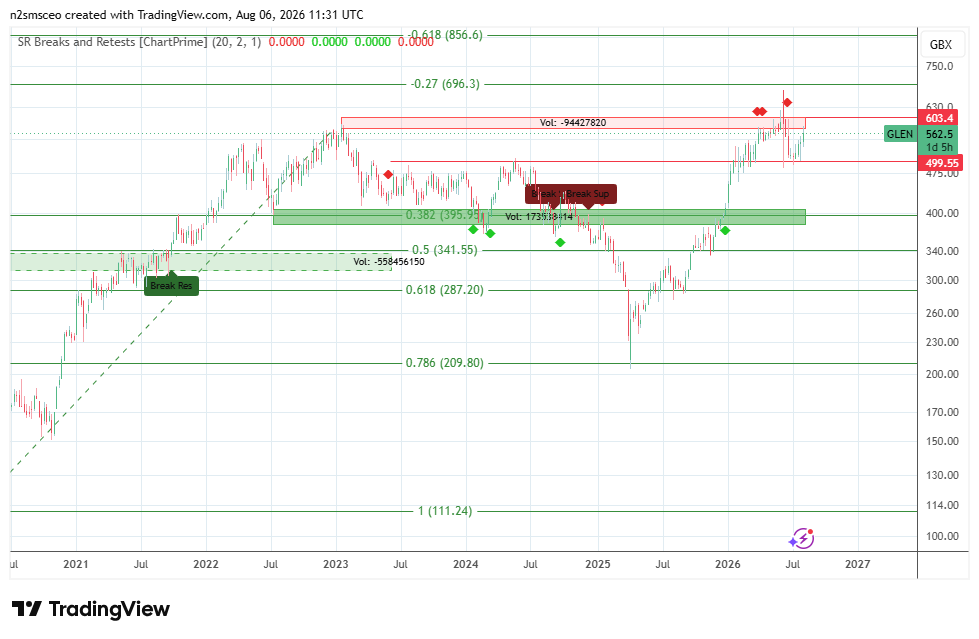
The brief violation of the upper boundary of the supply zone found support at the 499.55 price mark, making this the downside level to beat. A retracement to the 38.2% Fibonacci level at 395.95 has to follow a breakdown of this pivot. Additional support lies at the 50% Fibonacci retracement at 341.55.
On the flip side, a break of the 603.4 barrier enables a potential push towards the 27% Fibonacci extension at 696.3, with 856.6 serving as the next potential resistance, being the 61.8% Fibonacci extension.