



- The outlook for the Barclays' share price remains constructive even as investors question revenue growth in the face of rising costs.
Current setup
Barclays share price is currently trading within a constructive fundamental outlook. However, expectations around interest rates, capital returns, and costs are increasingly under investor scrutiny, given the recent earnings results.
The bank’s H1 2026 results, published on 28 July showed strong earnings. However, investors are now seeking validation that increased investments and operating costs are producing a corresponding increase in revenue growth. This led to a more nuanced reaction in Barclays’ share price to the interim report.
The UK banking sector remains constructive as UK interest rates remain at 3.75%. Several MPC members wanted a rate hike to 4.0% due to inflationary risks from the Middle East geopolitical conflict, which drove oil prices higher. This relatively hawkish tilt means rates may stay higher for longer, which typically supports UK banking stocks that depend on mortgage rates and lending fees as part of their revenue base.
Barclays Share Price: Current Macro Drivers
1) Investment Banking Earnings
Barclays operates a diversified business model that goes beyond retail banking. One earnings diversification channel is investment banking. The investment banking division is actively engaged in sell-side activity covering global equities, debt instruments, and the US markets. It is also involved in corporate finance and mergers/acquisitions. The bank’s recent earnings call shows strong contributions from the investment banking division. Barclays is therefore not just a UK retail banking or mortgage-bank story. Rather, it is a robust investment thesis that incorporates these, along with investment banking and US consumer exposure, in an environment of strong capital market activity.
2) Interest Rates Environment
The Bank of England voted to leave rates at 3.75%, with at least 3 policymakers even voting for a 25bps rate hike. This leaves funding and lending rates in the UK at relatively high levels, supporting UK banks’ net interest income. But this can be a double-edged sword. If rates stay high or rise further due to imported inflation from the geopolitical risk premium, this could squeeze disposable incomes and make mortgages less affordable. This could also negatively impact business borrowing, consumer credit, and credit quality.
3) Middle East Geopolitics
The US-Iran conflict escalated two weeks ago after the ceasefire ended. This presents material complications for the UK’s macroeconomic outlook. The BoE now identifies volatility in energy prices as a primary source of this macroeconomic uncertainty because of the impact on the inflationary outlook. Despite a fall in UK CPI to 2.6% YoY, higher energy prices are expected to seep into the economy later in the year and raise inflation. Higher inflation keeps bank rates higher and could support the Barclays share price due to the positive impact on net interest income. But as identified earlier, higher rates make mortgages less affordable, reduce disposable income, and increase credit risk. This makes geopolitics a double-edged sword for the Barclays share price.

4) Costs and Barclays’ Valuation
The market had a muted response to Barclays ‘ recent earnings result. This shows growing investor concern about how ballooning costs will translate into the bank’s future revenue growth. The bank will need to show that revenue growth will remain strong despite higher spending on investments and operating costs. If investors see costs outpacing revenue, this could compress valuations even with upbeat headline profits.
Barclays’ Share Price Catalysts
1) UK interest-rate expectations: There was a hawkish tilt in the BoE MPC vote at the July meeting. This tilt has increased the importance of upcoming data on inflation, the average earnings index (wage inflation), and energy-price-dependent data. If BoE rate expectations are repriced more hawkishly, this is deemed supportive of Barclays’ share price. However, if UK growth is priced lower and rate expectations shift dovishly, this could lead to bearish sentiment on Barclays’ share price.
2) Credit quality: persistence of the geopolitically motivated energy risk premium will eventually lead to imported inflation, which will leave the BoE with no choice but to keep rates higher for longer. This will eventually feed into household disposable income and corporate earnings. For UK banks such as Barclays, credit-risk losses could outweigh interest income from higher rates.
Barclays Share Price: Technical Outlook
A trace from the 7 April 2025 swing low to the 9 February 2026 swing high has 573.7 as the 27% Fibonacci extension level. This is the upside target for the bulls in record territory if they can force the bounce from 488.05 to uncap the current barrier at 531.2.
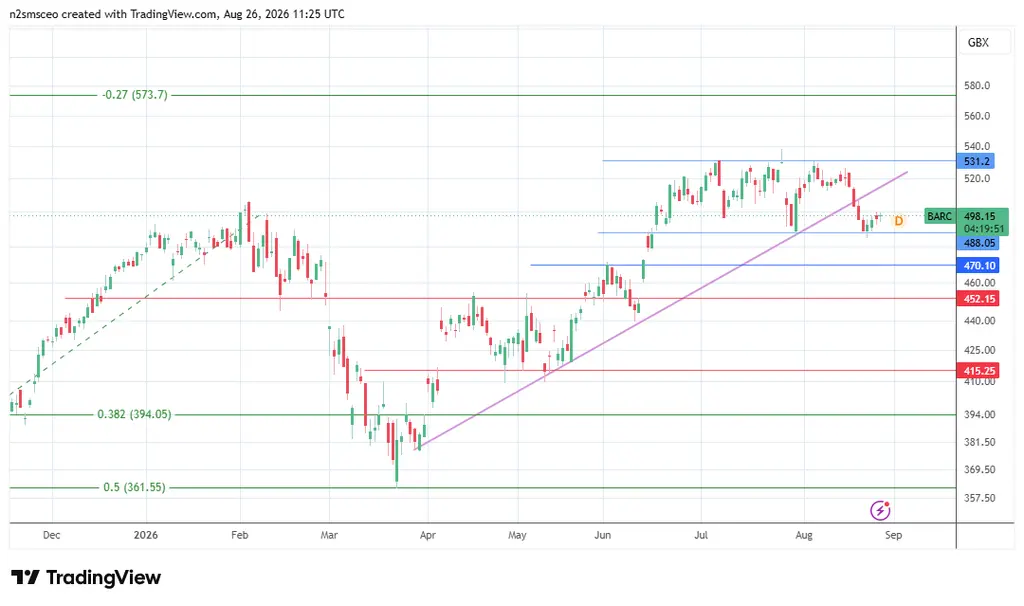
However, a breakdown of the 488.05 support makes a case for a further push lower towards the 470.10 support. Below this level, 452.15 forms the next downside barrier, marking the prior lows of 24 February and 27 February 2026.