


- The reinstatement of Jensen Huang as NVIDIA's CEO drove a sector wide rally, which boosted the AMD share price on Monday.
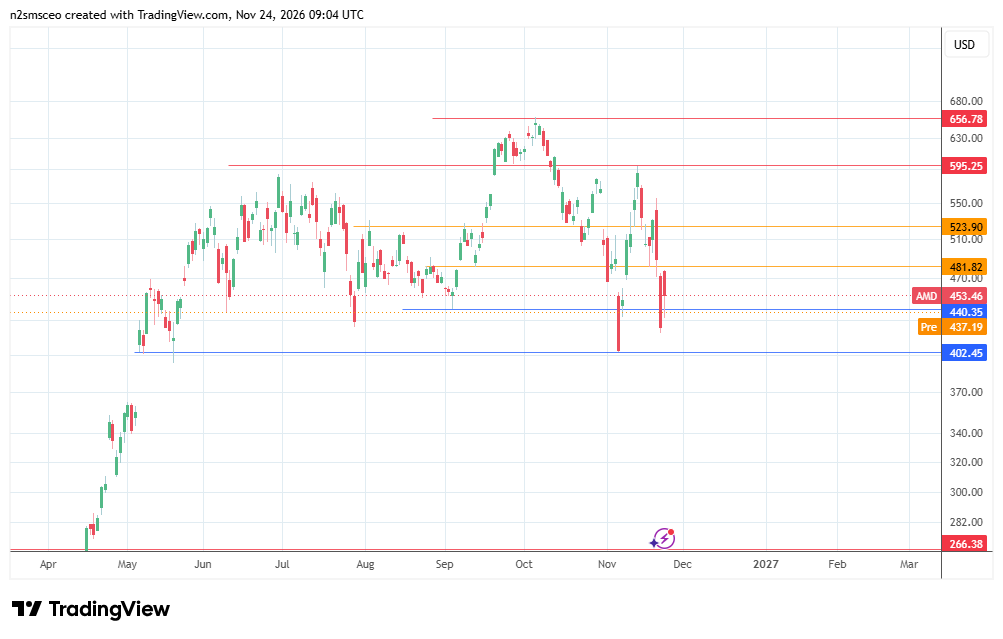
- 1$481.81 ResistanceBreak above $481.81 exposes further upside targets
- 2$440.35 SupportConsolidation floor; decline below triggers another leg lower
- 3$500.00 Upside targetPsychological barrier and upside target above $481.81
- 4$523.90 Upside targetUpside target at 9 September and 30 October highs
- 5$402.45 Downside targetDownside target if price declines below 440.35
TradingView Lightweight Charts™ · Yahoo Finance data
Current Market Setup
Shares of Advanced Micro Devices had closed 13.25% lower on 20 November. However, the stock rebounded in Monday’s trading session, closing 6.9% higher at $453.46. The AMD share price oscillated between $432 and $437 during the session. The recovery was part of a broader AI stock bounce, driven by a dramatic reinstatement of Jensen Huang as Nvidia’s CEO. Nvidia shares gained 31% on the news, contributing to a broad-based recovery across AI-related stocks. The rebound in AMD’s share price was more modest, showing that other company-specific influences are at work.
The AMD share price is now at a junction where the market is debating whether the recent selloff in tech sector stocks reflects concerns about these companies’ valuations (amid changing interest rate conditions) or whether the price has fallen to a level where it is now cheap to produce a temporary buying opportunity.
Key Drivers
1. Nvidia Leadership Developments
The decision by NVDA’s board to reinstate Jensen Huang as CEO was the catalyst for Monday’s sector-wide recovery in AI-related equities. The reinstatement was a market booster, restoring investor confidence in the semiconductor sector after the events surrounding Huang’s initial exit had severely eroded it. With the leadership uncertainty now resolved, the market demand for AI-associated equities appears to have returned, even if only temporarily. AMD’s share price benefited from Monday’s sector-wide recovery.
2. Regulatory Concerns Around China Chip Exports
The U.S. government currently maintains a sector-wide restriction on the sale of advanced semiconductor components to China. The recent scandal involving Jensen Huang highlights this sector’s vulnerability to penetration by Chinese agencies seeking US tech secrets, a major concern that drove the initial export curbs.
A short-selling entity, Hunterbrook, recently alleged impropriety in AMD’s chip revenue exposure, including supply chain relationships with a Chinese entity on a US export prohibition list. Advanced Micro Devices firmly rejected the allegations. However, recent events in that sector appear set to draw increased congressional scrutiny of AI-related companies’ export relationships. With the U.S. Congress now controlled by Democrats who have traditionally favored increased regulation, a regulatory cloud now hangs over that sector.

3. Sector-wide Exposure
The extended losses and subsequent recovery in AMD’s share price, relative to events at NVIDIA (the sector’s undisputed leader), indicate the sector-wide exposure semiconductor and AI stocks currently have. The recent price moves in AMD’s share price indicate the strength of sector-wide fundamentals and their impact on individual AI-related equities.
4. Treasury Yields and Fed Expectations
The US 10-year Treasury yield remains a relevant valuation factor for AI-associated equities and high-growth technology stocks. Higher US bond yields reflect hawkish Fed rate expectations. Higher interest rates discount the future valuation of these companies. With the US PCE Price Index data due for release on Wednesday, 25 November, AMD’s share price could face a valuation test if the release tilts toward a December rate hike.
5. AI Infrastructure Spending and Valuation Concerns
AMD is benefiting from increased AI infrastructure spending, driven by rising demand for data-center processors and supporting infrastructure. However, the sustainability of such spending remains a grave industry-wide concern, especially if the cost of financing credit rises with another Fed rate hike. How durable the current recovery will be will depend heavily on the sustainability of the current AI spending cycle.
AMD Share Price: Market Scenarios
Bullish scenario: Continued sector-wide recovery in semiconductor stocks, along with easing regulatory concerns, will promote further recovery. Furthermore, PCE data that dampens expectations of a December rate hike will be a booster. The bulls would be seeking a sustained break above $481.81, which exposes further upside targets at 500.00 (psychological barrier) and 523.90 (9 September and 30 October highs)
Base scenario: The AMD share price consolidates between 440.35 and 481.82. This scenario will play out as investors try to balance Monday’s AI-led recovery with the long-term impact of another Federal Reserve rate hike on the stock’s valuation. Furthermore, any regulatory-sensitive headlines and changes in US Treasury yields are competing factors that will come into play.
Bearish scenario: A decline below 440.35 would trigger another leg lower, targeting 402.45. This could result from renewed regulatory concerns about China chip exports or from reduced AI-sector valuations due to heightened Fed rate hike expectations.
What is your outlook on Advanced Micro Devices?
Anonymous · no sign-up · results from the last 30 days · not investment advice