


- The Nasdaq 100 index is under pressure following the hawkish hold by the US Fed Reserve. Three policymakers wanted an immeduate rate hike.
The Nasdaq 100 is trading lower on the day. This follows the Federal Reserve’s interest rate decision of 7Wednesday, 29 July, which reinforced a “higher for longer” Fed interest rate policy narrative. As expected, the Fed left interest rates unchanged at 3.75%. Still, markets interpreted the outcome as more hawkish than expected after three Fed policymakers voted in favor of an immediate rate increase.
In the press conference held 30 minutes later, new Fed Chair Kevin Walsh reemphasized that inflationary risks remained elevated, partly due to higher energy costs linked to the current US-Iran conflict. The Nasdaq is currently trading within a regime governed by a hawkish Fed, rising bond yields, and also concerns over an increase in capital expenditure in AI stocks. A higher-for-longer Fed interest rate environment is deemed negative for tech stocks. Not surprisingly, the decline in the Nasdaq 100 was led by semiconductor stocks as investors rotated into more defensive sectors that are deemed more insulated to the Fed policy narrative or the geopolitical conflict.
Macro Drivers for the Nasdaq 100
1) Hawkish Post-Fed Market Expectation
With three Fed policymakers voting for an immediate rate hike, the message from the Fed is clear: inflation remains an ongoing concern, and as long as this is the case, borrowing costs are going to remain higher for longer. Under this condition, financial conditions will remain restrictive. For growth stocks in the Nasdaq, the discount rates applied to future earnings will remain elevated and thus weigh on valuations. Therefore, a hawkish Fed is going to be a Nasdaq-negative narrative.
2) Semiconductor Stocks Under Pressure
Investors are now reassessing the impact of an expanded capital expense profile being assumed by many AI companies. This reassessment follows the “higher for longer” interest rate narrative, which will weigh on future valuations of these companies.
Areas of recent weakness have included:
- AI manufacturers
- data center providers
- memory producers
- semiconductor equipment companies
Investors are starting to question whether the pace of AI capex increase can be sustained over the next few quarters. This will directly lead to improved margins for the companies.
3) U.S. Treasury Yields

The hawkish Fed narrative has led to a rise in U.S. long-term Treasury yields. This increase is continuing to pressure high-duration growth stocks. Why is this the case?
Higher U.S. bond yields reduce equity valuation multiples and increase borrowing costs. A stronger U.S. dollar makes AI components expensive for non-U.S. international buyers. Furthermore, geopolitical tensions are also fuelling the rise in U.S. bond yields and are encouraging a rotation away from growth stocks into defensive stocks. The situation has continued to constitute a valuation headwind for tech stocks listed on the NASDAQ.
Nasdaq100 Near-Term Price Catalysts
1) Treasury yields: This is the most important price catalyst for the Nasdaq 100 index. As long as bond yields keep rising due to hawkish Fed expectations and geopolitical pressure, the Nasdaq 100 is expected to keep declining. However, a relief rally will be on the cards once the US bond yields retreat.
2) US Data: Upcoming macroeconomic releases, especially the ones around US inflation and employment, will be key drivers for the Nasdaq 100 due to the influence these data will have on the Fed’s policy moves. The next consignment of US PPI and CPI data will capture the renewed inflationary pressures resulting from the resumption of the Middle East conflict. Also watch out for the Non-Farm Payrolls data of 7 August.
3) Big Tech earnings and guidance: This is earnings season for US stocks. Markets will place special emphasis on Big Tech stocks, all of which are now fully vested in the AI market. The key price catalyst is whether the earnings figures guide to justify expanded spending on AI infrastructure. Furthermore, company guidance in this regard will be a key mover for the Nasdaq 100.
Nasdaq 100 Forecast Scenarios
Base case: the current pullback is expected to be modest, as the decline following the Fed’s hawkish hold on 29 July is expected to be cushioned by strong earnings fundamentals of growth stocks. Furthermore, the long-term AI demand narrative is still attracting buyers on dips, which should provide near-term support.
Bull case: the trigger for a rally on the Nasdaq 100 index will be a lowering of US bond yields, stronger-than-expected Big Tech earnings, and underwhelming NFP and inflation data. This is because lower bond yields expand tech valuations and boost the recovery in AI and semiconductor stocks.
Bear case: a further rise in US Treasury yields, stronger-than-expected US data prints, and disappointing AI earnings, backed by a lack of market confidence around increased AI capex among the industry’s biggest players, all support a further decline in the Nasdaq. If the geopolitical situation worsens, this will further pressure the Nasdaq.
Nasdaq 100 Technical Outlook
The bounce on the 28961 support is set to test the resistance at 28184 formed by the prior low of 9 June and 24 July. A break of this barrier makes a case for the bulls to reclaim the 29884 resistance (6-15 July highs). A retest of the all-time high follows a break of this barrier, with 30758 being the price to aim for.
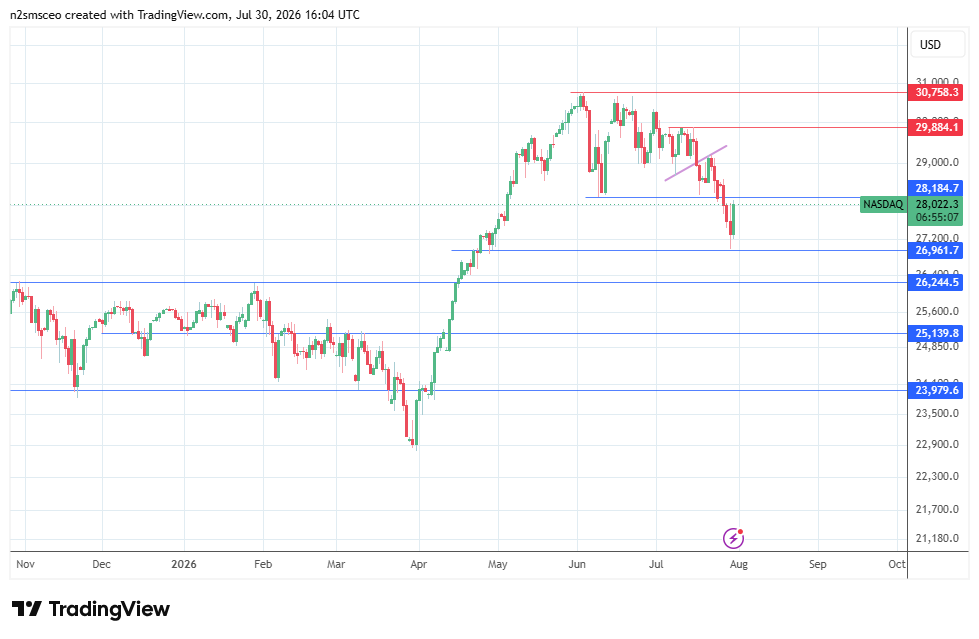
However, rejection at 28184 and a subsequent breakdown of 26961 makes a case for a further retracement, which brings in the 26244 support as the next downside target.