


Current Setup and Live Chart
USD/NOK is currently trading within the context of two dominant macro themes: rising global energy prices and US dollar resilience. The Norwegian crude is gaining support due to Norway’s positioning as one of Europe’s largest oil and gas producers. At the same time, the US dollar retains support from safe-haven demand driven by a renewal of the U.S.-Iran conflict and the closure of the Strait of Hormuz, which poses the risk of a return of the oil shock risk premium that hit financial markets in March.
Higher oil prices support Norway’s export outlook and increase the country’s revenues, leading to a strengthening of the Krone. This factor offsets US dollar strength. This week’s price action in USD/NOK will depend on which currency gains the most from the current geopolitical risk premium, since it creates demand for both currencies.
USD/NOK Macro Drivers
1) Higher Oil Prices
Norway’s status as one of the world’s largest crude and natural gas exporters puts it in a position to benefit from higher oil prices. Most of this oil wealth goes into the sovereign wealth fund, and higher oil prices increase the fund’s contributions. Furthermore, higher oil prices increase the country’s export revenues, fiscal balances, and trade surplus, all of which serve as a direct tailwind for the Krone. But we must also recognize that where geopolitical risk premium has driven up oil prices, there will be safe-haven demand for the U.S. dollar, which helps offset the strength of the Norwegian Krone.
2) Fed Policy
Despite the Federal Reserve no longer providing forward guidance and making policy decisions based on macroeconomic data, markets continue to price in the bank’s projected hawkish trajectory. This is resulting in higher U.S. Treasury yields. The reduction of U.S. Treasury yields provides global demand for U.S. generative assets. It attracts institutional capital and maintains U.S. dollar strength. This has been the factor that has kept the USD/NOK supported despite the strengthening impact of higher oil prices on the Krone.
3) Hawkish Norges Bank
Despite a cooling in consumer inflation, Norway’s central bank remains cautious about policy easing. This is despite the cooling of consumer inflation. Still, not to the levels where the Norges Bank would consider a dovish change in its policy tone. Norway’s core consumer price index report for June, as released by Statistisk Sentralbyra (Statistics Norway), showed an easing of local inflation by more than anticipated (2.7% actual vs 3.1% prior). Overall, the CPI showed a 0.2% month-on-month reduction. The Norges Bank’s cautious policy stands in contrast to the easing path many developed-market central banks have already adopted.

Price Catalysts for the Week
1) Brent crude prices: Oil prices remain the primary price catalyst for the USD/NOK. Any further gains in Brent crude would likely strengthen the Norwegian krone, but not by much, as the safe-haven demand for the greenback remains intact.
2) US Treasury yields: Despite a cooling of the June Consumer Price Index and Producer Price Index prints, US bond yields remain high. This is because the CPI and PPI data captured activity in June, when the ceasefire was holding. It does not reflect the return of the geopolitical risk premium in July (the current month), which is why traders are still pricing inflationary trends into the US 10-year bond yield. However, a decline in yields could allow the krone to outperform the greenback.
3) Norges Bank communication: Markets will monitor commentary from the Norges Bank regarding local inflation and future interest-rate policy. For a bank that is notoriously slow in adopting any changes in monetary policy pathway, any commentary that points to interest rate changes can produce a move on the NOK.
USD/NOK Forecast Scenarios
Base case: Mild bearishness is expected due to the support that higher oil prices will grant to the Norwegian Krone. However, safe-haven dollar demand will provide an offsetting contrast that will limit the USD/NOK’s downside push.
Bull case: The US Dollar gains from rising US bond yields and stronger US economic data. The overriding impact of these drivers will only allow the USD to flourish at the expense of the Krone as oil prices decline and commodity support for the NOK weakens.
Bear case: a further rise in Brent crude (>$100 per barrel), alongside softer US inflation and falling bond yields, allows the commodity strength of the Krone to shine through. In this circumstance, whatever safe-haven demand for the USD that is available will be too weak to override the weakening macro fundamentals mentioned above.
USD/NOK Technical Outlook
The decline in the USD/NOK looks set to test the 9.6207 support level. If this level fails to hold firm, the resulting downside move will reclaim the 9.4682 support level, which houses the former lows of 12 February and 23 March 2026. A further breakdown of this support lines up a move to test the 9.3606 support, which forms the neckline of the previous rounded bottom pattern.
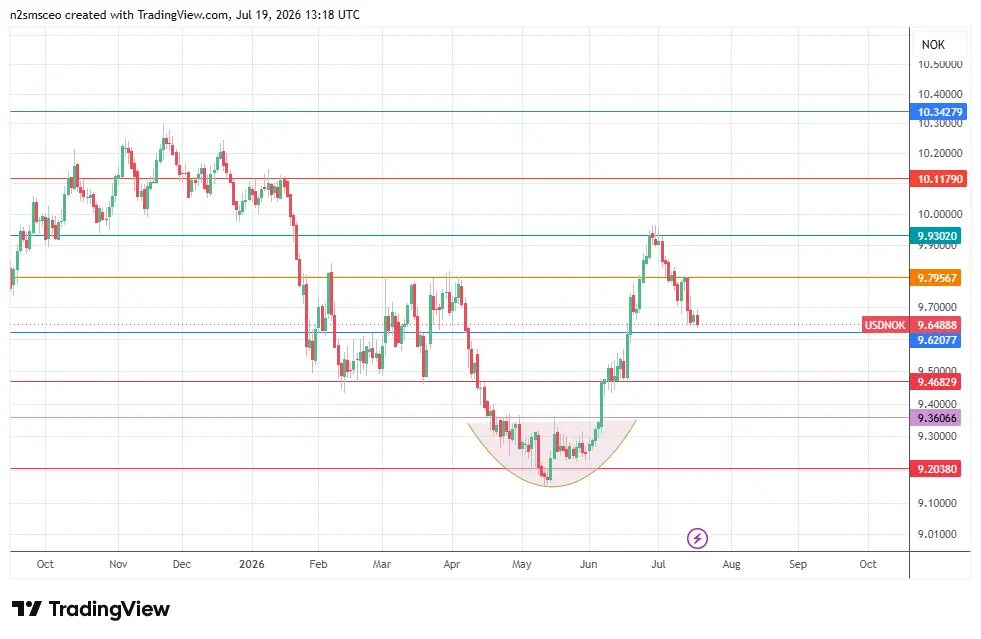
However, a bounce on the 9.6207 support will have to uncap the prior highs of late March/early April at 9.7956, exposing the 30 June high at 9.9302. If this resistance is broken, the recovery trend continues, with 10.1179 (16 January high) lining up as the next upside target.