


- The US dollar started the year on a high note, rising on the back of strong US economic data and reduced chances of a Fed rate cut
- Analysts say that the Big Beautiful Bill spending could trigger inflation and necessitate interest rate cuts by the Federal reserve later in the year
- Many central banks are spending more on buying gold
The US Dollar Index, or DXY, which tracks the greenback against a basket of six major currencies, has exhibited significant fluctuations in recent weeks. It climbed steadily in the first half of January 2026, peaking around 99.39 on January 19, before entering a downtrend, shedding nearly 2% to close at 97.13 by January 26. If you’re wondering why the world’s primary reserve currency is suddenly looking a bit shaky, you aren’t alone. So what’s happening and what awaits the dollar in 2026?
The Dollar Shaped By Policy and Politics
At first, the dollar got a boost from good economic news in the US and worries around the world. Later, the dollar went down because those worries calmed down and there was widespread belief that the Federal Reserve would cut interest rates.
However, data from OANDA’s MarketPulse shows that the dollar’s recent dip isn’t because of big changes in what people expect from interest rates. The main reason seems to be political uncertainty.
Earlier in January, the dollar was steady when the Federal Reserve decided to keep interest rates where they were (3.50%–3.75%). But then, some strange policy announcements about new trade taxes and questions about how independent the Fed is made investors nervous. When people think the rules are changing, they often pull their money out.
Analysts at Morgan Stanley say this could continue for a while, with the dollar dropping further until mid-2026 before possibly going up again. They believe this will depend on how well the US economy does and what happens with interest rates. J.P. Morgan Asset Management says that changes in capital flow and worries about policy are also making the dollar’s path bumpy.
What’s in Store for the Dollar in 2026?
There are a few things that will likely affect the dollar this year. Some experts at Capital.com think the first half of the year will be rough, but that the dollar could recover later on. Why? Because the big spending bill could cause inflation to rise again in the coming months. If that happens, the Fed might have to raise rates again by the end of 2026.
Overall, the US economy is still doing well relative to other countries, which could help the dollar. But big deficits and global issues could create some problems.

Is the Dollar’s Safe Haven Appeal Eroding?
People are starting to wonder if the dollar is as safe as it used to be. Central banks are buying more gold because they’re not sure if they can trust the dollar, especially if they think their dollar reserves could be vulnerable to confiscation.
Usually, when there’s trouble in the world, people buy dollars. But now, in 2026, a significant amount of trouble is happening in the US because of problems with its institutions. So, investors are starting to see gold as a safer option. Still, most global trade and central bank reserves are in dollars.
DXY Chart Technical Outlook
The DXY is on a strong downward momentum, with the RSI at 30. It will likely find initial support at year-to-date lows at 96.94. Further losses could drive the index to 92.21. On the upside, the momentum will only favour the buyers if the index returns above 97.50, with the first resistance is at 97.96. An extended control by the buyers could push the index to 98.62.
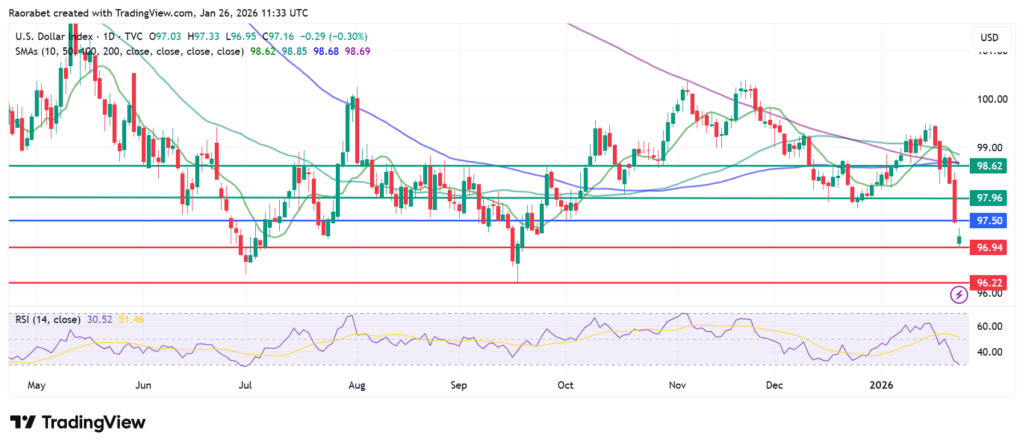
DXY chart on January 26, 2026 with key levels. Created on TradingView
It initially rose from US economic data and global tensions but then went down because of reduced risks, expectations of Fed rate cuts, and fiscal concerns.
Yes, but its status is strained. Investors still rely on its liquidity, but they are increasingly diversifying into gold when uncertainty stems from U.S. domestic policy rather than global crises.
Massive fiscal stimulus could be inflationary. If prices jump in the second half of 2026, the Fed may have to pause rate cuts or even hike, which would provide an unexpected boost to the dollar.