


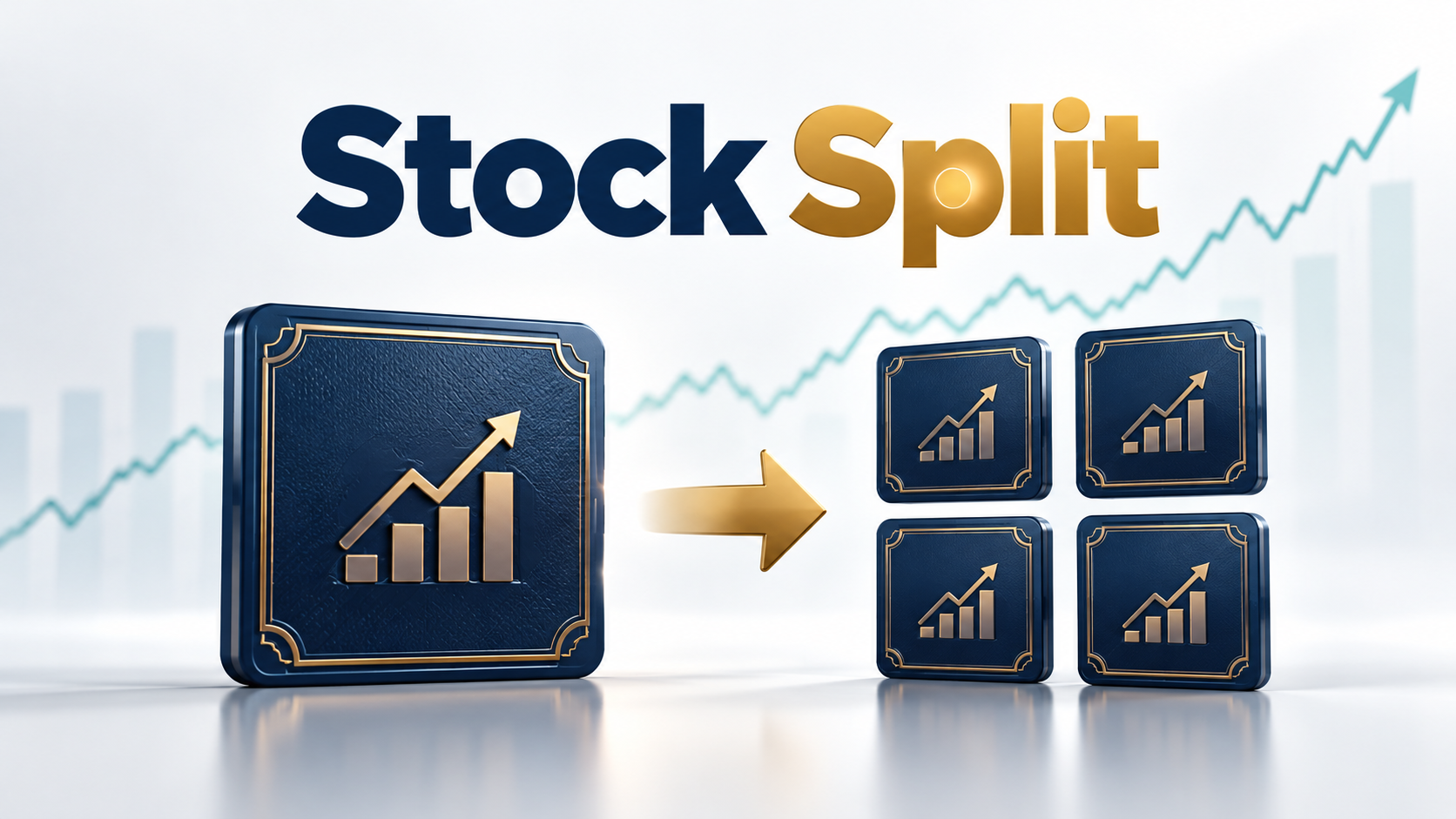
- Learn what a stock split is, how it works, why companies split their shares, and what it means for investors, share prices and portfolio value.
Investors searching for stock split today are looking for more than a lower share price. They want to know which companies are splitting their shares, when the new price takes effect and whether the corporate action creates a genuine investment opportunity.
The stock split calendar for October 2026 is relatively quiet for large US companies. Most of the immediate events involve reverse stock splits by smaller businesses, while the next notable forward split is scheduled for November. Eli Lilly has also returned to the conversation. Its share price is trading above $1,000, but management has not announced a stock split. That makes a split possible, not certain.
Quick overview
- A stock split changes the number of shares and the price per share.
- It does not immediately change a company’s market value.
- Several reverse stock splits are scheduled during the rest of October.
- The iShares Semiconductor ETF is scheduled for a 3-for-1 split in November.
- Eli Lilly has not announced a stock split despite its four-figure share price.
Stock Split Calendar: Upcoming Dates to Watch
A stock split calendar lists announced forward and reverse splits, their ratios and the dates on which shares begin trading on an adjusted basis. The following events are scheduled for the coming weeks:
| Company or fund | Symbol | Split ratio | Type | Ex-split date |
|---|---|---|---|---|
| The Beauty Health Company | SKIN | 1-for-20 | Reverse split | October 14 |
| Jianzhi Education Technology | JZ | 1-for-15 | Reverse split | October 15 |
| AMTD IDEA Group | AMTD | 1-for-60 | Reverse split | October 19 |
| Lufax Holding | LU | 1-for-10 | Reverse split | October 23 |
| Enhanced Group | ENHA | 1-for-10 | Reverse split | October 28 |
| iShares Semiconductor ETF | SOXX | 3-for-1 | Forward split | November 5 |
The calendar can change when companies announce new actions, amend ratios or delay effective dates. Investors should confirm each event through the relevant company filing or official exchange notice before making a decision.
SOXX is the standout forward split on the current US calendar. A 3-for-1 split would give investors three shares for every share held, while reducing the price of each share to roughly one-third of its pre-split level.
What Is a Stock Split?
A stock split is a corporate action that changes the number of outstanding shares and adjusts the price of each share by the same ratio. In a 2-for-1 stock split, one share becomes two. A stock trading at $200 would theoretically begin trading near $100 after the adjustment.
An investor holding 50 shares before the split would own 100 afterward:
- Before the split: 50 shares × $200 = $10,000
- After the split: 100 shares × $100 = $10,000
The investor owns more shares, but the value of the position does not automatically increase. A split also does not change the company’s revenue, profit, debt or competitive position. Any subsequent gain or loss depends on how the market values the business after the adjustment.
Forward Stock Splits vs Reverse Stock Splits
A forward stock split increases the number of shares while lowering the price per share. Companies may use forward splits after a sustained share-price increase. The lower price can make whole shares more accessible to retail investors, although fractional-share trading has reduced the importance of this benefit. A reverse stock split works in the opposite direction. It reduces the number of shares and raises the price per share.
Smaller companies frequently use reverse splits to lift a low share price, satisfy exchange-listing requirements or simplify their capital structure. A reverse split can solve the mechanical problem of a low trading price, but it does not repair weak revenue, heavy debt or persistent losses. That distinction matters when reviewing the stock split calendar. A forward split by a successful large company sends a different signal from a reverse split by a business trying to avoid delisting.

Will Eli Lilly Do a Stock Split in 2026?
Eli Lilly has not announced a stock split for 2026. Although its shares trade above $1,000, a high share price does not guarantee a split.
The company last split its stock in 1997. A future Eli Lilly stock split would reduce the price per share but would not change the value of investors’ holdings. Until the company makes an official announcement, a 2026 split remains speculation.
Does a Stock Split Make a Stock a Better Buy?
A stock split alone does not make a company cheaper in valuation terms.
If a company trades at 40 times expected earnings before a split, it should still trade at roughly 40 times expected earnings immediately afterward. Both the share price and earnings per share adjust for the higher share count.
Investors should instead examine:
- Revenue and earnings growth
- Free cash flow
- Debt levels
- Profit margins
- Competitive advantages
- Valuation relative to expected growth
- Reasons for the split
- Recent share-price performance
Stock splits can still affect market behaviour. A lower price may attract additional retail interest, improve trading activity or create short-term momentum. These effects are not guaranteed, and they do not replace fundamental analysis.
Important Stock Split Dates Explained
Stock split announcements normally include several dates that can cause confusion. The announcement date is when the company formally confirms the split and discloses the ratio. The record date identifies shareholders recorded on the company’s books for the corporate action. Modern brokerage systems usually process legitimate purchases made around this period according to exchange rules.
The payable or distribution date is when the additional shares are delivered or the consolidated shares are processed. The ex-split date is when the stock begins trading at its adjusted price. This is usually the most visible date because brokerage accounts, charts and quoted prices change to reflect the new share count. Investors should not assume that a sharp apparent fall on the ex-split date represents a real loss. Historical prices and cost bases are normally adjusted to reflect the split.
The number of shares and price per share change according to the split ratio, but the initial total value of the investment remains approximately the same. Normal market movements can change that value afterward.
Some stocks rise around a split because of momentum, improved accessibility or positive investor sentiment. Others fall or remain unchanged. The split itself does not improve the underlying business.
Investors can monitor stock split calendars provided by major exchanges and financial-data platforms. Company investor-relations announcements and regulatory filings should be used to confirm the ratio and effective date.