



Current Setup and Live Chart
The Nifty 50 index is the Indian national index that lists the top 50 companies by market cap. The Nifty 50 is trading as a proxy for the oil shock, INR weakness, and foreign-portfolio flow stress brought on by the Middle East geopolitical impasse and the closure of the Strait of Hormuz. This closure has been complicated by an additional blockade imposed by the US Navy, which has created a supply shock. India’s crude imports flow along this route. The situation has disrupted India’s oil imports, forcing the country to shift towards Russian barrels.
The Nifty 50 Index closed 0.81% today, led by a selloff in IT stocks.
Nifty 50 Index: Macro Drivers
The Nifty 50’s macro drivers center on energy prices, the rupee, foreign portfolio flows, earnings, the RBI’s policy stance, and global risk sentiment. So the Nifty 50 is not just a regular domestic benchmark, but also a barometer of India’s massive exposure to crude imports and foreign capital trading in the stock markets.
1. Crude oil and the U.S.–Iran war
By far the most relevant macro driver for the Nifty 50 index right now. India is a major crude importer (3rd largest globally), and remains sensitive to higher oil prices. Higher energy prices have an immediate impact on inflation expectations, trade, corporate margins, and the rupee. Moody’s has already warned of a potential trade deficit if the oil shock is prolonged. It also warned that India’s FY2027 GDP growth expectations could fall from 6.8% to 6.0%.
Oil drives the Nifty’s valuation as it impacts various oil-sensitive sectors. The current rebound, which is taking place as oil approaches sub-$90, is a clear indication of this.
2. Foreign portfolio flows
Funds from foreign institutional investors flow into Indian equities. Higher oil prices and geopolitical risk premia have led to the exit of $12.7 billion foreign portfolio funds in March 2026, a record.
The Nifty is made up mostly of large-cap financials, energy, IT stocks and big names in the consumption sector. These sectors have a large concentration of foreign portfolio investors. Domestic mutual funds alone cannot support the Nifty 50 index, and when foreign investors sell aggressively, the Nifty 50 index struggles. Improving global risk appetite draws foreign investors back into the market, which is supportive of the Nifty 50 index.
3. Rupee weakness and dollar strength
India’s energy import dependence and the heavy presence of foreign portfolio investors also ripple through the rupee. The rupee fell to 93.50 per dollar on April 21 due to oil price risks and foreign capital outflows.
A weak rupee is bad for import-intensive sectors and increases inflationary pressures. Sustained rupee weakness devalues foreign investor holdings, forcing them to buy foreign currency to preserve their asset valuations. This creates a negative cycle, as increased demand for US Dollars puts more pressure on the Rupee. This is generally negative for the Nifty50 index.

4. RBI policy
The Reserve Bank of India (RBI) performs three functions: FX management, setting of interest rates and maintaining liquidity. The oil risk premium means the Indian central bank must balance inflation risk from oil with the need to stabilize markets and support growth. On 20 April, the RBI eased restrictions on rupee derivatives after they had been in place for a week. This boosted the Nifty 50’s bank stocks and provided support for the broader market.
5. Global risk sentiment and U.S. interest rates
The Nifty 50 index is also sensitive to global equity risk appetite, US bond yields and US interest rates. A rise in bond yields or US interest rates draws flows away from emerging-market FX and towards US Treasuries. Improvement in global risk sentiment sends foreign investment funds into emerging-market indices such as the Nifty 50.
Nifty 50 Price Catalysts This Week
- Oil direction: currently the single largest driver of India risk premia (the Rupee, current account)
- INR stability & RBI policy response: The RBI intervenes to reduce any undue pressure on the rupee. If the RBI tightens financial conditions, this poses a risk to the Nifty 50’s cyclicals/financial stocks.
- Foreign flows/risk appetite: The Nifty 50 index typically sees more selling during a global risk-off sentiment.
Nifty 50 Index Forecast Scenarios
Base case: a volatile downside skew could resume if crude prices resume their climb. Otherwise, expect more recovery, especially if the Rupee stabilizes.
Bull case: An oil price retracement and a stable Rupee are driving the kind of relief rally we are seeing right now. If geopolitical conditions become calmer, the rally will continue.
Bear case: a renewed oil spike or shipping disruption headlines pose a deeper drawdown risk for the Nifty 50, especially for sectors or individual stocks with direct oil-price sensitivity (airlines, travel stocks).
Nifty 50 Index: Technical Outlook
The current situation in the Middle East is more conciliatory than it was in March, which is why the Nifty 50 index chart shows a V-shaped recovery from the March slide. The index has recouped at least half of the losses sustained since the 5 January 2026 high at 26,366. However, the price is now contending with a major resistance as traders rebalance their portfolios and evaluate their positioning.
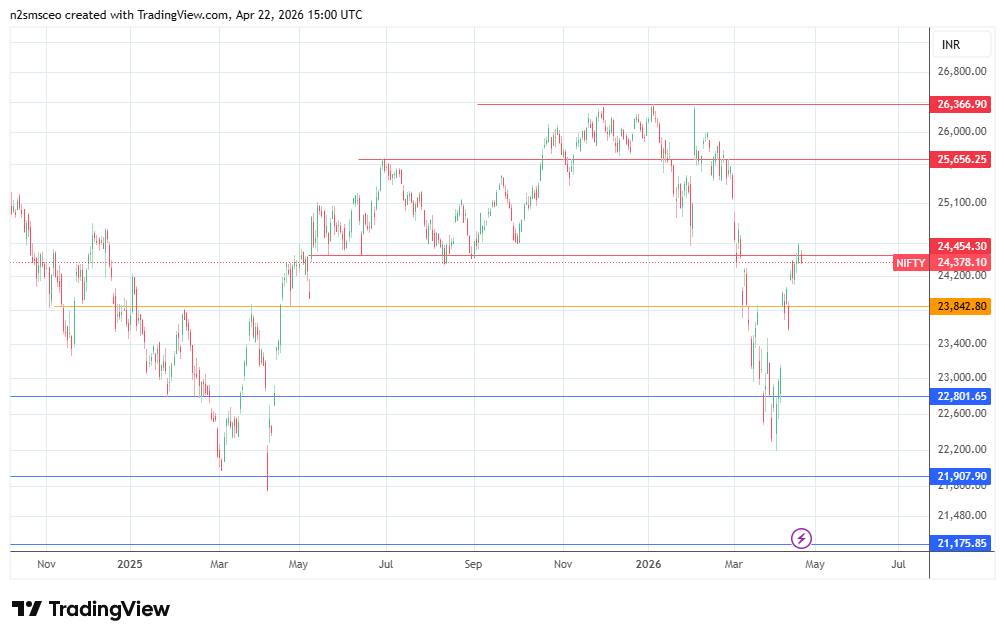
A break of the 24454 resistance and the current barrier makes a case for a continuation towards the 25656 resistance and the high of 30 June 2025. This barrier must be uncapped if the bulls are to reclaim the 26366 high for 2026.
On the flip side, rejection at 24454 suggests a pullback towards the 23842 support and the prior highs of 5 Feb and 25 March 2025. Only when this pivot breaks down can we see the price declining further towards 22801, or the lows of 4 March/8 April 2025 at 21907.