


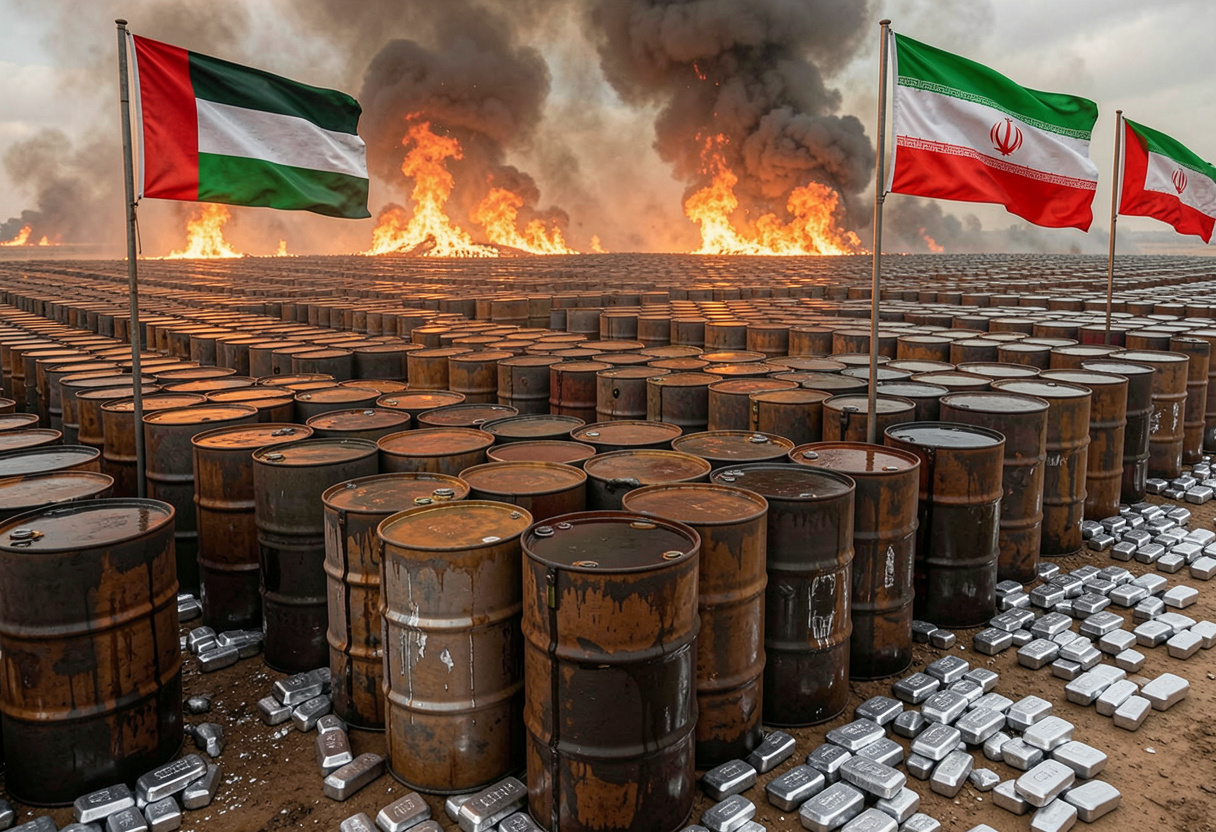
- Silver remains in a consolidation phase, trapped below its 200-period moving average and the $74.33 resistance level, showing a significant lag compared to Gold's performance.
The silver price opened in a similar range. However, Iran’s strike on the UAE’s Fujairah caused a new surge in crude oil prices. Authorities in the United Arab Emirates’ Fujairah said that a fire broke out in the oil industry zone after an Iranian drone attack.
Iran later denied any involvement in the incident at the UAE’s Fujairah oil facility, stating that no attack had been planned, even as authorities confirmed a fire had broken out, leaving three Indian nationals injured and hospitalized.
Such geopolitical developments were expected to impact commodity markets, including gold, silver, and oil. Gold prices edged slightly higher, rising by 0.95% (42.65 points). Meanwhile, crude oil reacted immediately to the Fujairah fire, surging to a peak of $111 per barrel. However, prices later pulled back toward the $104 range after Iran’s denial.
Contrary to what might be expected during a major geopolitical event, silver prices did not rally after the Fujairah incident on May 4, 2026. Instead, silver fell sharply as markets reacted to broader macroeconomic pressures rather than safe-haven demand.
Why Did the Silver Price Drop Instead of Rallying?
- Crude oil price spiked, driven by the attack at Fujairah, which briefly touched $115 per barrel. With higher energy prices, the fears of sustained inflation rise. This led to a sharp jump in global bond yields, with the US 10-year yield reaching its highest daily close since July 2025. Since silver doesn’t yield interest, it became significantly less attractive to investors compared to high-yielding bonds, leading to a sell-off.
- Before the incident, silver was already under pressure due to hawkish signals from the Federal Reserve and expectations of delayed interest rate cuts. At the same time, market activity was relatively low because of holidays in key Asian markets like China and Japan, which limited liquidity and prevented a strong safe-haven demand from building in the metals market.

Silver Price Technical Outlook:
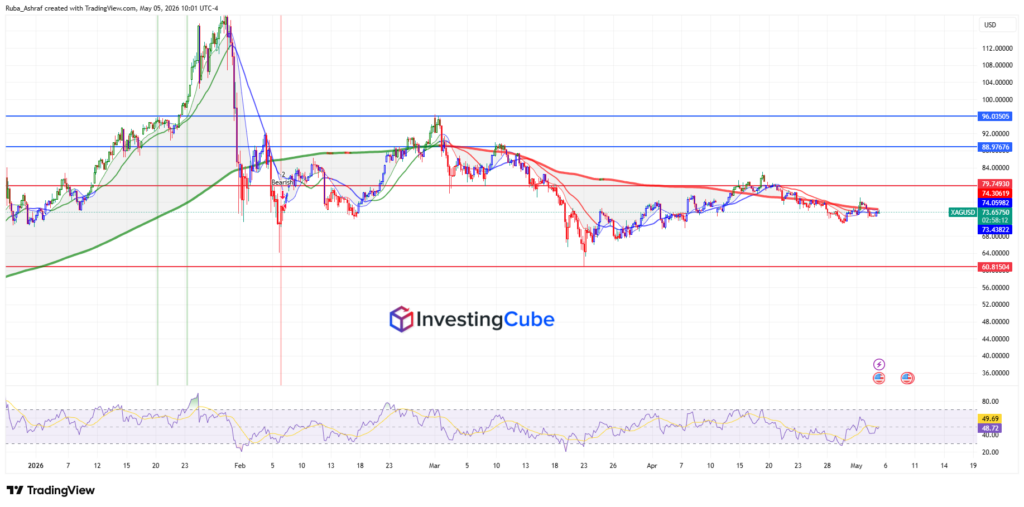
Silver is currently trading sideways in the 73.5-74.0 region, unable to find any momentum after the recent pullback. Price is just under a cluster of short-term moving averages that are beginning to flatten and turn a little lower. That implies a waning of bullish momentum and an indecisive market that is slightly tilted to the downside in the near term.
If we look at the indicators, it is evident that moving averages are narrowing, which means consolidation. The long-term average is above the price, confirming the general bearish bias. The RSI is hovering around the 50 level, indicating neutral momentum, with buyers and sellers in a deadlock. This fits with the current sideways action and the lack of strong directional conviction.
The market is at a crossroads, scenario-wise. A break below 73.40 would likely open the door for further downside and deeper support levels as the broader downtrend continues. On the other hand, if buyers manage to push price back above 74.30, this could signal a short-term recovery, with a potential move towards the 79.70 resistance zone. But until it breaks through that higher resistance, any upside is likely to be corrective, not a full trend reversal.
The attack caused oil prices to spike, which triggered a surge in global bond yields and made non-yielding assets like silver less attractive to investors.
Silver, unlike gold, is more sensitive to rising oil prices as higher energy prices increase the cost of mining silver and can also reduce global manufacturing demand for the metal.