



Archived Article This article was published more than 5 months ago. The market data, prices, forecasts, and analysis were accurate at the time of publication but may have changed since then. Please use this article for historical reference only and refer to our latest content for current market information.
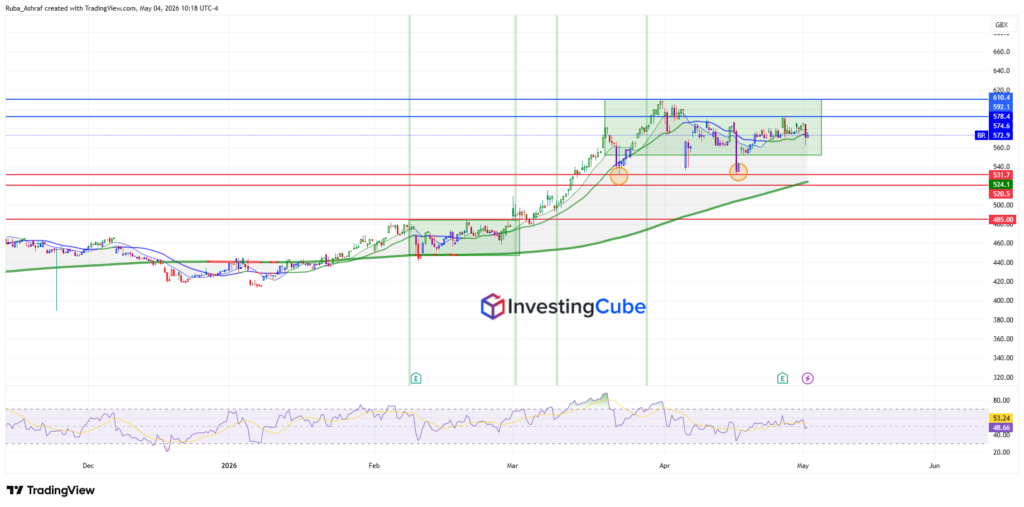
- The stock is currently in a neutral consolidation phase within the 555 to 610 GBX range, reflecting a "wait-and-see" market sentiment following its recent rally.
BP is reportedly thinking about selling part or even all of its operations in the UK North Sea, according to a report by Bloomberg News. The move comes as the energy company looks to reduce its debt and shift its focus back toward oil and gas. Some sources say BP is currently reviewing its upstream business in the UK, and a full sale could bring in around 2 billion sterling. BP has not yet commented on the report.
The review is being led by Carol Howle, who is overseeing the company’s broader strategy. This follows a deal last year in which BP sold part of its North Sea assets to Serica Energy for $232 million.
How BP’s Exit Plans Might Move the Stock:
- Short-term sentiment:
- Selling off North Sea assets would provide a massive immediate cash injection. If BP uses this capital to increase share buybacks or issue a special dividend, the stock would likely see a short-term rally.
- The key driver behind BP’s potential UK North Sea exit is escaping tax volatility there. The region has faced frequent policy changes, including windfall taxes like the Energy Profits Levy, making earnings less predictable. This kind of uncertainty often weighs on investor sentiment, as sudden tax shifts can cut into profits and cash flow. By reducing exposure, BP may be aiming to “de-risk” its portfolio and focus on more stable regions, a move that could support valuation and improve market confidence.
- Long-term strategy:
- It’s important to look at whether the money is moving into renewables or high-margin oil. If the funds are shifted to low-return green projects, “value” investors might sell the stock. In the case that the cash moves to high-growth areas like the Gulf of Mexico or Brazil, where BP has been expanding, it could justify a higher stock valuation.

The Technical Outlook for the BP Stock:
The chart shows the BP stock has transitioned from a strong rally into a consolidation phase at higher levels. Since late March, BP has been trading sideways within a clear range between 551 and 610 GBX. This indicates that the market is currently in “equilibrium,” waiting for a fresh catalyst to determine the next major move.
The key resistance level for the stock sits at 610 GBX. The stock has attempted to break this level multiple times but has been rejected. As shown on the chart, the orange circles highlight higher lows where buyers are consistently stepping in to defend this zone. Major structural support sits at 531.7 and 524 GBX.
Looking at moving averages, the stock remains above its long-term moving average, which is currently near 515 GBX. This confirms that the broader primary trend is bullish. The RSI is at 48, which means that the momentum is neutral right now. This means that neither buyer nor seller has control.
Potential Scenarios:
- Bullish Breakout: If the news of a North Sea exit is viewed as a strategic positive (higher margins or increased buybacks), the stock could break above the 610.4 GBX resistance. A clean break here would likely give us a new leg up towards 630 – 650 GBX.
- Bearish Correction: If the price breaks below the bottom of the green box (555 GBX), it would signal a deeper correction. The price would likely look for support in the “Red Zone” between 524 and 531 GBX, where it would also hit the long-term green moving average. That would be a normal “retest” of a prior breakout zone.
BP reported a strong $3.2 billion underlying replacement cost profit for Q1 2026, which is more than double the profit from the previous quarter.