



- BP reported strong Q1 2026 profit of $3.2 billion, beating expectations, yet shares showed limited gains after the April 28 earnings release
- BP’s Q1 results confirmed operational resilience, yet the share price reaction underscores investor selectivity
- Recovery for BP stock will likely hinge on sustained higher-for-longer oil prices combined with tangible progress on net debt reduction and cost savings
Brent crude now sits past $103 a barrel. Energy shares rise across the board – BP even reported their strongest quarterly results in years. Still, through the recent surge in oil prices, BP’s stock hasn’t moved much at all. Little excitement followed the earnings announcement on April 28. This disconnect between robust commodity tailwinds and subdued share price performance invites closer examination.
The Earnings Backdrop and Market Reaction
On April 28, CNBC shared numbers showing BP made $3.2 billion in early 2026, beating analyst’ forecast figures of around $2.63 billion according to data from LSEG. First-quarter profits more than doubled year-on-year, fuelled by what the company called an exceptional oil trading performance, improved refining margins, and record throughput.
The Iran war-driven disruption to the Strait of Hormuz has proved a perverse windfall for integrated energy companies capable of navigating volatile supply chains, and BP’s trading desk captured that opportunity with precision.
Shares rose modestly in early trading on the London Stock Exchange and NYSE but failed to sustain meaningful gains, closing with only a limited advance. This tempered response stands in contrast to the sharp rally in oil benchmarks, which benefited from supply disruptions linked to Middle East tensions.
The AGM and A Potential Governance Storm
Five days before the earnings release, BP’s April 23 AGM produced a different kind of headline. The Globe and Mail reported that shareholders voted down two board-backed governance proposals, with just under 53% of votes going against management’s recommendations.
More strikingly, chair Albert Manifold received only 82% shareholder support for his re-election. That was a significant rebuke in a context where directors typically receive close to 100%. Investors including Legal & General and proxy advisers Glass Lewis and ISS voted against the chair, citing serious governance concerns.
The Armchair Trader noted that BP’s multiple reversals on climate targets, capital expenditure plans, and production forecasts have eroded investor confidence. Around 25% of shareholders sided with ACCR, pushing for straight answers on whether oil and gas bets pay off down the line. That is a significant protest vote that BP has acknowledged, promising to engage within six months. This governance cloud did not disappear with Tuesday’s earnings beat.

Is a Recovery in Sight?
A meaningful recovery for BP stock will likely hinge on sustained higher-for-longer oil prices combined with tangible progress on net debt reduction and cost savings. The company’s diversified trading capabilities provide a buffer during volatile periods.
However, core profitability remains sensitive to realizations and refining margins. If BP successfully executes its portfolio simplification and delivers on hybrid bond reductions without compromising dividends, sentiment could improve.
That said, risks persist. Any rapid resolution of Middle East tensions could pressure oil prices, while seasonal maintenance, suspension of share buybacks and regional disruptions already point to softer upstream volumes ahead. Broader concerns around long-term energy transition pressures and potential demand softening also linger in the background.
BP Stock Price Forecast
BP stock RSI hovers around 54, indicating neutral momentum. The pivot point is at Immediate support levels sit around 563p, aligning with short-term moving. A break below 563p could expose further downside toward 552p. Resistance appears at 584p, with stronger overhead near 592p.
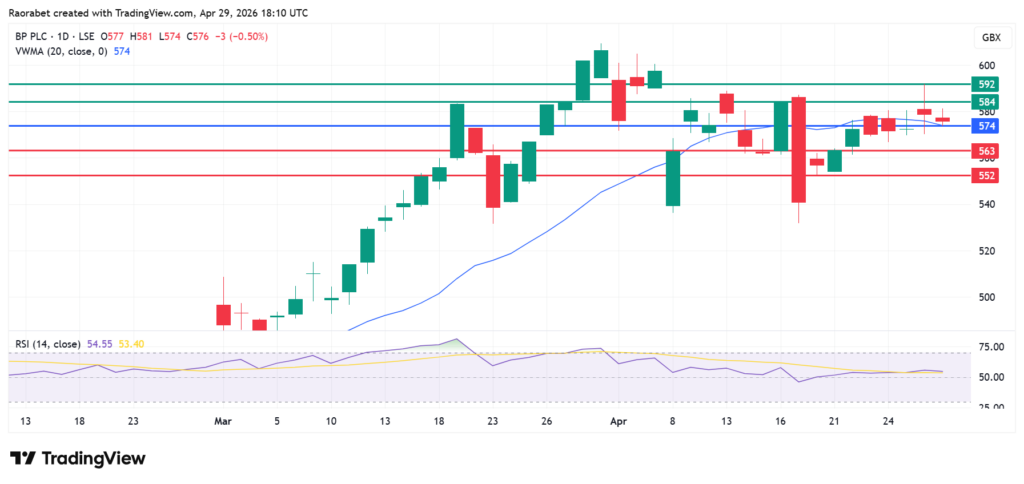
BP share price on the daily chart on April 29, 2026, with key support and resistance levels. Created on TradingView
Strong performance in the customers and products segment, particularly higher refining margins and exceptional oil trading results fueled by volatility from the Iran conflict, pushed profits well above expectations
Strong performance in the customers and products segment, particularly higher refining margins and exceptional oil trading results fueled by volatility from the Iran conflict, pushed profits well above expectations
Beyond consensus profit-taking narratives, the reaction highlights questions around sustainability of trading gains, balance sheet repair priorities, and suspended buybacks. Durable cash flow execution will matter more than cyclical boosts.