



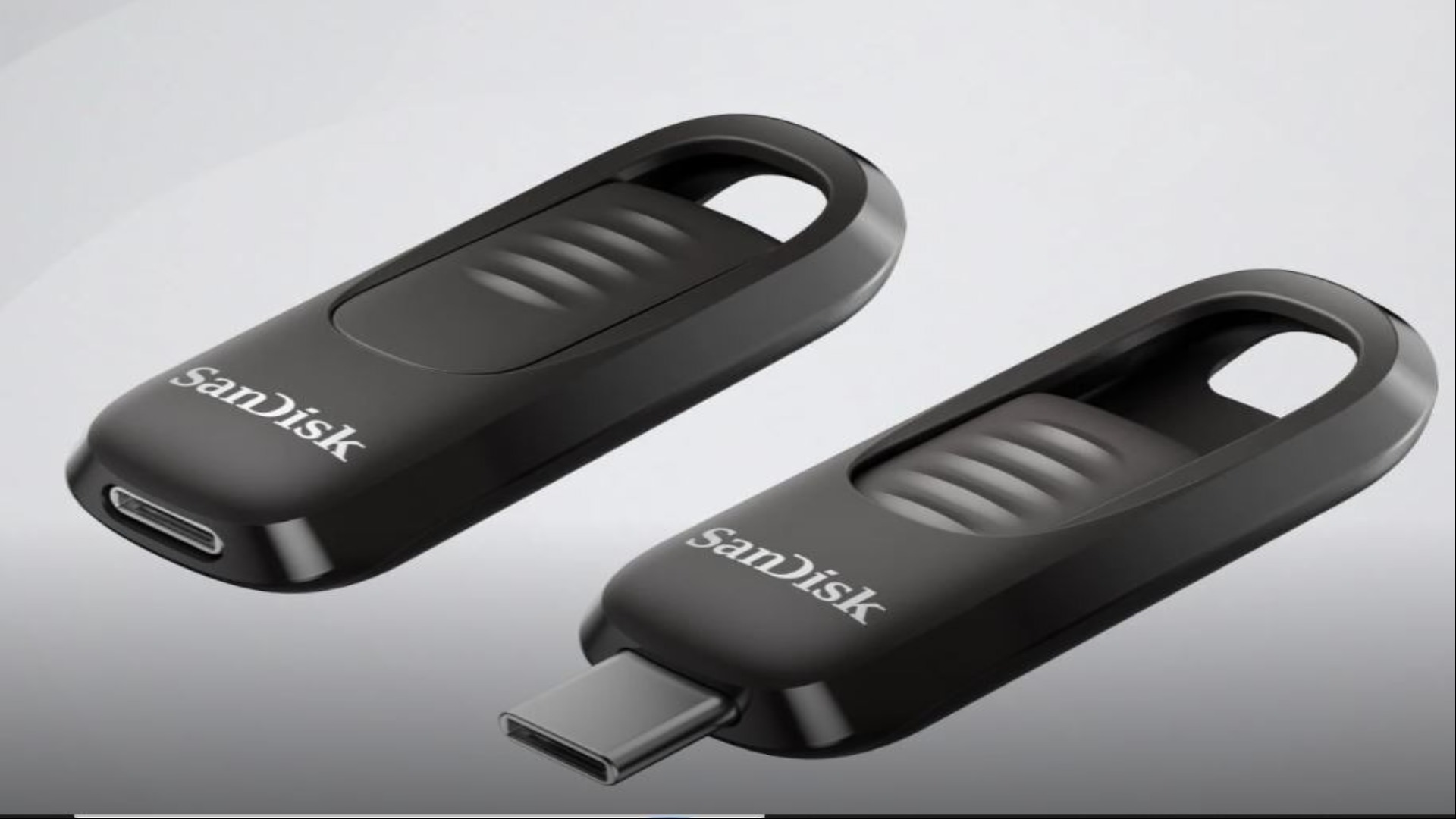
- On April 30, the SanDisk reported a GAAP profit of $23.03 per share on $6 billion revenue, far-exceeding analyst forecast of $14.66 per share and $4.7 billion revenue.
- SanDisk stock has risen by over 80% YTD, raising valuation concerns but it has secured billions worth of contracts, with some covering five years and offering long-term safety
- There is a risk of oversupply in the coming months, which could potentially trigger profit taking
SanDisk Corporation (NASDAQ: SNDK) has certainly been on investors’ radar recently with a notable upward trend. The company’s shares have seen a substantial increase, rising over 80% since the beginning of April. In addition, a significant portion of that (more than 24%) came in within the most recent five trading sessions. This culminated in the stock reaching a new all-time high of $1,189.24 on Friday, May 1.
For many observers, this performance appears as a remarkably steep upward line on a financial chart, seemingly defying typical market movements. For investors on the sidelines, the obvious question is whether this train has already left the station or whether there is still a compelling case to get on board.
Why Is SanDisk Stock Surging?
At its core, SanDisk’s rally is a story of artificial intelligence colliding with a constrained supply chain. The company, spun off from Western Digital in early 2025 and now a pure-play NAND flash memory specialist, sits at exactly the point where AI demand is most acute.
A key driver behind the appreciation in SanDisk’s stock is the robust demand for NAND flash memory and enterprise solid-state drives, which is largely fueled by the ongoing expansion of AI infrastructure. Data centers require substantial storage capabilities for the extensive datasets involved in training and inference processes for large language models and various other AI applications. SanDisk, as a pure-play leader in NAND, sits at the center of this bottleneck.
Then came the earnings catalyst. On April 30, SanDisk reported Q3 2026 results that stunned even the most optimistic forecasters. The company reported a GAAP profit of $23.03 per share on revenues totaling $6 billion, significantly exceeding analyst expectations of $14.66 per share and $4.7 billion in sales. Notably, quarterly revenue saw an almost two-fold increase compared to the previous year. CEO David Goeckeler characterized these results as a pivotal moment, attributing them to a strategic focus on the highest-value AI end markets.
Further reinforcing this trend, CNBC pointed out that SanDisk has secured five multi-year supply agreements, collectively valued at more than $11 billion. These contracts include firm purchase commitments, offering a level of earnings predictability not typically seen in the memory sector. The longest of these contracts extends for five years, which is a notable development in an industry known for its cyclical nature.
Is It Too Late to Buy?
The prevailing market consensus often warns that after an 80% run, a stock is “priced for perfection” and too late to buy. While the stock is certainly not cheap by traditional metrics, we are currently witnessing a memory supercycle unlike any before.

If SanDisk continues to beat its earnings by the margins we saw this quarter, the current “record high” might actually look like a bargain by year-end.
Key Risks to the Momentum
Several factors could disrupt the uptrend. Memory markets are notoriously cyclical. Increased production capacity from competitors or SanDisk itself could ease shortages and pressure pricing. Valuation concerns are also significant. Following such substantial appreciation, any unexpected earnings miss or a more conservative outlook from management could prompt investors to realize gains.
SanDisk Stock Price Forecast
Following Friday’s peak at $1,189, immediate resistance is purely psychological at $1,200. Moving past that could see the next target at $1,300. However, the RSI on SanDisk stock currently reads overbought at 73.82. That could potentially trigger some profit taking. On the downside, the first major support level sits at $1,032 near the 10-day EMA, with much deeper support at the 20-day Exponential Moving Average near $947.
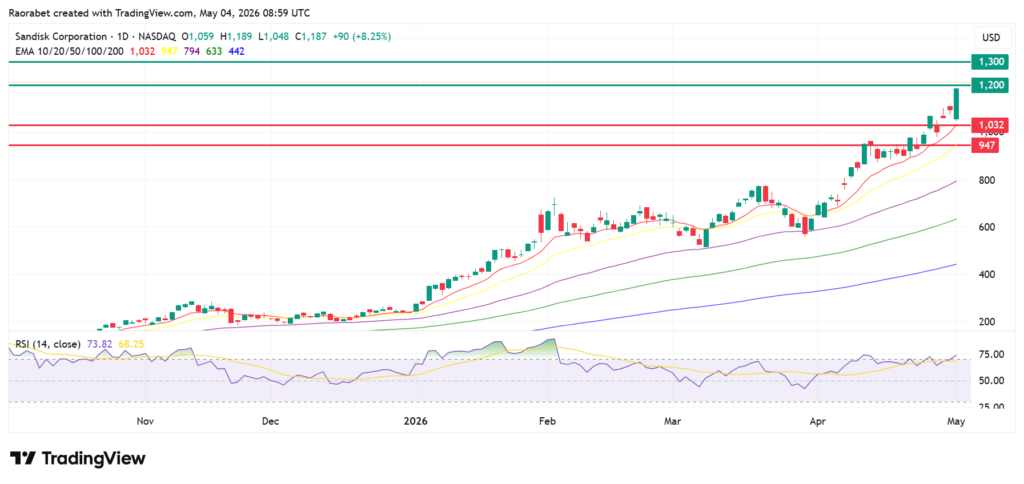
SanDisk stock daily chart on May 5, 2026, showing the key support and resistance levels. Created on TradingView
The 24% gain was driven by a blowout Q3 earnings report where revenue doubled and the company secured $42 billion in long-term AI contracts. This signaled to investors that AI storage demand is accelerating faster than anticipated.
It depends on risk tolerance. Momentum favors continued strength short-term, but stretched valuations mean new buyers assume higher risk of correction. Consider waiting for a pullback or using smaller positions.
The key threats include cyclical memory pricing, potential supply increases, valuation compression after huge gains, and any slowdown in AI infrastructure spending.