



Archived Article This article was published more than 5 months ago. The market data, prices, forecasts, and analysis were accurate at the time of publication but may have changed since then. Please use this article for historical reference only and refer to our latest content for current market information.
- Brent crude oil prices have declined in the last two days, with the market betting on the success of a second round of negotiations between United States and Iran
- There is an element of profit taking in the recent downward momentum, but a statement by President Donald Trump shows that negotiations may take some time to bear fruit
- The 1973 War Powers law means the US cannot take further military action without Congress approval, and that could help reduce oil prices
Brent crude prices saw a significant rise since mid-April, often staying above $100 a barrel due to persistent disruptions from the Iran conflict. However, the last two trading sessions showed declines of more than 1.4% each, bringing the price closer to $109. This development naturally prompts a closer look at what’s driving this change and what it means for the wider market perspective.
Diplomacy Trade Cools Off Prices
The recent price decrease this week wasn’t primarily due to an unexpected increase in supply. Instead, it seems to have stemmed from a glimmer of diplomatic possibility. As reported by Reuters, markets quickly responded to Tehran’s proposal for new negotiations with Washington, mediated by Pakistan. This prospect of easing tensions promptly reduced some of the geopolitical risk embedded in the price.
Adding to this, the War Powers Resolution introduced another element. President Trump is under a 60-day deadline stemming from this resolution. The 1973 law specifies that a president must withdraw troops within 60 days of informing Congress if military action hasn’t received Congressional authorization. Market participants appear to be factoring in the chance that legal constraints might lead to a de-escalation.
This Is Not a Reversal
Assuming a reversal is here just because of a negotiation proposal is a dangerous bet. Historical patterns reveal discussions tend to freeze, yet if one ship faces risk, what seemed like a small drop might suddenly climb fast. We aren’t in a reversal. We are in a high-stakes consolidation phase.
Therefore, the prevailing market narrative that diplomacy signals a near-term resolution deserves scrutiny. Trump later said he was not satisfied with Iran’s offer. Meanwhile, the U.S. Naval blockade remains in place. Even if a deal were signed tomorrow, the physical supply chain cannot recover overnight.
Finding new oil sources is getting harder as global supplies shrink, so countries that rely on imports face growing pressure. With fewer barrels available, the gap between actual delivery prices and future contracts keeps widening. Also, divergences between spot and paper markets highlight real tightness that could linger if Hormuz normalization drags on.

The Outlook for 2026
For the rest of the year, expect sticky high prices. Most major banks, including Goldman Sachs and Citi, have revised their 2026 forecasts upward, targeting an average of $90 to $100 through Q4. Even in the event of an immediate cessation of conflict, the damage to regional energy infrastructure and the depletion of global inventories suggest the supply-demand equilibrium will remain fragile for an extended period.
A swift resolution could see prices moderate toward the $80s, but a protracted stalemate or renewed tensions would likely keep Brent supported well above pre-war levels. The recent downward movements appear to reflect profit-taking and market positioning driven by optimism, rather than a fundamental resolution to underlying issues.
Brent Crude Oil Forecast
Brent price pivots at 109.30 and the downward-facing RSI line indicates that the sellers are taking over. Immediate support sits around $105.23, coinciding with the 10-day EMA. Below that, the $100 psychological level provides a critical floor. On the upside, resistance clusters near $114.70 weekly high, with a secondary hurdle at $120.
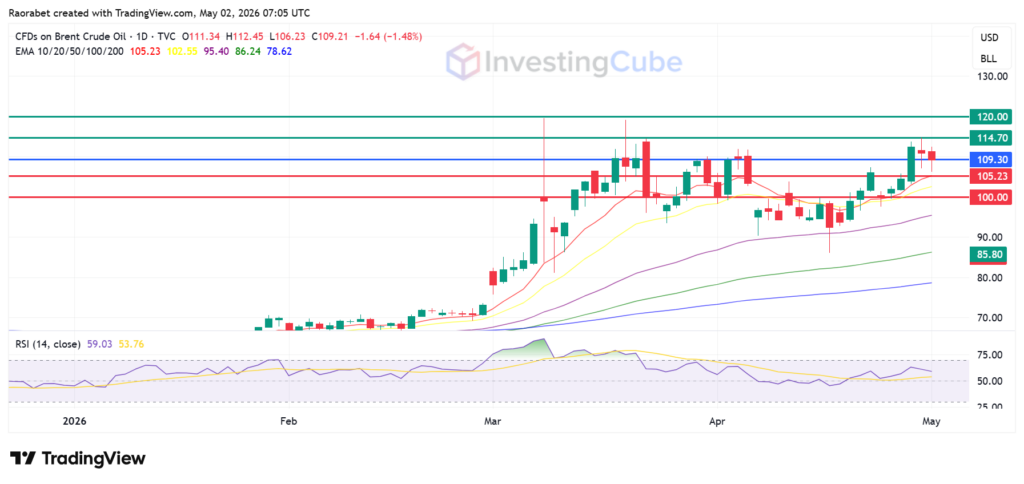
Brent crude price daily chart on May 1, 2026 with the key near-term levels of support and resistance. Created on TradingView
The decline was primarily triggered by news of potential negotiations between the U.S. and Iran. This reduced the immediate geopolitical risk premium that had been propping up prices above $110.
While prices dropped 2.8% over two days, a structural deficit remains. Unless the Strait of Hormuz fully reopens, supply shortages will likely prevent a return to pre-war price levels.
Market analysts from Barclays and J.P. Morgan expect Brent to remain volatile, likely averaging between $90 and $100 for the remainder of 2026 as inventories continue to draw down.