




- Gold prices continue to trade in a two-way pattern with the Fed decision now dominating sentiment amid the oil shock risk premium.
Following the Fed’s hawkish hold in last week’s interest rate decision, gold prices have been trading within the context of a macro liquidation. The language and voting patterns of the Federal Open Market Committee (FOMC) suggest that the Fed is willing to keep interest rates as they are for a long time to come, given the inflationary trends the oil shock has produced. The evidence from the gas pumps in the US indicates that users are now paying gasoline prices not seen in decades.
As long as inflationary expectations rise due to the Middle East geopolitical situation, monetary conditions will remain tight, and the attendant rise in US bond yields is making the US Dollar a more desirable asset than the non-yielding yellow metal.
Since the oil shock began, gold no longer functions solely as a safe-haven asset; it is now trading on a two-way street, where the impact of US Dollar demand dwarfs its safe-haven status. Currently, gold prices are up intraday, but this rally is approaching resistance, where the expectation is that sellers will fade the rally. Gold is trading at $4579/ounce as of writing.
Gold Price: Macro Drivers for the Week
1) Oil-shock inflation fears
The oil shock continues to drive inflation fears. This has led the Fed to declare what the markets interpreted as a hawkish hold. Interest rate expectations now tilt towards fewer rate cuts (if any at all), which is driving US bond yields higher and pushing the US Dollar’s valuation higher. This scenario is a headwind for gold prices. This has been a recurring theme, and with the latest strike and counterstrikes between the US and Iran in the Strait of Hormuz, the conviction is that any retracement rallies in gold will be capped.
2) USD yield picture
The Fed’s hawkish stance is driving the US Dollar higher amid oil-driven inflation expectations. The response of a central bank is typically to tighten monetary conditions whenever there are inflationary pressures on an economy. This causes US bond yields to rise due to demand for an assured stable-yielding asset over a non-yielding yellow metal.
As long as inflationary pressures keep the Fed away from the dovish tilt, we are likely to see US bond yields rise further, putting more pressure on gold.
3) Institutional Unwinding of Earlier Longs
There is also the added factor of institutional unwinding of long orders. The Wall Street Journal specifically frames the broader selloff in precious metals as being driven mostly by dimming rate-cut hopes and rising inflationary expectations. Recall that some of these orders were placed when gold prices were much lower. The oil shock and the Fed decision have provided a fundamental basis for the unwinding of these long positions to take profits.
Gold Price Catalysts for the Week
US yields/DXY direction: This is the primary driver of price action. Firmer yields will lead to USD strength, which keeps gold heavy. Yield stabilization or a decline can trigger a rebound in gold prices, as we saw in the pre-New York trading session of 5 May.

Oil shock/Hormuz/inflation narrative: Tensions continue to rise in the Strait of Hormuz. This keeps oil prices supported and renders the oil shock risk premium as active as can be. As long as the oil shock persists, the two-way trade in gold remains intact. In other words, oil prices now dictate how gold trades. Higher oil prices, lower gold prices, and vice versa, all via choppy consolidation movements.
Geopolitical headlines: Oil prices are currently driven by geopolitical headlines. However, the impact has been weakened by the Fed’s decision last week. Geopolitical headlines (escalation vs. de-escalation) need to be very major to overcome the impact of the US yield trade impulse.
Gold Prices: Forecast Scenarios
Base case: gold prices will remain in a volatile consolidation, with loads of intraday whipsaws. The two-way trade with sharp intraday swings remains the market bias, with the safe-haven nature contesting higher US yields/firmer US Dollar amid macro headwinds.
Bull case: a rebound in gold prices occurs if US bond yields and the dollar soften. If the oil risk premium also cools enough to lower inflationary expectations, rate-cut expectations will be back on the table, supporting gold prices.
Bear case: a major downside push occurs if there is a renewed oil spike above $110/barrel, along with higher US Treasury yields and a firmer greenback. This scenario heightens inflationary trends and doubles down on the Fed’s higher-for-longer rhetoric of last week.
Bottom line
This week, gold will trade based on rate expectations and US Dollar strength, all of which are a function of the oil shock, inflationary expectations, Fed monetary policy pathway, and US bond yields.
Gold Price: Technical Outlook
Pay attention to the rising trendline on the 1-hour chart. That has been the intraday support for gold prices. Also pay attention to the 4582 resistance line where price previously peaked on 30 April. These are the boundaries of the day’s price action.
The bulls need to uncap the 4582 resistance barrier for the price to advance to the 4600 resistance and prior high of 28 April. If the advance uncaps that psychological level, a further push towards the 4640 and 4666 resistance levels will be on the cards.
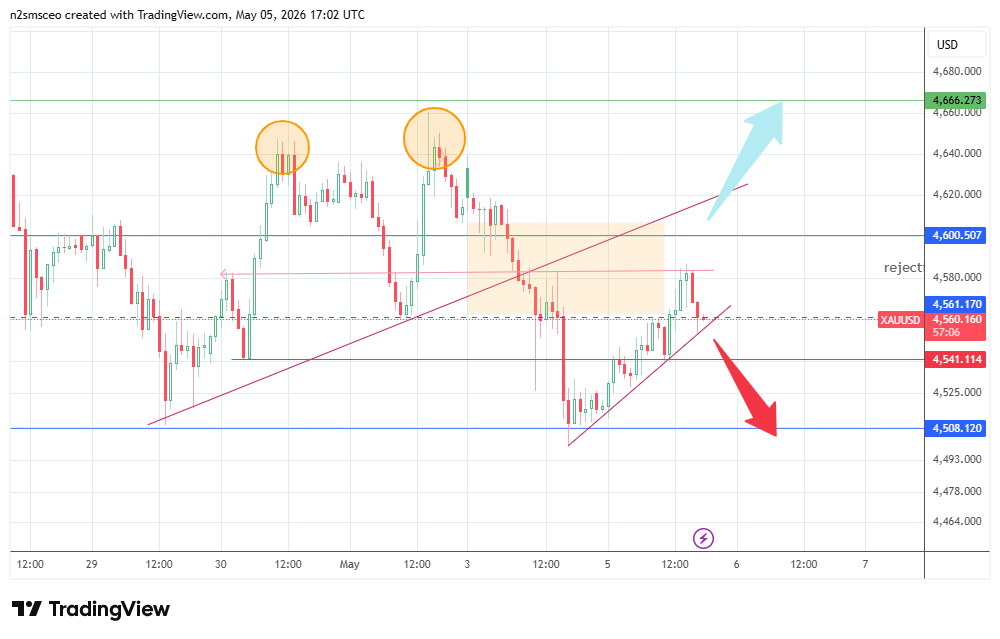
On the flip side, a rejection at 4582 needs to take out the ascending trendline for the downside move to extend lower. The 4541 support level is the next price pivot in line. If the bears degrade this pivot, the pathway towards the 458 support and prior low seen on 29 April and 4 May becomes clearer.