


InvestingCube chart · Yahoo Finance data
Current setup
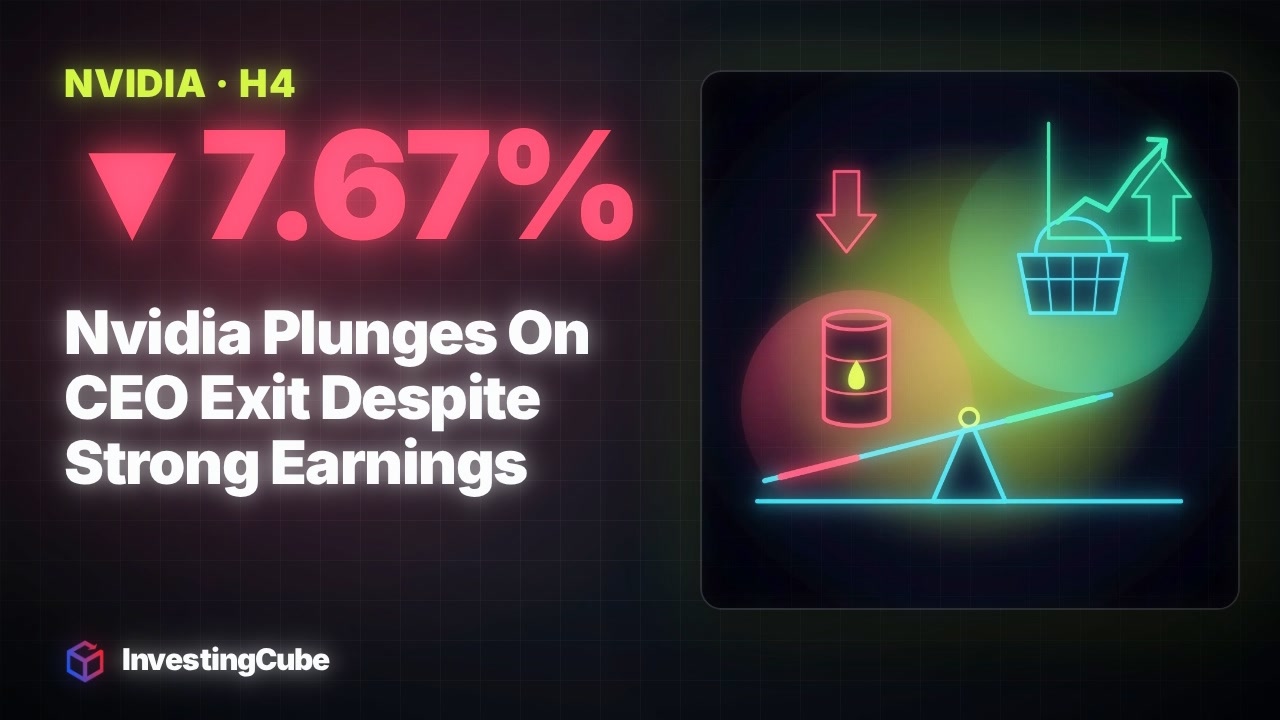
Nvidia delivered what we consider an exceptional quarterly performance, with Q3 2026 revenue rising 103% year-on-year to $115.8 billion. The company’s adjusted net earnings per share came in at $2.68, and Q4 revenue guidance stood at $130 billion, plus or minus 3%. Although the stellar results confirm the company’s premier position at the center of the global AI infrastructure boom, investors were not especially moved, and the Nvidia share price declined. It is currently down 2.90% as of writing.
The results are also coming as the company is at a crossroads following the infidelity scandal plaguing its longtime CEO, Jensen Huang. On his subsequent resignation, an interim CEO has been appointed in the person of erstwhile CFO Colette Kress. Huang’s reported attempts to stage a comeback as CEO have put the company’s leadership in uncharted territory.
For investors, the key question is not whether Nvidia Nvidia earnings beat estimates, but whether the company can continue to drive growth in revenue, earnings, margins, and upbeat forward guidance amid its exceptional hyperscale spending. So far, the Nvidia share price has taken a massive hit following the scandal, losing more than a third of its value since the 6 October highs.
Nvidia Share Price: Key Macro Drivers
1. Data-centre Revenue Affirms AI Demand
NVIDIA’s data-centre business remains the principal engine of its growth, generating $107.6 billion in Q3 revenue, an increase of 110% year-on-year and 21% quarter-on-quarter. This represents approximately 93% of total company revenue, highlighting the extent to which NVIDIA’s financial performance is tied to global investment in AI computing infrastructure.
Demand from hyperscale cloud providers, AI developers and enterprise customers continues to drive purchases of GPUs, networking equipment and complete computing systems. The strength of this segment suggests that spending on AI infrastructure remains robust, although investors will increasingly want evidence that customers can translate these investments into sustainable commercial returns.
2. Q4 guidance Signals Revenue acceleration
A substantial increase in revenue guidance was delivere by the management, calling for a Q4 2027 revenue of approximately $130 billion, plus or minus 3%. This forecast excludes any data-centre compute revenue from China, which shows that the company expects to expand its product demand outside the controversial Chinese market.
With investors becoming increasingly concerned on the sustainability of the current extraordinary AI infrastructure spending, the markets will watch to see if the actual Q4 revenue delivery will exceed these increasingly ambitious expectations.
3. Vera Rubin Platform Ramp
The company has begun shipping components of the next-generation Vera Rubin NVL72 systems, marking a major milestone in transitioning away from the Blackwell computing system to the more advanced, faster and robust AI computing platform. The Vera Rubin NVL72 systems have enhanced computing capabilities that are expected to match AI workloads of increasing difficulty and demand. Rapid adoption by cloud and technology partners will enforce Nvidia’s pole position in this sector.

4. Earnings Numbers
NVIDIA’s GAAP gross margin rose fro 73.4% in Q3 2025 to 74.8%. GAAP operating income and net income rose 115% and 105%, respectively to $77.5 billion and $65.3 billion. Earnings per share also registered a 111% year-on-year growth to $2.68, and $28.1 billion was returned to shareholders via dividends and share repurchases. However, the expectation of investors now has to do with whether the company can hit the ambitious Q4 targets and improve its economics of scale with the launch of the next-generation AI infrastrucure.
5. Leadership Transition, & Regulatory Risks
Jensen Huang led NVIDIA for more than three decades. His exit could leave investors wondering if the company can sustain its growth trajectory and strategic executions in the AI market without him. The company’s long-term roadmap is currently in doubt.
The scope of the Jensen Huang’s infidelity scandal has widened as more facts emerge as to the alleged links of his mistress to the Chinese government’s espionage operations. This has heightened the company’s exposure to regulatory risks in the foreseeable future. This could have an impact on the company’s market opportunities and supply chains.
NVIDIA Forecast Scenarios
Bull case: If data-center revenue keeps growing along with optimal adoption of the Vera Rubin platform, investors could combine these with the earnings numbers to buy into the stock at what would be lower prices. This would be the impetus that drives recovery.
Base case: Consolidation as investors balance the leadership uncertainty and valuation concerns against the strong earnings performance. In this scenario, additional evidence of the company’s growth trajectory remaining on course via the enterprise Vera Rubin adoption and hyperscaler spending would be needed for a directional move to take off once more.
Bear case: A deepening leadership transition crisis, a slowdown in AI infrastructure spending,, or regulatory fallout from the recent scandal could undermine any recovery attempts. Furthermore, a buildup in competition from other AI accelerator companies could negatively impact earnings and revenue expectations.
Technical Outlook
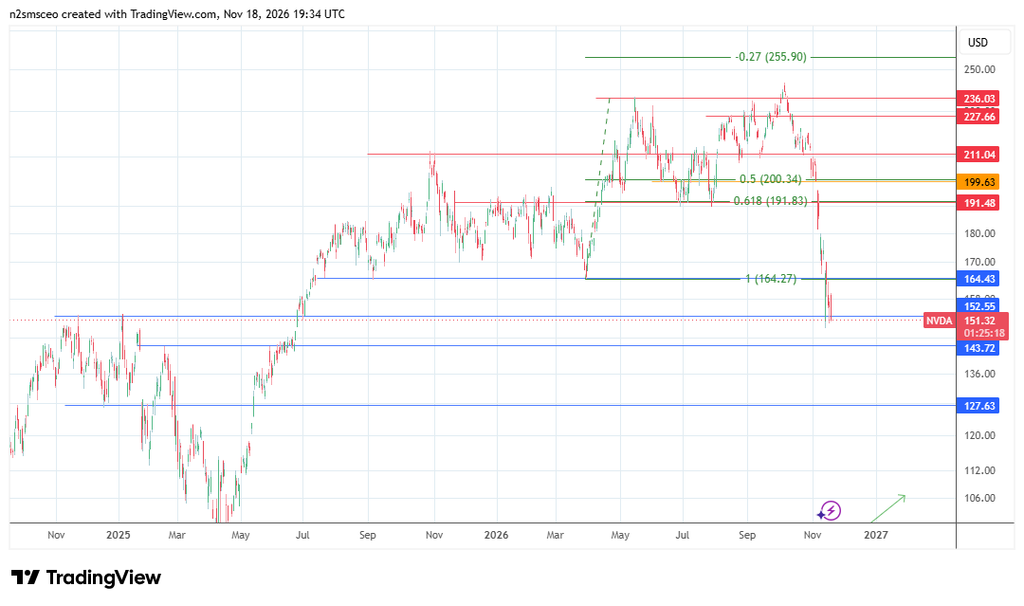
The 152.55 support is being challenged following the decline on 18 November. A breakdown of this support level ushers in a move toward the 143.72 support, followed by the 127.63 low of 18 December 2024 as the next pivot.
On the flip side, a bounce on the 152.55 support makes a case for a recovery towards 164.43 (5 September 2025 and 30 March 2026 lows). If the advance continues, 191.48 resistance comes into play as the next barrier to the north.
What is your outlook on NVIDIA?
Anonymous · no sign-up · results from the last 30 days · not investment advice