



- SpaceX stock's break past the $200 mark to $2.5 trillion market cap has excited the market, but analysts are warning of potential overvaluation
- Starlink's recurring revenue model provides a stable base, but the broader SpaceX itself is yet to turn profitable
- Many retail traders are still barred from selling their SpaceX stock due to a 15-day anti-flipping rule placed by top brokers. Expiry of that period could being selling pressure
SpaceX stock has risen quickly following its IPO at 135 dollars per share, recently moving past the $200 mark and bringing the company’s market capitalization above 2.5 trillion dollars. This price action suggests strong interest from both retail and institutional investors who view the company as a significant long term investment.
Is the Performance Detached from Reality?
Despite the momentum, the current valuation has drawn scrutiny. Trading volumes reached 52 billion dollars in one session, leading some analysts to compare the stock’s volatility to speculative assets. When evaluated against financial fundamentals, the valuation appears high.
At the time of its IPO, the price to sales ratio was approximately 60, a figure that places it among the most expensive technology companies in the market. Some analysts suggest even higher multiples depending on the data used.
The company’s revenue trajectory is mixed. Starlink brought in $3.26 billion during the first quarter of 2026, accounting for about 69% of SpaceX’s total quarterly revenue of $4.7 billion. While the satellite internet division is doing well, it’s currently the only consistently profitable part of the business.
Starlink’s high-margin, recurring revenue model provides a stable base, but SpaceX itself remains capital-intensive. Significant spending on research, satellite deployment, and infrastructure has squeezed near-term profitability, even with Starlink’s positive contribution to adjusted EBITDA.
Bringing in AI-related ventures adds complications, with some costs affecting consolidated results. Talk of trillion-dollar revenue potential by 2030 certainly grabs investors’ attention, but reaching that goal hinges on Starship consistently flying high-frequency missions. That’s a milestone still in active testing.
How Soon is a Correction Coming?
SpaceX stock’s current price is supported by several structural factors. Underwriters recently exercised their greenshoe option, which increased the total IPO proceeds to 85.7 billion dollars.

Furthermore, many brokerage platforms enforce anti flipping rules that prevent retail investors from selling their shares within the first 15 days of trading. These restrictions effectively limit selling pressure until late June.
However, once these initial protections wear off, and early institutional investors look to lock in their 50% gains, a sharp technical correction back towards the original $150-$160 breakout zone looks pretty likely.
Technical Analysis: 2-Hour Timeframe
Looking at the 2-hour chart, the RSI at 67.29 shows its approaching overbought extremes, which suggests the stock could soon be running out of steam. The pivot is at the psychological $200 mark. The first key barrier is likely to be at $212, beyond which the buyers could target current record highs of $225. The current price action mostly reflects supply constraints, not the company’s fundamentals.
Primary support sits at $190, with a break below that level likely to invalidate the upside narrative and pull he price to the second one at $180. We’ll likely see some near-term consolidation before a pullback to $185-$190.
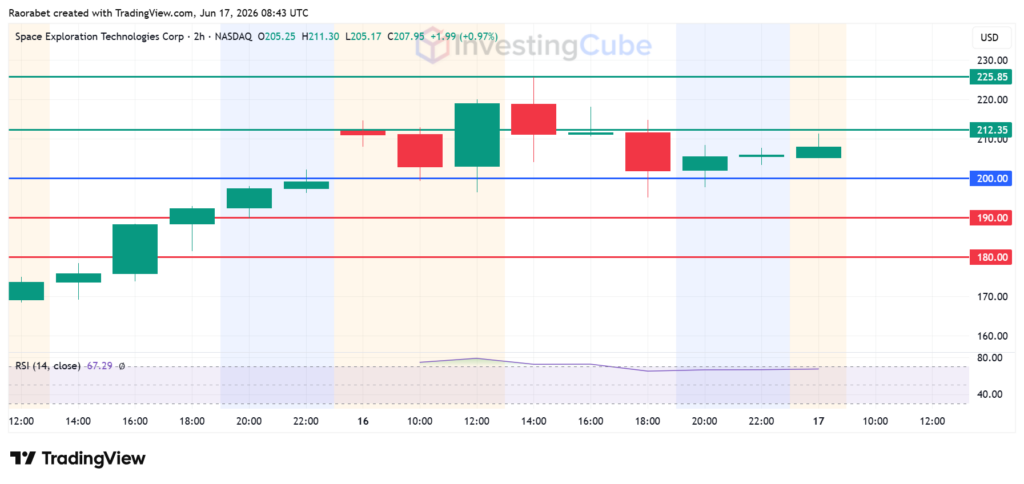
SpaceX stock price chart on a 2-hour time frame on June 17 showing key levels of support and resistance. Created on TradingView
Strong investor demand for its Starlink growth and Starship potential drove rapid gains after the record IPO, lifting valuation above $2.5 trillion.
Valuations appear stretched relative to current revenue and profits, with some analysts seeing overvaluation compared to conservative models.
Some analysts point to the price to sales ratio and the previous year’s net loss of 4.94 billion dollars as evidence that the stock price has outpaced the company’s current financial reality.