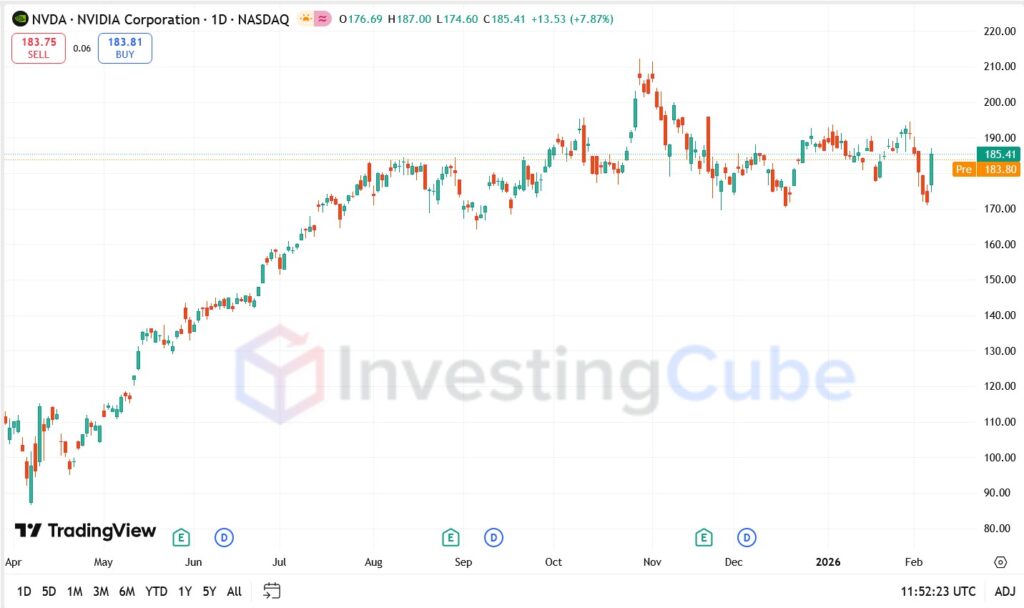
- NVIDIA shares surged 7.87% last Friday, to close at $185.41 after CEO Jensen Huang declared that the global AI infrastructure buildout has "seven to eight years" of growth remaining.
- NVIDIA Q4 fiscal 2026 earnings on Wednesday, February 25, with Wall Street expecting revenue to hit a record $65 billion.
- Despite early-year volatility, analysts at Goldman Sachs and Morgan Stanley have issued fresh "Buy" ratings, citing the massive production ramp of the Blackwell architecture as a multi-trillion dollar catalyst.
After a punishing start to 2026 that saw shares retreat from their all-time highs, NVIDIA (NVDA) staged a massive recovery as the market moved into the second week of February. The stock climbed 7.87% on Friday, February 6, closing at $185.41 and effectively wiping out a week of “valuation fatigue”. While our previous analysis explored the initial technical “ceiling” of the Blackwell chip, today’s rebound suggests that the fundamental floor for NVIDIA is far sturdier than skeptics anticipated.
As reported by Bloomberg, this $300 billion recovery in market value was driven by a shift in sentiment regarding “hyperscaler” spending. Fears that the AI bubble was bursting were quickly replaced by the reality of the 2026 capex boom. With Amazon, Alphabet, and Meta collectively earmarking over $650 billion for AI infrastructure this year, NVIDIA remains the primary beneficiary of what is now being called the “largest infrastructure buildout in human history”.
Huang’s AI Roadmap: The Seven-Year Buildout Cycle
The spark for the 7.8% rally was a direct intervention by CEO Jensen Huang. Speaking on CNBC, Huang pushed back against the narrative that data center demand is peaking, instead forecasting a seven to eight-year cycle for the global AI infrastructure expansion. He described the current phase as a “once-in-a-generation” transition where every data center in the world is being re-architected for accelerated computing.
According to Reuters, Huang emphasized that demand for NVIDIA’s specialized chips remains “computer constrained,” meaning developers like OpenAI and Anthropic are still waiting on more power to scale their next-generation models. Most notably, Huang pointed to a unique “pricing phenomenon” where GPUs sold over half a decade ago are actually increasing in resale value, highlighting the severe supply-demand imbalance that continues to support NVIDIA’s premium pricing power.
The February 25 Verdict: Blackwell and Gross Margin Scrutiny
All eyes are now fixed on Wednesday, February 25, when NVIDIA will release its Q4 fiscal 2026 results. This earnings call is expected to be a “crossroads” moment for the stock’s 2026 trajectory. Analysts are forecasting revenue of $65.5 billion and earnings per share (EPS) of $4.69.
However, the real story will be the Blackwell ramp-up. While Blackwell generated billions in its debut quarter, investors will be scrutinizing whether the high costs of scaling this complex architecture will pressure NVIDIA’s gold-standard 75% gross margins.
As noted by Investing.com, if Colette Kress (CFO) provides guidance for fiscal 2027 that exceeds the current $70.7 billion Q1 consensus, it could trigger a massive short-squeeze and a run toward the $250 price target set by Goldman Sachs.

NVIDIA Technical Forecast
From a technical lens, NVDA is currently fighting to maintain its bullish posture ahead of the earnings call.
- Immediate Resistance: $186–$188. The stock is currently testing the 200-day simple moving average, a critical trend filter. A daily close above this level would signal a full “trend reversal”.
- Key Support Zone: $174–$176. This area, which aligns with the 50-day moving average, has proven to be a reliable zone for “dip buyers” over the last two trading sessions.
Conclusion: The $5 Trillion Path
NVIDIA’s 7.8% rebound has successfully “calmed the tape,” providing a much-needed buffer before the February 25 earnings volatility. While regulatory “taxes” on China exports and legal challenges around training data remain “wildcards,” the core demand for the Blackwell platform appears to be in its infancy.
For investors, the current consolidation near $185 represents the ultimate litmus test: if NVIDIA can prove its margin resilience later this month, the path to a $5 trillion valuation may be closer than the market thinks.
NVIDIA is officially confirmed to report its Q4 fiscal 2026 financial results on Wednesday, February 25, 2026, after the market close.
Investors are looking for Blackwell to drive the “lion’s share” of the projected $65 billion in quarterly revenue. Specifically, any commentary on production yields or supply chain constraints will be the primary driver of the stock’s post-earnings move.
Huang argues that the entire $1 trillion global data center footprint must be upgraded to accelerated computing. He believes we are only in the early stages of this “once-in-a-generation” shift, fueled by sovereign AI and enterprise robotics.