


- The Nifty 50 index is facing pressure as oil prices tick higher due to fading hopes of a resolution of the status of the Strait of Hormuz.
Current Setup
The Nifty 50 index is back under pressure as Indian stock markets face a renewed battle against geopolitical uncertainty, rising energy prices, and weakness in the local currency. The index traded in a largely range-bound session on Monday, leaving it marginally higher by 0.05%. Tuesday’s market session has seen the Nifty 50 drop by 0.46% as of writing, due to investors reacting to renewed rises in oil prices as well as uncertainty surrounding the Middle East geopolitical situation.
The biggest problem that the Indian stock markets have faced in 2026 is that the geopolitical shock from the Middle East conflict has continued to be transmitted through the energy market. As the world’s third-largest crude oil importer, India is facing more pressure from rising energy prices than most other countries. As Brent prices push northwards, investors are assessing India’s current account and corporate margin outlook, and renewed inflationary expectations are emerging.
The rupee, which also serves as the transmission channel between foreign portfolio investors and Indian stock markets, has weakened further, adding another layer of pressure to markets like the Nifty 50 index. However, Indian stock markets continue to receive support from the country’s domestic growth and upbeat corporate earnings, amid resilience in domestic portfolio flows that have cushioned the impact of the earlier exit of foreign institutional funds.
Nifty 50 Index: Macro Drivers
1) Elevated Oil Prices
Crude oil prices remain a critical micro-driver for the Nifty 50 index because of India’s exposure as the world’s third-largest crude importer. Whenever crude oil prices rise substantially, India’s import bill rises. This puts pressure on the rupee, as the country now needs more rupees to buy the same product at high prices, especially when the local currency is already in a weakened state.
The situation also raises inflationary expectations, as higher energy prices raise the cost of inputs for many manufacturing companies and also raise transportation costs. Consumer purchasing power is reduced due to inflationary pressures, and corporate entities tend to see margin compression. This ultimately puts pressure on the Indian stock markets, and the Nifty 50 index is no exception.
2) Geopolitics
The US-Iran conflict is currently in de-escalation mode, but occasionally sources of escalation crop up, and the conflict therefore remains an important source of risk premium. Specifically, the Nifty 50 index is sensitive to headlines or developments around shipping in the Strait of Hormuz and the ongoing negotiations, as well as any military developments. Typically, a renewed escalation triggers a wave of risk-off sentiment that leads to a sell-off in emerging market indices.
3) Domestic Corporate Earnings

A great source of cushion against the external risks in the activity index remains the resilience in corporate earnings, which is currently being seen in India’s earnings season. Investors continue to focus on consumer-facing companies, their tech stocks, industrials, and financial stocks. The Indian government’s expanded expenditure in many critical sectors of India’s economy has proved to be a source of stimulus to these companies. The broad-based nature of these stellar corporate earnings has helped cushion against the exit of foreign portfolio funds.
Within the context of the current trading conditions, investors are now using sector-specific investment cases as the basis of their Nifty 50 plays, as opposed to just selling off the entire market in panic. This is helping the index in the medium to long term, as the index has recovered by 2,470 points from its 2 April 2026 low.
Nifty 50 Index Price Catalysts
1) Oil prices: this factor remains the most important price catalyst for the Nifty 50 index via its impact on the margins and input cost expectations for the listed companies, as well as the impact on the rupee and flows for foreign portfolio funds. Higher oil prices pile more pressure on the rupee and cap the Nifty 50’s upside.
2) USD/INR rate: higher oil prices and a weaker rupee tend to lead to more foreign portfolio outflows. International portfolio funds seek the increased returns that come with investing in emerging markets, but seek quick exit under adverse conditions to protect their original valuations. Once a local currency falls along with the local bourse, there is no incentive to stay.
3) Corporate earnings: India is currently in its earnings season. Investors will seek additional evidence of robust earnings growth. If earnings results remain upbeat or surpass expectations, this can offset any macro headwinds from portfolio fund outflows or higher oil prices. Watch for the banks and industrials as a potential source of stability.
Nifty 50 Index Forecast Scenarios
Base case: domestic earnings are currently providing a constructive influence on the Nifty index, helping to offset major pressure from elevated oil prices and geopolitical uncertainty. A neutral to mildly bearish outlook sees the Nifty 50 index losing ground, but not by much as the price could be stabilized at the nearest support (24454). Volatility within a consolidation is the base case scenario, with price testing the support level more than it tests the range’s upper boundary.
Bull case: falling crude prices as a result of geopolitical de-escalation, coupled with stabilization of the rupee and stronger-than-expected corporate earnings, would improve foreign portfolio flows and boost risk appetite. Also, financials and the cyclical stocks will see recovery, as inflationary expectations fade away. This scenario see the Nifty 50 index continuing its recovery from post-war levels.
Bear case: further geopolitical escalation, more rupee weakness and a renewed oil price surge will send foreign portfolio funds flying out of the window as risk aversion seizes the markets. In this scenario, bulls will find very little strength to support the Nifty 50 index and a further push below the current support cannot be ruled out.
Nifty 50 Index Technical Outlook
The 24454 support is under pressure, and a breakdown here could lead to a test of the 23842 support, formed by the previous highs of 5 February and 25 March 2025. Below this level, the trendline support also gives way, bringing in the 21 November 2024 and 13 May 2026 lows at 23271 into the mix.
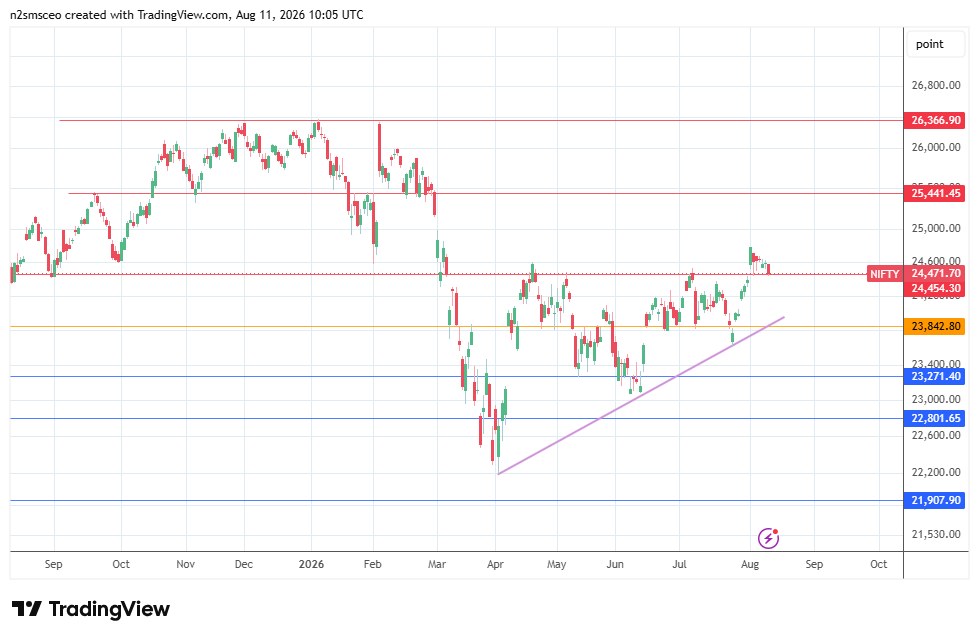
However, if the bulls defend the current support, it may allow for a bounce that extends the advance to the 25441 resistance and prior high of 19 September 2025. If this barrier is uncapped, a return to the pre-war high of 26366 (November 2025-February 2026 top) cannot be ruled out.