


- The Hang Seng Index has rebounded in the first half of April, with risk aversion reducing as US-Iran ceasefire negotiations uplift sentiment
- China's stimulus plan could come to the rescue and help the Index realize its first monthly gain since January
- Generally, the Hang Seng Index faces a battle between positive domestic developments and external headwinds
The Hang Seng Index has exhibited significant volatility for most of April 2026, yet it has posted an overall gain exceeding 4% so far this month. This performance contrasts with the consecutive monthly declines recorded in February and March. While the broader trend indicates an upward trajectory, the daily action demonstrates significant variability. One day we observe strong tech sector performance, and the next, we are contemplating a 200-point decline. What factors are currently influencing Hong Kong’s benchmark index?
Why April Looks Better and Why You Shouldn’t Fully Trust It
The Hang Seng’s recent behaviour reflects a tug-of-war between positive domestic developments and external headwinds. In early April, big names like Tencent and Alibaba caught a break when sentiment shifted slightly upward. Still, gains didn’t stick long under foreign market stress.
However, periodic profit-taking and concerns over the pace of stimulus implementation have prevented a decisive breakout. The broader equity market’s sensitivity to Middle East oil price swings has also contributed to the choppiness, as higher energy costs could weigh on consumer spending in China.
A notable shift occurred on April 8, with the Hang Seng advancing 3.1% to reach 25,893, as reported by BBN Times, following market reaction to the announcement of a US-Iran ceasefire. The prospect of the Strait of Hormuz reopening mitigated concerns over energy costs and stimulated widespread purchasing.
Additional impetus came from data indicating China’s industrial profits increased by 15.2% year-on-year for January-February, a development CNBC characterized as a significant inflection point for factory-gate pressures.
Q2 Calls for Cautious Optimism
Most institutional forecasts remain constructive. China CITIC Bank International has raised its year-end HSI target to 29,800, while IG International’s base case sits at 28,300. Nomura expects an 8-10% full-year return, driven by sustainable earnings growth and a modestly stronger renminbi. Hong Kong’s GDP is projected to expand around 2.6% this year, with the S&P Global PMI holding above the expansion threshold of 50 for six consecutive months through January.

Even now, questions linger about how long this rebound can last. Staying above critical lows has kept the index afloat so far, yet staying above 22,000 has proven to be a challenge. The upward momentum might pick up speed should China follow through on stimulus and if tech profits beat forecasts.
However, it is worth noting that the prevailing assumption that any stimulus announcement will automatically initiate a prolonged rally may need re-evaluation. The true impact of these measures will be contingent upon their practical execution and subsequent consumer reaction.
Hang Seng Index Forecast
The Hang Seng Index RSI is currently positioned at 53, indicating it is neither in an oversold nor an overextended condition. An immediate resistance level is identified at 26,092 aligning with the 100-day SMA. Should this level be maintained, a progression towards the 26,200 resistance point appears probable. Conversely, the first support is at 25,860 and the second one will likely be at 25,794, corresponding to the 200-day SMA.
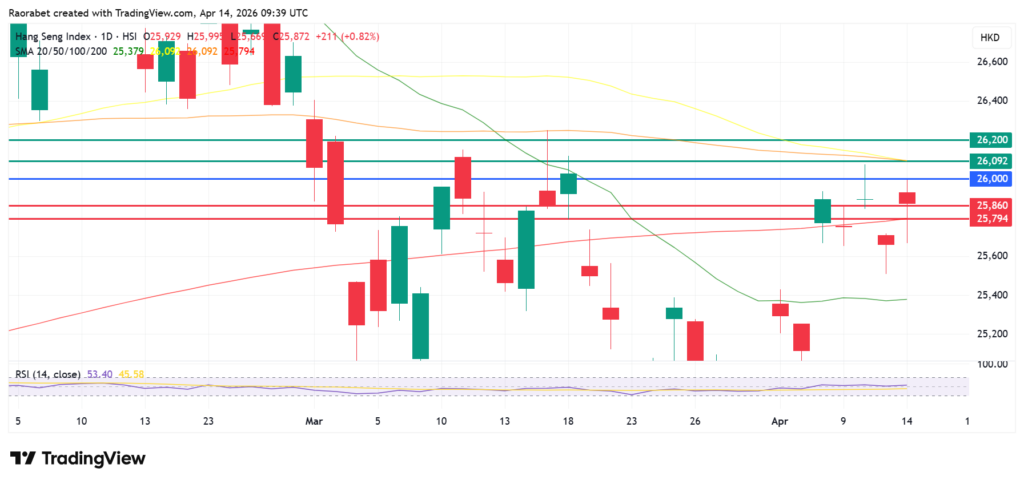
Hang Seng Index daily chart showing the key levels of support and resistance on April 14, 2026. Created on TradingView
The US-Iran conflict, which erupted on February 28, triggered a broad global risk-off move. Rising energy prices and geopolitical uncertainty weighed heavily on Hong Kong equities, pushing the index into negative year-to-date territory by mid-March.
The recovery appears predominantly driven by geopolitical factors. The most significant gains were observed subsequent to the US-Iran ceasefire announcement, rather than being propelled by earnings revisions. Given the delicate nature of the ceasefire and the fact that major technology stocks still show a 15-20% decline over the past three months, the recovery currently lacks robust fundamental backing.
Sustainability depends on whether record-high household savings transition into equity investments. Without a boost in consumer confidence or a stabilization of the property sector, the recovery remains vulnerable to sudden geopolitical reversals.