



Current Setup and Live Chart
The Dow remains exposed to the Middle East’s geopolitical conflict through the impact of high oil prices on inflationary expectations and increased market volatility. Unlike the Nasdaq, which is composed mainly of tech stocks facing stretched valuations, the Dow has greater exposure to industrial, financial, consumer, and healthcare stocks. Some of these classes are regarded as defensive stocks, and uninvested flows tend to move into these sectors away from the risk-associated Nasdaq index.
Dow Jones: The Macro Drivers
1. Higher-for-longer Rates
The Fed’s hawkish hold and the “higher for longer” interest rates narrative favor some of the sectors listed on the Dow Jones Industrial Average. For instance, banks and other financial stocks benefit from higher interest rates. The situation also forces an increase in capital flowing away from the risk-associated tech stocks on the Nasdaq toward more defensive stocks (energy companies, defense contractors, insurance firms, industrial companies).
2. Energy Prices
The current geopolitical tensions have led to an increase in oil prices. There are companies listed on the Dow Jones Industrial Average that benefit from this situation: oil servicing companies, industrial suppliers, and integrated energy producers are all beneficiaries of the elevated energy price regime. On the flip side, higher oil prices also increase transportation costs as well as costs for manufacturing and consumer businesses. Therefore, the Dow Jones Industrial Average is susceptible to two-way changes in energy prices.
3. U.S. Economic Resilience
The U.S. economy continues to show resilience, backed up by recent U.S. economic data, especially data on employment and consumer sentiment (UoM Consumer Sentiment: 55.2 vs 53.9 consensus and 54.4 prior). This has translated into stronger corporate earnings across several Dow constituents, as is currently being seen within the context of the earnings season. This stronger economic growth and resilience also reinforces the Fed’s higher-for-longer interest rate expectations.
Dow Jones: Price Catalysts
1. Corporate Earnings: Corporate earnings of listed stocks are the determinants of the price action of any U.S. index asset. Therefore, the Dow Jones will remain susceptible to earnings of industrial, healthcare, and financial stocks, as well as investors’ sentiment toward those earnings results.

2. Treasury Yields: Rising U.S. Treasury yields are usually a function of higher interest rate expectations. This is supportive of financial stocks but constitutes a headwind for other stocks whose margins risk compression from higher borrowing costs. Generally speaking, the Dow Jones is supported when bond yields stabilize.
3. Geopolitics: The geopolitical front usually exerts an influence on global stock markets, and the Dow is not an exception. Whenever there is an escalation or de-escalation in the Middle East geopolitical situation, oil prices tend to change, and this impacts inflation expectations as well as investors’ risk appetite. The combination of changes in oil prices, shifting inflationary expectations, and risk-on/risk-off market scenarios is a key price catalyst for the Dow Jones index.
Dow Jones Forecast Scenarios
Base Case: The bias here is for the index to remain neutral or moderately bullish. The Fed’s hawkish hold is not a shift from a previous position, which is why the market did not react violently to the Fed’s decision. However, the market continues to look at the current situation, where there has been a lull in the fighting in the Middle East, which is allowing for a recovery from the weekly lows even in the midst of a consolidation.
Bull Case: The scenario here will be triggered by resilient corporate earnings and stability in U.S. Treasury yields, as well as continued rotation of capital flows into value and defensive sectors. This scenario will see a strengthening of financial and industrial stocks, allowing the Dow to recover more quickly than the NASDAQ 100 index.
Bear Case: However, if there is another sharp increase in U.S. Treasury yields and the geopolitical situation worsens, or there is evidence that the economic resilience of the U.S. has begun to weaken as a result of higher-for-longer interest rates, this would expose the Dow’s cyclical stocks to a potential decline.
Dow Jones: Technical Outlook
The bounce from the trendline and 51509 support, which has held firm since 19 June 2026, has kept the Dow in consolidation, with the 52885 resistance and the 27% Fibonacci extension of the 20 June 2025 – 11 February 2026 upswing acting as the ceiling of this range. If the bulls uncap this ceiling, the Dow moves into record territory, targeting the 61.8% Fibonacci extension at 55939.
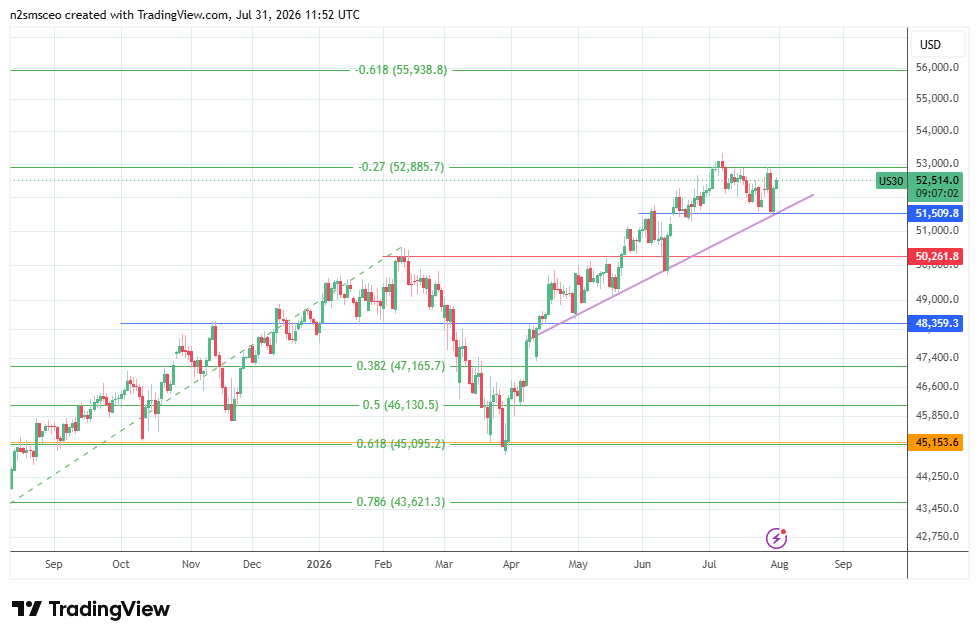
On the flip side, a breakdown of the range floor at 51509 unlocks access to the 11 February high and 50261 support level. A further move to the south brings in the 21 January 2026 low at 48359.