



Archived Article This article was published more than 5 months ago. The market data, prices, forecasts, and analysis were accurate at the time of publication but may have changed since then. Please use this article for historical reference only and refer to our latest content for current market information.
- An earlier rally by GBP/USD in early April was primarily fueled by weaker-than-expected US PPI figures, which hinted at an end to the Federal Reserve's tightening policy
- The narrative has recently shifted from concerns over US disinflation to broader global energy shocks, raising safe haven demand for the US dollar
- Rising concerns over UK economy puts strain on the GDP, limiting the Cable's upside
From April 6 through April 14, GBP/USD demonstrated an impressive upward trajectory, achieving a winning streak over seven consecutive sessions. The currency pair moved from approximately 1.323 to reach a high of 1.357 during this period. However, the market dynamics have shifted in the subsequent four sessions.
The Cable has seen a decline, retreating towards the 1.351 level. As of April 21, the pair appears to be navigating conflicting pressures stemming from elevated UK inflation expectations and a persistent strength in the US Dollar.
What Has Changed for GBPUSD?
The previous upward momentum in GBP/USD encountered a shift in macroeconomic sentiment. An initial rally was supported by a weaker-than-anticipated US Producer Price Index (PPI) report, which led to speculation that the Federal Reserve might conclude its tightening cycle. However, as April progressed, market discourse moved from “US disinflation” to concerns about a “Global Energy Shock.”
On Sunday, an incident involving the US Navy seizing an Iranian vessel, followed by Tehran’s actions of firing at ships and re-closing the Strait of Hormuz, significantly impacted global energy markets. Brent and WTI futures experienced approximately a 6% increase, leading the dollar to reinforce its position as a safe-haven asset. The geopolitical factor that initially propelled the seven-session advance was subsequently reversed within a matter of days.
With ongoing disruptions in the Strait of Hormuz due to the Middle East conflict, the UK economy is confronting a renewed threat of inflation. Forecasts indicate that UK inflation could climb to 3.1% in the upcoming March report.
While higher inflation typically provides some support to a currency by suggesting the potential for increased interest rates, market participants are increasingly concerned that the UK may be heading towards a period of stagflation, characterized by slowing economic growth alongside sustained high prices.
The Bank of England’s Impossible Dilemma
The backdrop for sterling has been complicated further by an inflation picture that defies clean policy responses. On March 19, the Bank of England adjusted its forecast higher, with CPI now expected to sit between 3% and 3.5% in Q2-Q3 2026.

Higher energy costs are behind this move. Because of it, earlier hopes for interest rate reductions have faded. At the same time, raising rates brings risk, especially after the OECD pointed out the UK could suffer the sharpest economic slowdown across all G20 developed nations.
What the second half of 2026 looks like for the pair
The broader year-end outlook appears more constructive, provided that geopolitical risks begin to subside. Forecasts compiled by NAGA indicate that investment banks are positioning for GBP/USD to trade within a 1.36–1.47 range by the close of the year.
Morgan Stanley’s optimistic scenario projects a 1.47 level, contingent upon aggressive easing by the Federal Reserve. Goldman Sachs offers a more conservative estimate, targeting 1.36, and views sterling’s direction as largely influenced by EUR/USD movements rather than primarily by UK-specific factors.
GBP/USD Forecast
GBP/USD has its pivot at the 10-day EMA level at 1.3485. The recent high of 1.3565 is the primary hurdle. A sustained close above this level target 1.3600. Immediate support is at 50-day EMA at 1.3438. A break below this psychological level could see the pair slide to the 200-day EMA at 1.3376.
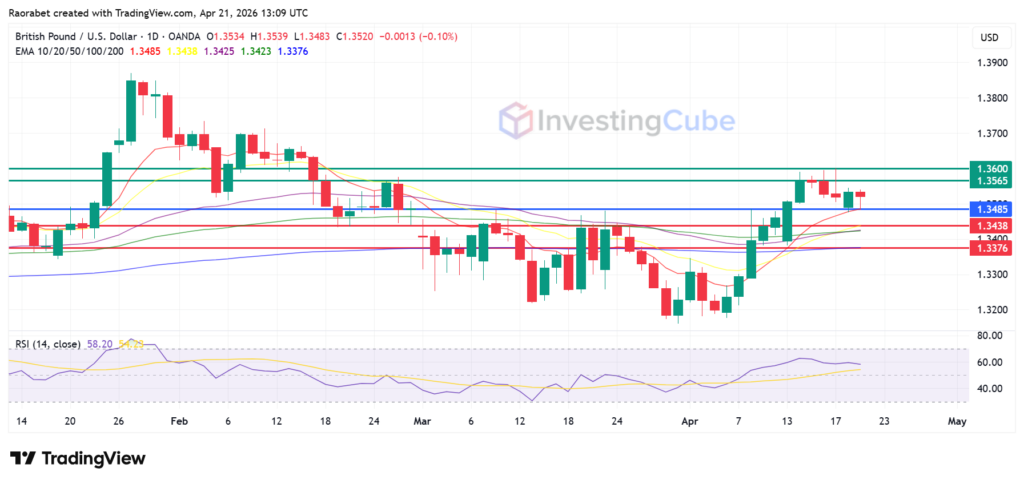
GBP/USD daily chart with the key near-term support and resistance levels shown on April 21, 2026. Created on TradingView
The rally was sparked by softer-than-expected US inflation data (PPI), which led markets to believe the Federal Reserve would pause rate hikes.
It is more likely to disappoint those hoping for a hawkish surprise. Markets have already pared back aggressive rate hike expectations. A hold at 3.75% confirms the status quo but removes near-term yield-based support for the pound.
The most critical data point is the UK March CPI report due on April 22. This will dictate whether the Bank of England remains hawkish or starts to worry more about economic growth.